The English Bible has undergone numerous revisions and translations since the Geneva Bible (1560) and the King James Bible (1611). While some updates were made for readability, many modern versions introduce doctrinal shifts, omit key verses, and alter the meaning of Scripture. Understanding these differences is crucial for believers seeking the most accurate, God-honoring translation.
The Bible – A Foundation Under Attack
The Bible is the inspired Word of God, given to humanity as a guide to salvation, truth, and righteousness. However, throughout history, the integrity of God’s Word has been challenged, altered, and in some cases, corrupted. While many assume that all modern Bible translations carry the same message, the reality is that significant changes have taken place—many of which distort key doctrines, remove critical teachings, and introduce subtle yet dangerous deceptions.
The question must be asked: Does every Bible version truly represent the Word of God, or have modern translations been deliberately altered to fit an agenda?
The Battle Over God’s Word
From the Garden of Eden to today, Satan’s primary strategy has been to twist and manipulate God’s words. His first recorded act of deception was altering God’s command in Genesis 3:1—“Yea, hath God said…?”—planting doubt in Eve’s mind. This same tactic continues today through subtle changes in Scripture that impact doctrine, prophecy, and even the deity of Christ.
Understanding the history and corruption of Bible versions is crucial for believers who desire to stand on the pure, unaltered Word of God. Many modern versions are based on manuscripts that differ significantly from the preserved text used by the early church and faithful translators throughout history.
The Two Competing Streams of Manuscripts
All English Bible translations are based on one of two major manuscript families:
1️⃣ The Majority Text / Textus Receptus (Received Text)
🔹 Used by faithful believers throughout church history.
🔹 Preserved by God’s providence and used for translations like the King James Version (KJV).
🔹 Aligns with the manuscripts used by the early church.
🔹 Maintains doctrinal purity, with no key omissions or alterations.
2️⃣ The Alexandrian Text (Critical Text / Westcott & Hort Text)
🔹 Derived from a minority of manuscripts (Vaticanus & Sinaiticus).
🔹 Formed the basis for most modern versions (NIV, ESV, NASB, etc.).
🔹 Contains thousands of deletions, doctrinal changes, and textual omissions.
🔹 Produced by men who held unorthodox beliefs about Christ and Scripture.
By comparing these two manuscript streams, it becomes clear that many modern translations systematically remove references to Jesus’ deity, diminish His atonement, and introduce confusion about core doctrines. The question then arises: Why would translators remove or change God’s Word unless there was an agenda behind it?
What Has Been Corrupted?
While some argue that modern translations simply make the Bible “easier to understand,” the deeper issue is that they change the actual meaning of Scripture. Many verses have been removed, altered, or paraphrased in a way that weakens biblical truth.
Some of the most concerning changes include:
🔹 The removal of entire verses (e.g., Matthew 17:21, Acts 8:37, 1 John 5:7).
🔹 The omission of Jesus’ name in key passages (e.g., Colossians 1:14).
🔹 The weakening of Christ’s divinity (e.g., 1 Timothy 3:16).
🔹 The removal of words tied to spiritual warfare (e.g., “Lucifer” in Isaiah 14:12 replaced with “morning star,” confusing Jesus with Satan).
🔹 Doctrinal shifts that downplay the blood of Christ, fasting, and repentance.
Each change, whether minor or major, influences how Scripture is interpreted and understood. When enough of these alterations accumulate, they create a different gospel—one that subtly undermines biblical truth.
How This Affects Prophecy & End-Time Deception
One of the most alarming aspects of Bible corruption is its effect on prophecy. Many modern versions weaken or obscure key prophetic passages related to the Antichrist, the Great Tribulation, and the return of Christ. By altering these passages, Satan seeks to confuse believers about end-time events, making them vulnerable to deception.
For example:
🔹 Revelation 13:18 (the verse about the mark of the beast) is phrased differently in some versions, creating confusion about its meaning.
🔹 2 Thessalonians 2:3 (which speaks of a falling away before the Antichrist is revealed) is changed in some versions to mean “the rapture,” altering the prophetic timeline.
🔹 Daniel 3:25 removes the phrase “the Son of God,” replacing it with “a son of the gods,” weakening the prophetic connection to Christ.
Satan knows that if he can corrupt the Bible, he can confuse the church and prepare the world for deception. This is why understanding the corruption of modern Bible versions is not a secondary issue—it is a matter of spiritual life and death.
Why This Study Matters
As believers, we are called to stand on the pure, unaltered Word of God. Jesus said, 📖 “Heaven and earth shall pass away, but my words shall not pass away” (Matthew 24:35). If we truly believe this, we must ask ourselves: Where is His Word preserved? Has God allowed His Word to be lost, or has He preserved it through faithful manuscripts and translations?
This study will expose the differences between Bible versions, analyze key changes, and equip readers with the knowledge to discern which Bible carries the true, uncorrupted Word of God.
Next, we will begin breaking down each English Bible version, examining what changed, who was behind it, and how it affects doctrine.
The King James Version (1611) – A Deep Discovery
The King James Version (1611) (KJV), also known as the Authorized Version, is one of the most influential and widely read Bible translations in history. Commissioned by King James I of England, it was intended to create a unified English Bible that would satisfy both the Anglican Church and the Puritan factions. Unlike its predecessor, the Bishop’s Bible (1568), the KJV was a masterful work of translation that carefully balanced faithfulness to the original texts with linguistic beauty.
📜 Key Historical Facts:
- Commissioned in 1604 by King James I and completed in 1611.
- Translated by 47 scholars, working in six committees.
- Based on the Textus Receptus (New Testament) and Masoretic Text (Old Testament).
- Intended to unify the Church of England and replace earlier translations.
- Removed marginal notes (like those in the Geneva Bible) to avoid political and doctrinal disputes.
The KJV quickly became the dominant English Bible for centuries and played a key role in shaping theology, literature, and culture.
Comparison to Other Bibles

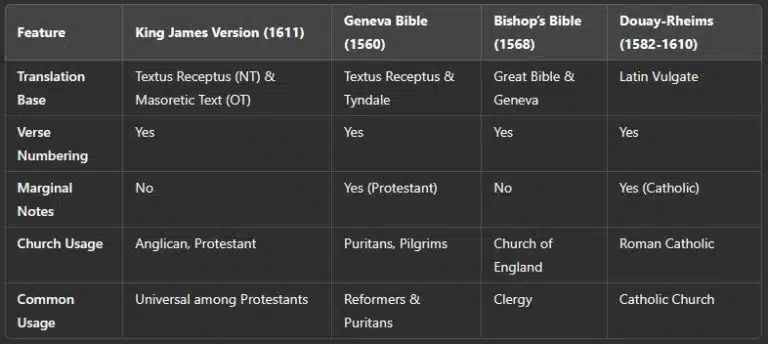
Unlike the Geneva Bible, which contained extensive commentary, the KJV focused only on translation, ensuring it was free of political and doctrinal bias.
Doctrinal Integrity & Translation Accuracy
Faithfulness to the Original Text
The KJV translators worked diligently to ensure that their work was as close as possible to the original Hebrew and Greek manuscripts. Unlike later translations influenced by the Westcott & Hort Critical Text, the KJV preserved the traditional text used by Christians for centuries.
Theological Emphasis
- Christ’s Divinity: Strongly affirmed (e.g., 1 Timothy 3:16).
- Blood Atonement: Emphasized in verses like Colossians 1:14.
- The Trinity: Supported by verses like 1 John 5:7.
- Satan’s Identity: Maintains “Lucifer” in Isaiah 14:12, unlike modern versions.
By preserving key doctrinal passages, the KJV ensures that essential Christian beliefs remain intact, unlike many modern translations that omit or alter critical verses.
Persecution & Controversy
Why Was the KJV Created?
- To replace the Bishop’s Bible (1568), which was considered poorly translated.
- To end the dominance of the Geneva Bible, which contained anti-monarchical notes.
- To unify English-speaking Christians under one authoritative translation.
Opposition to the KJV
- Puritans rejected it at first because it lacked marginal commentary.
- Catholics opposed it since it was based on the Textus Receptus rather than the Latin Vulgate.
- Modern scholars attack it today, claiming newer versions are more “accurate” (despite using corrupted manuscripts like Vaticanus and Sinaiticus).
Though initially met with skepticism, the KJV became the gold standard of English Bible translations.
Notable Features & Innovations
1. Linguistic Excellence
The KJV is known for its majestic, poetic style, which has deeply influenced English literature and public worship.
2. Standardized English Bible
Unlike earlier translations, which had inconsistent spellings and grammar, the KJV set a standard that shaped the English language.
3. No Doctrinal Commentary
Unlike the Geneva Bible, the KJV does not contain theological interpretations, allowing Scripture to speak for itself.
Key Textual Differences
Examples of Verses Affected

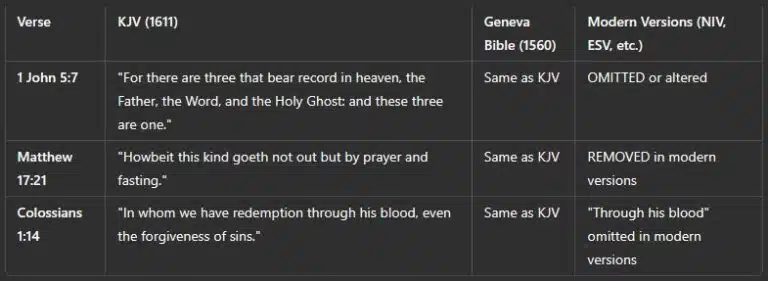
The KJV preserves key doctrines that modern translations have removed or altered, ensuring doctrinal consistency with the early church.
Legacy & Modern Usage
Why the KJV Still Matters
- It remains the most widely read and printed Bible in history.
- It has shaped Christian theology and Western culture for over 400 years.
- It is based on the preserved, traditional manuscripts rather than the corrupted Critical Text used in modern translations.
Modern Reprints & Accessibility
- The 1611 edition is available for historical study.
- The 1769 Cambridge Edition (with spelling updates) is the most commonly used version today.
- Remains the primary Bible for many Protestant denominations.
Conclusion: The Gold Standard of English Bibles
The King James Version (1611) is the most enduring, doctrinally pure, and widely read English Bible translation. Unlike modern versions, which rely on corrupt manuscripts, the KJV remains faithful to the preserved Word of God.
📖 Next, we will analyze the rise of modern translations and their deviations from the traditional text.