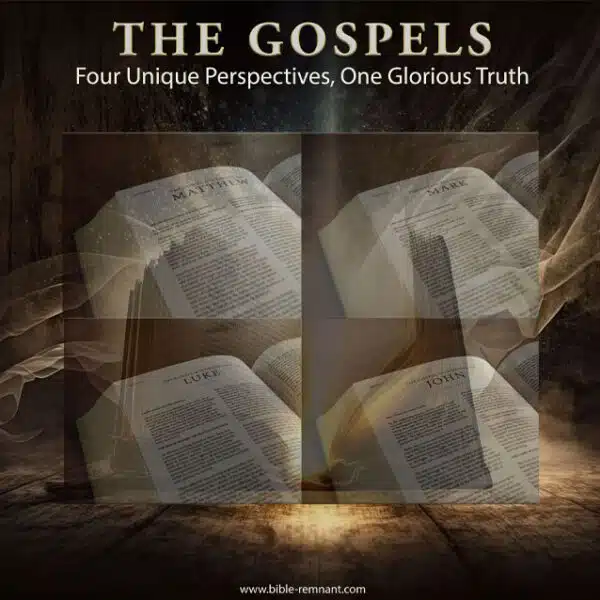
The Gospels – Four Unique Perspectives, One Glorious Truth
Ezekiel 1:10 – “As for the likeness of their faces, they four had the face of a man, and the face of a lion, and the face of an ox, and the face of an eagle.”
The four Gospels are not competing stories — they are four divine portraits of one perfect Savior. Like the four faces of the cherubim seen in Ezekiel and Revelation, each Gospel reveals a different aspect of Christ’s nature: the King (Matthew), the Servant (Mark), the Man (Luke), and the God (John). Together, they form a complete image of redemption — the Lion who reigns, the Ox who bears our burden, the Man who walks among us, and the Eagle who ascends on high.
Revelation 4:7 – “And the first beast was like a lion, and the second beast like a calf, and the third beast had a face as a man, and the fourth beast was like a flying eagle.”
From the royal promises of Matthew to the heavenly revelation of John, the Gospels reveal not four Christs, but one Christ in four perspectives. Each writer, guided by the Holy Spirit, recorded truth for a specific audience, yet every page leads to the same eternal message: Jesus Christ is Lord — King of kings, Servant of servants, the Son of Man, and the Son of God.
John 20:31 – “But these are written, that ye might believe that Jesus is the Christ, the Son of God; and that believing ye might have life through his name.”
In this study, we will explore how each Gospel shines its own light on the same glorious truth — the fullness of Jesus Christ revealed through four voices, one Spirit, and one eternal purpose: to bring life to all who believe.
The Gospel of Matthew – Jesus, the King (The Lion)
📖 Matthew 1:1 – “The book of the generation of Jesus Christ, the son of David, the son of Abraham.”
🔎 Matthew’s Gospel opens not with a mystery, but with a claim — Jesus is the rightful heir to the throne of David and the fulfillment of every messianic promise. To the Jewish audience steeped in prophecy, this was not a new religion but a divine continuation. The Lion of the tribe of Judah had roared, and prophecy was now history fulfilled.
📖 Matthew 2:2 – “Where is he that is born King of the Jews? for we have seen his star in the east, and are come to worship him.”
🔎 From His birth, Matthew presents Christ as King — worshipped by Gentiles, threatened by tyrants, and misunderstood by His own. Every miracle, every parable, every fulfillment recorded by Matthew shouts one truth: The Kingdom of Heaven has come near.
📖 Matthew 5:17 – “Think not that I am come to destroy the law, or the prophets: I am not come to destroy, but to fulfil.”
🔎 Matthew’s Gospel emphasizes that Jesus did not abolish the Law but completed it — revealing its true spiritual intent. He fulfills every shadow of the Old Covenant: the true Passover Lamb, the greater Moses, and the promised King who establishes an eternal Kingdom built not on conquest, but on righteousness.
Prophetic Symbol – The Lion
The lion represents authority, kingship, and courage. Just as the lion leads its pride, Christ leads His people with both majesty and meekness. The royal genealogy in Matthew is Heaven’s declaration that the throne of David is now occupied by the Son of God.
📖 Revelation 5:5 – “Behold, the Lion of the tribe of Judah, the Root of David, hath prevailed.”
🔎 In Matthew, Jesus is the conquering King — yet His conquest begins not on a battlefield, but on a mountain where He teaches love for enemies and meekness over might. His Kingdom spreads not by sword, but by Spirit.
🔹 The Kingdom of Heaven — mentioned over 30 times, showing Christ’s reign both present and future.
🔹 Fulfillment of Prophecy — Matthew quotes the Old Testament more than 60 times, revealing the seamless link between covenant and completion.
🔹 The King’s Character — Jesus demonstrates that true royalty serves in humility. The Sermon on the Mount becomes His royal decree, redefining greatness through grace.
🔹 The Great Commission — The King sends His ambassadors to the nations, extending His reign to the ends of the earth.
📖 Matthew 28:18–20 – “All power is given unto me in heaven and in earth. Go ye therefore, and teach all nations.”
🔎 The Gospel of Matthew begins with royal lineage and ends with divine authority. The King who entered the world humbly now reigns universally. Every page reveals the same heartbeat: Jesus is Emmanuel — God with us, King forever among His people.
📖 Matthew 1:23 – “Behold, a virgin shall be with child… and they shall call his name Emmanuel, which being interpreted is, God with us.”
⚠️ Matthew’s Gospel calls us to bow before the rightful King. The Lion of Judah still reigns, not from an earthly throne but from the hearts of those who submit to His rule. His Kingdom is not political — it is personal, transforming every life that recognizes His sovereignty.
📖 Psalm 145:13 – “Thy kingdom is an everlasting kingdom, and thy dominion endureth throughout all generations.”
🔹 Emphasis on Jesus’ Royal Lineage – Matthew begins with a genealogy tracing Jesus to David and Abraham, proving His right to the throne (Matthew 1:1-17).
🔹 The Most Old Testament Quotations – Over 60 references to the Old Testament confirm that Jesus is the prophesied King.
🔹 Structured Like the Torah – Matthew contains five major discourses, mirroring the five books of Moses, presenting Jesus as the greater Lawgiver.
🔹 The Kingdom of Heaven – Matthew uniquely uses the phrase “Kingdom of Heaven” instead of “Kingdom of God,” emphasizing Jesus’ role as the King of a heavenly kingdom.
📖 Matthew 1:1 – “The book of the generation of Jesus Christ, the son of David, the son of Abraham.”
🔎 This genealogy affirms Jesus’ legal right to the throne, fulfilling God’s promise to David in 2 Samuel 7:12-13.
The Gospel of the King – Matthew’s Themes of Authority
Matthew emphasizes Jesus’ divine authority as King in numerous ways:
🔹 The Royal Birth – Jesus is worshiped by wise men from the East, acknowledging Him as King (Matthew 2:1-11).
🔹 The Royal Lawgiver – The Sermon on the Mount (Matthew 5-7) shows Jesus giving a greater law, just as Moses did on Mount Sinai.
🔹 Authority Over Nature – Jesus calms the storm, demonstrating His control over creation (Matthew 8:23-27).
🔹 Authority Over Sickness & Demons – Jesus heals the sick and casts out demons, proving His dominion over both the physical and spiritual realms (Matthew 8-9).
🔹 Authority Over Sin & Death – Jesus forgives sins and raises the dead, proving He has power only God possesses (Matthew 9:2-6, 28:6).
🔹 The Royal Entry into Jerusalem – Jesus rides into the city as the prophesied King, fulfilling Zechariah 9:9 (Matthew 21:1-11).
🔹 The Great Commission – Jesus, as the victorious King, commands His disciples to spread the Gospel to all nations (Matthew 28:18-20).
📖 Matthew 28:18 – “All power is given unto me in heaven and in earth.”
🔎 As King, Jesus possesses absolute authority over heaven and earth.
Jesus as the Fulfillment of Messianic Prophecy
Matthew repeatedly highlights how Jesus fulfills prophecy, showing He is the true King Israel had been waiting for. Some key fulfillments include:
🔹 Born of a Virgin – Isaiah 7:14, Matthew 1:22-23
🔹 Born in Bethlehem – Micah 5:2, Matthew 2:5-6
🔹 Called Out of Egypt – Hosea 11:1, Matthew 2:15
🔹 Herod’s Slaughter of Infants Foretold – Jeremiah 31:15, Matthew 2:17-18
🔹 Ministry in Galilee Foretold – Isaiah 9:1-2, Matthew 4:14-16
🔹 Rides into Jerusalem on a Donkey – Zechariah 9:9, Matthew 21:4-5
🔹 Betrayed for Thirty Pieces of Silver – Zechariah 11:12-13, Matthew 27:9-10
🔹 Silent Before His Accusers – Isaiah 53:7, Matthew 27:12-14
🔹 Crucified and Mocked – Psalm 22:7-8, Matthew 27:39-43
🔹 Resurrected on the Third Day – Psalm 16:10, Matthew 28:6
📖 Matthew 5:17 – “Think not that I am come to destroy the law, or the prophets: I am not come to destroy, but to fulfil.”
🔎 Jesus fulfills every prophecy, proving that He is the promised King and Messiah.
Deeper Insights in Matthew’s Gospel
🔹 Matthew’s Genealogy Includes Five Women – A shocking break from Jewish tradition, highlighting God’s grace to the outcast (Tamar, Rahab, Ruth, Bathsheba, and Mary).
🔹 The Parables of the Kingdom – Unique to Matthew, these parables reveal the mystery of the Kingdom of Heaven (Matthew 13).
🔹 The Miraculous Coin in the Fish’s Mouth – Found only in Matthew, demonstrating Jesus’ authority over all things, even taxes (Matthew 17:24-27).
🔹 The Phrase “That it Might be Fulfilled” – Found 16 times in Matthew, reinforcing Jesus as the fulfillment of prophecy.
🔹 Jesus’ Use of “Son of Man” – A reference to Daniel 7:13-14, where the Son of Man is given an everlasting kingdom.
🔹 Matthew Alone Mentions the Guards at the Tomb – Highlighting the resurrection as a historical, undeniable event (Matthew 27:62-66).
📖 Revelation 19:16 – “And he hath on his vesture and on his thigh a name written, KING OF KINGS, AND LORD OF LORDS.”
🔎 Matthew presents Jesus as the rightful King, the fulfillment of prophecy, and the eternal ruler of God’s Kingdom.
The Gospel of Mark – Jesus, the Servant (The Ox)
📖 Mark 10:45 – “For even the Son of man came not to be ministered unto, but to minister, and to give his life a ransom for many.”
🔎 Mark’s Gospel moves fast — brief, urgent, and alive with action. Written for the Roman world, it presents Jesus not as a philosopher or king, but as the servant of all. Here, Christ’s authority is displayed through His humility. Every miracle, every act of compassion, and every confrontation with darkness reveals His power not to rule over men, but to lift them.
📖 Mark 1:35 – “And in the morning, rising up a great while before day, he went out, and departed into a solitary place, and there prayed.”
🔎 Mark’s Jesus is constantly in motion — healing, teaching, and serving — yet always anchored in prayer. His strength is His communion with the Father. The ox, a symbol of endurance and sacrifice, perfectly portrays this Gospel’s rhythm: work, worship, and willingness to give all.
📖 Isaiah 42:1 – “Behold my servant, whom I uphold; mine elect, in whom my soul delighteth.”
🔎 Mark fulfills Isaiah’s vision of the Messiah as the Servant of the Lord. The miracles of Jesus are not random acts of power — they are deliberate acts of mercy. He cleanses lepers, restores sight, feeds multitudes, and forgives sinners — proving that the greatest in the Kingdom is the one who serves.
Prophetic Symbol – The Ox
The ox represents service, patience, and sacrifice. It bears burdens silently and plows through resistance without recognition. This is the Christ Mark reveals — strong, steady, and selfless. The ox does not seek applause; it labors in love. Christ’s greatest work was done in the posture of a servant, crowned not with gold but with thorns.
📖 Philippians 2:7–8 – “But made himself of no reputation, and took upon him the form of a servant… and became obedient unto death, even the death of the cross.”
🔎 The cross was the final field He plowed — the furrow through which eternal life would spring. The Servant gave His strength until the very end, offering His life as a ransom for all.
🔹 Immediate Obedience — Mark often uses the word “immediately” or “straightway” over 40 times, emphasizing urgent, Spirit-led action.
🔹 The Power of Service — True greatness is not found in position, but in compassion and faithfulness to God’s will.
🔹 Christ’s Humanity & Compassion — Mark records emotions vividly — Jesus sighs, weeps, and feels compassion. The Servant feels what His people feel.
🔹 The Servant’s Sacrifice — Every act points toward the cross — the ultimate expression of self-giving love.
📖 Mark 14:22–24 – “This is my blood of the new testament, which is shed for many.”
🔎 The Servant’s table becomes the place of covenant. The one who washed feet also poured out His blood — love in its highest form. In a world obsessed with status, Mark reminds us that true power kneels.
📖 John 13:14–15 – “If I then, your Lord and Master, have washed your feet; ye also ought to wash one another’s feet.”
⚠️ Mark’s Gospel teaches that the path to glory passes through servanthood. The ox never stops to rest in its own honor — it presses on until the work is finished. Likewise, Christ calls His followers to serve with endurance, compassion, and humility until He returns.
📖 Galatians 6:9 – “And let us not be weary in well doing: for in due season we shall reap, if we faint not.”
🔎 The Gospel of Mark is the heartbeat of a servant — steady, sacrificial, and unstoppable. The same Spirit that drove Christ into ministry now drives His people to labor in love until the last soul is reached.
🔹 Action-Packed Narrative – Mark uses the Greek word “euthus” (immediately) over 40 times, giving the sense of urgency.
🔹 No Genealogy Given – Unlike Matthew and Luke, Mark omits Jesus’ lineage because a servant’s background was not important.
🔹 Jesus’ Actions Over Words – Mark focuses on miracles, healings, and power over demonic forces, showing Christ as a Servant fulfilling God’s will.
🔹 Written for a Roman Audience – Romans valued power and efficiency, which aligns with Mark’s concise, fast-moving style.
The Gospel of Action – Key Themes in Mark
Unlike the other Gospels, which emphasize Jesus’ teachings and genealogy, Mark focuses on His servanthood, power, and sacrifice.
🔹 Jesus as the Worker of Miracles – Over half of Mark’s Gospel is dedicated to documenting Jesus’ miracles, healings, and exorcisms.
🔹 Power Over Demons – Mark highlights Jesus’ authority over demonic forces, with multiple exorcisms (Mark 1:23-27, 5:1-20).
🔹 The Suffering Servant – Mark places special emphasis on Jesus’ suffering, preparing His followers for persecution and trials (Mark 8:31, 9:31, 10:33-34).
🔹 Discipleship and Servanthood – Jesus teaches His followers that to be great, one must serve (Mark 9:35, 10:44).
🔹 The Mystery of the Messianic Secret – Mark frequently records Jesus commanding people not to reveal His identity, pointing to the timing of God’s redemptive plan (Mark 1:44, 5:43, 8:30).
📖 Mark 8:34 – “Whosoever will come after me, let him deny himself, and take up his cross, and follow me.”
🔎 Jesus calls His followers to a life of service, sacrifice, and self-denia
📖 Mark 10:45 – “For even the Son of man came not to be ministered unto, but to minister, and to give his life a ransom for many.”
🔎 Jesus’ entire mission is summed up in this verse—He came to serve, suffer, and save.
The Suffering Servant Foretold in Prophecy
Mark closely aligns Jesus’ ministry with Isaiah’s prophecy of the Suffering Servant (Isaiah 53).
🔹 Despised and Rejected – Isaiah 53:3, Mark 6:3
🔹 A Man of Sorrows, Acquainted with Grief – Isaiah 53:4, Mark 14:34
🔹 Silent Before His Accusers – Isaiah 53:7, Mark 15:5
🔹 Numbered with Transgressors – Isaiah 53:12, Mark 15:27
🔹 Bore the Sins of Many – Isaiah 53:12, Mark 10:45
📖 Mark 14:36 – “Abba, Father, all things are possible unto thee; take away this cup from me: nevertheless not what I will, but what thou wilt.”
🔎 Jesus, as the perfect Servant, submits to the will of the Father, even unto death.
Unique Features of Mark’s Gospel
🔹 Shortest Gospel – Only 16 chapters, but rich in action.
🔹 Records Jesus’ Deepest Emotions – Mark uniquely records Jesus’ compassion, sighs, and grief (Mark 1:41, 3:5, 7:34).
🔹 Eyewitness Detail – Scholars believe Mark recorded Peter’s firsthand account of Jesus’ ministry.
🔹 Immediately Used Over 40 Times – Emphasizing the urgency of Christ’s mission.
🔹 Abrupt Ending – The earliest manuscripts end suddenly at Mark 16:8, emphasizing the mystery and wonder of the resurrection.
📖 Mark 3:14 – “And he ordained twelve, that they should be with him, and that he might send them forth to preach.”
🔎 Jesus’ mission was not only to serve but to train others to continue His work.
The Gospel of Luke – Jesus, the Son of Man (The Man)
📖 Luke 19:10 – “For the Son of man is come to seek and to save that which was lost.”
🔎 Luke’s Gospel paints Jesus in the colors of compassion and perfect humanity. Written by a physician to a Greek audience, it presents the Savior who understands human weakness — who weeps, prays, bleeds, and forgives. Through Luke’s eyes, we see not only the divinity of Christ, but His nearness: God in flesh who walks with the poor, dines with sinners, and restores the brokenhearted.
📖 Luke 2:10–11 – “Fear not: for, behold, I bring you good tidings of great joy, which shall be to all people. For unto you is born this day in the city of David a Saviour, which is Christ the Lord.”
🔎 From the angelic announcement to shepherds — the lowly and overlooked — Luke emphasizes that the Gospel is for all people. Kings and commoners, Jews and Gentiles, men and women, rich and poor — all find their invitation at the feet of the Son of Man.
📖 Luke 4:18 – “The Spirit of the Lord is upon me, because he hath anointed me to preach the gospel to the poor; he hath sent me to heal the brokenhearted, to preach deliverance to the captives, and recovering of sight to the blind.”
🔎 Luke’s Christ is not distant but deeply involved — touching lepers, forgiving adulterers, and comforting the forgotten. His miracles are acts of mercy, and His parables reveal the Father’s heart for the lost. No Gospel shows the tenderness of God more clearly than Luke.
Prophetic Symbol – The Man
The face of a man represents wisdom, compassion, and identification. In Luke, Jesus reveals what true humanity looks like when fully yielded to God. He is not “God disguised as man” — He is God with us, sharing our pain, understanding our tears, and showing us how to live in perfect harmony with the Father’s will.
📖 Philippians 2:7 – “But made himself of no reputation, and took upon him the form of a servant, and was made in the likeness of men.”
🔎 Jesus is called the “Son of Man” over 25 times in Luke, reminding us that the divine chose to enter human frailty — not to excuse sin, but to redeem it. The Son of God became the Son of Man so that the sons of men might become sons of God.
🔹 Universal Salvation — Luke alone records the parables of the lost sheep, the lost coin, and the prodigal son, showing God’s heart for every soul.
🔹 The Humanity of Christ — Luke shows Jesus praying more than any other Gospel writer. The Son of Man depended daily on the Father.
🔹 The Compassionate Healer — As a physician, Luke noticed details others missed — the touch, the tone, the tenderness. Every healing displays divine empathy.
🔹 The Role of Women & the Poor — Luke elevates the overlooked, recording stories of Mary, Elizabeth, Anna, and others who reflected true faith.
📖 Luke 15:20 – “But when he was yet a great way off, his father saw him, and had compassion, and ran, and fell on his neck, and kissed him.”
🔎 The parable of the prodigal son captures the essence of Luke’s Gospel — the Father’s heart revealed through the Son’s mission. Love runs before judgment, mercy embraces before words are spoken.
📖 Luke 23:34 – “Then said Jesus, Father, forgive them; for they know not what they do.”
🔎 From the manger to the cross, Luke’s Christ forgives. His final words embody the very reason He came — to seek, to save, and to show the mercy of God to the undeserving.
⚠️ Luke’s Gospel calls every believer to live as Christ lived — walking in compassion, seeing the unseen, and loving the unlovable. The Son of Man came not to condemn humanity but to lift it. To follow Him is to live with hands that heal, hearts that forgive, and eyes that see with divine empathy.
📖 Hebrews 4:15 – “For we have not an high priest which cannot be touched with the feeling of our infirmities; but was in all points tempted like as we are, yet without sin.”
🔎 The Gospel of Luke reveals the heart of God through the face of a Man. His humanity does not diminish His glory — it magnifies His grace. Through His compassion, He restores the image of God in us all.
🔹 Jesus’ Concern for the Poor and Outcast – Luke uniquely highlights Jesus’ care for the poor, widows, lepers, tax collectors, and sinners (Luke 7:36-50, 18:9-14).
🔹 The Role of Women in Jesus’ Ministry – Luke mentions more women than any other Gospel, including Mary, Elizabeth, Anna, and the women who supported Jesus’ ministry (Luke 8:1-3, 10:38-42).
🔹 The Parables of Mercy – Luke records some of Jesus’ most famous parables, emphasizing grace, forgiveness, and repentance (Luke 15:11-32, 10:30-37).
🔹 Jesus as the Great Physician – As a physician himself, Luke details Jesus’ healings and miracles more than any other Gospel (Luke 5:17-26, 7:11-17).
🔹 The Holy Spirit’s Prominent Role – Luke frequently refers to the work of the Holy Spirit, from John the Baptist’s birth to Jesus’ resurrection (Luke 3:22, 4:1, 24:49).
📖 Luke 5:31-32 – “They that are whole need not a physician; but they that are sick. I came not to call the righteous, but sinners to repentance.”
🔎 Jesus, the Son of Man, came to heal the spiritually broken.
Luke’s Unique Presentation of Jesus’ Birth and Early Life
Luke gives the most detailed nativity account, emphasizing Jesus’ humanity and His connection to all mankind.
🔹 The Angel Gabriel’s Announcement to Mary – Luke 1:26-38
🔹 The Song of Mary (Magnificat) – Luke 1:46-55
🔹 The Birth of John the Baptist – Luke 1:57-80
🔹 The Shepherds Witness the Birth of Christ – Luke 2:8-20
🔹 Jesus Presented in the Temple as an Infant – Luke 2:22-38
🔹 The Boy Jesus in the Temple – Luke 2:41-50
📖 Luke 2:11 – “For unto you is born this day in the city of David a Saviour, which is Christ the Lord.”
🔎 Luke emphasizes the universal joy of Christ’s coming, revealing Him as the Savior for all people.
The Journey to Jerusalem – Jesus’ Path to the Cross
🔹 Luke devotes a large portion of his Gospel to Jesus’ final journey to Jerusalem (Luke 9:51–19:28).
🔹 Along the way, Jesus teaches, heals, and calls sinners to repentance.
🔹 This section contains many parables unique to Luke, including the Prodigal Son and the Good Samaritan.
📖 Luke 9:51 – “And it came to pass, when the time was come that he should be received up, he stedfastly set his face to go to Jerusalem.”
🔎 Jesus’ journey is a determined path toward fulfilling His mission on the cross.
Deeper Insights in Luke’s Gospel
🔹 The Only Gospel with a Sequel – Luke wrote Acts as a continuation of Jesus’ mission.
🔹 The Longest Gospel – Luke contains more verses than any other Gospel.
🔹 Focus on Prayer – Jesus is recorded praying more times in Luke than in the other Gospels.
🔹 The Road to Emmaus – A unique post-resurrection appearance where Jesus explains the Scriptures to two disciples (Luke 24:13-35).
🔹 The Parable of the Pharisee and the Tax Collector – Unique to Luke, highlighting God’s grace over human pride (Luke 18:9-14).
🔹 Jesus’ Final Words on the Cross – “Father, into thy hands I commend my spirit” (Luke 23:46), reflecting His trust in the Father.
📖 Luke 24:32 – “Did not our heart burn within us, while he talked with us by the way, and while he opened to us the scriptures?”
🔎 Luke highlights the power of Scripture in revealing Jesus as the Christ.
The Gospel of John – Jesus, the Son of God (The Eagle)
📖 John 1:1 – “In the beginning was the Word, and the Word was with God, and the Word was God.”
🔎 John’s Gospel does not begin in Bethlehem or Nazareth, but in eternity. He lifts us beyond prophecy and history into the eternal realm where Christ already was — the uncreated Word, the eternal I AM. The eagle, symbol of divine vision and heavenly heights, perfectly captures this Gospel’s perspective. Where the other Gospels walk on earth, John soars above it — showing us Jesus as God Himself, clothed in flesh.
📖 John 1:14 – “And the Word was made flesh, and dwelt among us, (and we beheld his glory, the glory as of the only begotten of the Father,) full of grace and truth.”
🔎 John reveals what the prophets only glimpsed — God dwelling among men. The tabernacle of Moses foreshadowed this reality, but now the true Temple had come. In Christ, divinity walked where dust once ruled. Grace and truth are no longer distant concepts — they are embodied in a Person.
📖 John 8:58 – “Before Abraham was, I am.”
🔎 With these words, Jesus didn’t merely identify with God — He declared Himself to be the eternal One. The same voice that spoke to Moses from the burning bush now stood before Israel in human form. John’s Gospel unveils the mystery of divinity in humanity — God revealed in the flesh, the light shining in darkness, the Creator walking among His creation.
Prophetic Symbol – The Eagle
The eagle represents majesty, divinity, and eternal vision. It soars higher than all other creatures, seeing what none else can see. John’s Gospel is written from this height — where the wind of the Spirit carries the reader above human reasoning into divine revelation.
📖 John 3:13 – “And no man hath ascended up to heaven, but he that came down from heaven, even the Son of man which is in heaven.”
🔎 The eagle descends to earth but is never bound by it. Likewise, Christ came down to humanity without ceasing to be divine. He moves effortlessly between heaven and earth, revealing that salvation is not man reaching upward, but God reaching downward.
🔹 Divinity Revealed — John presents Jesus as the eternal Word, the “I AM,” the image of the invisible God.
🔹 Light vs. Darkness — The eternal conflict between truth and deception finds its answer in the Light that no darkness can overcome.
🔹 Signs That Reveal Glory — John’s seven recorded miracles are called “signs” — each unveiling a facet of divine identity: water to wine (transformation), healing (restoration), and resurrection (eternal power).
🔹 Love as the Mark of the Divine — John is the disciple of love, and his Gospel shows that love is not emotion but essence — the very nature of God.
📖 John 10:30 – “I and my Father are one.”
🔎 The unity between the Father and the Son is the foundation of John’s Gospel. Every word, every miracle, and every moment flows from this oneness. To know Christ is to know God; to love Christ is to love the Father.
📖 John 11:25–26 – “I am the resurrection, and the life: he that believeth in me, though he were dead, yet shall he live.”
🔎 Only in John do we see Jesus raise Lazarus — a foretaste of His own triumph over death. The resurrection is not an event to come; it is a Person already present. Eternity entered time so that mortality might be swallowed by life.
📖 John 14:6 – “I am the way, the truth, and the life: no man cometh unto the Father, but by me.”
🔎 John’s Gospel leaves no room for confusion. The pathway to God is not a philosophy, not a prophet, but a Person — Jesus Christ, the only bridge between heaven and earth. He is not a way among many, but the Way — the narrow gate through which eternal life flows.
📖 John 20:31 – “But these are written, that ye might believe that Jesus is the Christ, the Son of God; and that believing ye might have life through his name.”
🔎 John wrote so that faith might rise and life might flow. The eagle’s vision ends at the throne — where belief becomes sight and the Word made flesh becomes the Word enthroned forever.
⚠️ John’s Gospel calls us to ascend higher — to see Jesus not merely as man or prophet, but as the eternal Son of God whose light pierces every shadow. The same Spirit that inspired John now invites us to soar — to live from the heights of revelation rather than the limits of reason.
📖 Revelation 1:8 – “I am Alpha and Omega, the beginning and the ending, saith the Lord, which is, and which was, and which is to come, the Almighty.”
🔎 The eagle never stops ascending, and neither does the revelation of Christ. From creation to consummation, He remains the center — the eternal Word, the risen Lamb, the reigning King.
🔹 Written for a Universal Audience – Unlike the Synoptic Gospels (Matthew, Mark, and Luke), John’s Gospel is directed at all people, emphasizing faith in Christ for salvation.
🔹 The “I AM” Statements – John uniquely records seven “I AM” statements, where Jesus directly claims divinity.
🔹 No Parables, But Deep Symbolism – Instead of parables, John uses symbolic events and discourses to reveal Jesus’ mission.
🔹 Focus on Jesus’ Divinity – John opens by stating Jesus was with God and was God (John 1:1-3).
🔹 The Most Theological Gospel – John provides deep insights into Jesus’ preexistence, the Holy Spirit, and eternal life.
📖 John 1:1 – “In the beginning was the Word, and the Word was with God, and the Word was God.”
🔎 This verse establishes Jesus as the eternal Logos (Word), equal with God from the very beginning.
The Gospel of the Eternal Word – Key Themes in John
John presents Jesus as far more than a prophet, teacher, or king—He is fully God, the Creator, and the only way to eternal life.
🔹 Jesus is the Word Made Flesh – The divine Word took on human nature to reveal God to mankind (John 1:14).
🔹 The Preexistence of Christ – Jesus existed before Abraham, before creation, and before time itself (John 8:58).
🔹 The Light vs. Darkness – John contrasts spiritual light and truth with darkness and deception (John 1:5, 3:19).
🔹 The Role of the Holy Spirit – Jesus speaks extensively about the Comforter (Holy Spirit) who will guide believers (John 14:26).
🔹 The Necessity of Spiritual Rebirth – Jesus tells Nicodemus that one must be born again to enter the kingdom (John 3:3).
🔹 The Love of God Displayed in Christ – John uniquely highlights Jesus’ personal love for individuals (John 11:5, 13:1).
📖 John 3:16 – “For God so loved the world, that he gave his only begotten Son, that whosoever believeth in him should not perish, but have everlasting life.”
🔎 John’s Gospel emphasizes that salvation comes solely through faith in Christ.
The Seven “I AM” Statements – Jesus’ Declarations of Divinity
John records seven “I AM” statements in which Jesus directly applies the name of God (I AM) to Himself, mirroring Exodus 3:14.
🔹 “I AM the Bread of Life” – Jesus is the spiritual sustenance that gives eternal life (John 6:35).
🔹 “I AM the Light of the World” – Jesus is the only truth that overcomes darkness (John 8:12).
🔹 “I AM the Door” – Jesus is the only way into God’s Kingdom (John 10:9).
🔹 “I AM the Good Shepherd” – Jesus cares for and lays down His life for His sheep (John 10:11).
🔹 “I AM the Resurrection and the Life” – Jesus holds power over death itself (John 11:25).
🔹 “I AM the Way, the Truth, and the Life” – Jesus is the only path to the Father (John 14:6).
🔹 “I AM the True Vine” – Jesus is the source of spiritual life for all who abide in Him (John 15:5).
📖 John 8:58 – “Before Abraham was, I AM.”
🔎 Jesus boldly claims the divine name of Yahweh, proving He is God in the flesh.
The High Priestly Prayer and Jesus’ Deepest Teachings
John records the longest and most intimate prayers of Jesus, revealing His divine purpose and love for believers.
🔹 The High Priestly Prayer (John 17) – Jesus prays for His disciples and all future believers, desiring that they may be one with Him as He is with the Father.
🔹 The Washing of the Disciples’ Feet – A lesson on humility and servanthood, recorded only in John (John 13:4-17).
🔹 Jesus’ Promise of the Holy Spirit – The Comforter (Holy Spirit) is sent to guide, teach, and empower believers (John 14:16-17).
🔹 The Vine and the Branches – Jesus teaches that abiding in Him is the only way to bear true spiritual fruit (John 15:1-8).
📖 John 17:3 – “And this is life eternal, that they might know thee the only true God, and Jesus Christ, whom thou hast sent.”
🔎 John’s Gospel reveals that eternal life is not just living forever—it is knowing God through Jesus.
Deeper Insights in John’s Gospel
🔹 No Parables, But Profound Symbolism – Instead of parables, John uses real-life miracles as signs pointing to Jesus’ divinity.
🔹 Unique Miracles – John records miracles not found in the other Gospels, including turning water into wine, healing the man at Bethesda, and raising Lazarus.
🔹 The Cleansing of the Temple Happens Early – Unlike the Synoptics, John places the temple cleansing at the beginning of Jesus’ ministry (John 2:13-17).
🔹 Jesus’ First Miracle – Turning water into wine at Cana symbolized the New Covenant and Jesus as the source of true joy (John 2:1-11).
🔹 Thomas’ Confession – The climax of the Gospel is Thomas declaring Jesus as “My Lord and my God”, affirming His divinity (John 20:28).
📖 John 20:31 – “But these are written, that ye might believe that Jesus is the Christ, the Son of God; and that believing ye might have life through his name.”
🔎 John explicitly states that his Gospel was written to lead people to faith in Christ as the Son of God.
Final Reflection – Four Faces, One Savior
📖 Revelation 4:6–7 – “And before the throne there was a sea of glass like unto crystal… and in the midst of the throne, and round about the throne, were four beasts full of eyes before and behind. And the first beast was like a lion, and the second beast like a calf, and the third beast had a face as a man, and the fourth beast was like a flying eagle.”
🔎 The four living creatures surrounding the throne mirror the fourfold revelation of Christ in the Gospels. Each face reveals a dimension of His glory — the Lion of royal authority, the Ox of selfless service, the Man of divine compassion, and the Eagle of heavenly vision. Together, they form a complete testimony of the One who reigns from eternity to eternity.
📖 Hebrews 13:8 – “Jesus Christ the same yesterday, and to day, and for ever.”
In Matthew, He is the promised King — the Lion of Judah whose throne is forever.
In Mark, He is the faithful Servant — the Ox who labors for love and gives His life for many.
In Luke, He is the perfect Man — the compassionate Savior who walks among us and lifts the fallen.
In John, He is the eternal God — the Eagle who descends from heaven to bring us home.
📖 Colossians 1:15–17 – “Who is the image of the invisible God, the firstborn of every creature… and by him all things consist.”
🔎 The four Gospels are not four beginnings, but one continuation — four witnesses testifying to the same Light. They do not compete; they complete. Each one reveals a unique angle of an infinite truth, forming together the perfect portrait of the Redeemer who bridges heaven and earth.
📖 Psalm 85:10 – “Mercy and truth are met together; righteousness and peace have kissed each other.”
🔎 In Christ, all divine attributes unite — justice and mercy, power and humility, majesty and meekness. The Lion roars, but the Man weeps. The Ox serves, but the Eagle reigns. The same Savior who washed feet now sits enthroned in glory.
📖 Revelation 5:9–10 – “Thou wast slain, and hast redeemed us to God by thy blood out of every kindred, and tongue, and people, and nation.”
🔎 The harmony of the Gospels is the song of redemption — one melody sung through four voices. Together, they proclaim that the Lamb who was slain is also the King who reigns. The cross was not a contradiction but the crown in disguise.
📌 Have I seen Jesus only from one angle, or have I embraced the fullness of who He is?
📌 Do I honor Him as King, yet follow Him as Servant?
📌 Do I see His humanity with compassion and His divinity with awe?
📌 Do I live as one transformed by the One revealed in all four Gospels?
⚠️ The story is not divided — it is divine. Four rivers flow from one Source, watering the earth with truth, mercy, and grace. The more we study each Gospel, the clearer the whole picture becomes. In their unity, we see not just history — we see the heartbeat of Heaven revealed in Christ.
📖 John 21:25 – “And there are also many other things which Jesus did… the world itself could not contain the books that should be written.”
🔎 The revelation of Christ is endless. Every Gospel, every prophecy, and every soul redeemed is another reflection of His glory. The King who came as a Servant, lived as a Man, and reigns as God now calls us to bear His image to the world.
📖 Revelation 22:13 – “I am Alpha and Omega, the beginning and the end, the first and the last.”
🕊️ The four Gospels are not just the record of His works — they are the windows of His heart. And through them, we see the eternal truth: The Lion still reigns. The Ox still serves. The Man still intercedes. The Eagle still soars.
📖 Revelation 5:13 – “Blessing, and honour, and glory, and power, be unto him that sitteth upon the throne, and unto the Lamb for ever and ever.”