
Matthew 22 presents Jesus’ continued confrontation with religious leaders. Through the Parable of the Wedding Feast, He illustrates God’s invitation to salvation. The Pharisees, Sadducees, and scribes attempt to trap Him with questions, but He responds with divine wisdom, ultimately revealing the greatest commandment of all.
The Invitation, the Challenge, and the Greatest Law
Matthew 22 highlights the tension between Jesus and the religious elite. His parables expose Israel’s rejection of God’s Kingdom, and His wisdom silences those who seek to entangle Him.
✔ The Parable of the Wedding Feast warns against rejecting God’s invitation.
✔ The Pharisees, Herodians, and Sadducees challenge Jesus but fail.
✔ Jesus defines the greatest commandment—love God and love others.
✔ He confounds them with a question about the Messiah.
📖 Key Verse: “Thou shalt love the Lord thy God with all thy heart, and with all thy soul, and with all thy mind. This is the first and great commandment.” – Matthew 22:37-38
🔎 God calls all to His Kingdom, but only those who respond in faith will enter.
Matthew 22:1-14 – The Parable of the Wedding Feast
📖 Matthew 22:2 – “The kingdom of heaven is like unto a certain king, which made a marriage for his son.”
🔎 The king represents God, the son is Jesus, and the wedding feast symbolizes the invitation to salvation.
📖 Matthew 22:5-6 – “But they made light of it, and went their ways… and the remnant took his servants, and entreated them spitefully, and slew them.”
🔎 The invited guests represent Israel’s leaders, who rejected and persecuted the prophets.
📖 Matthew 22:11-13 – “Friend, how camest thou in hither not having a wedding garment?… Bind him hand and foot, and take him away.”
🔎 The wedding garment represents righteousness through Christ. Those who try to enter without true faith will be cast out.
📖 Matthew 22:14 – “For many are called, but few are chosen.”
🔎 God’s invitation is open to all, but only those who accept it through faith are chosen.
Matthew 22:15-22 – Render to Caesar What Is Caesar’s
📖 Matthew 22:17-18 – “Is it lawful to give tribute unto Caesar, or not?… Why tempt ye me, ye hypocrites?”
🔎 The Pharisees and Herodians seek to trap Jesus—supporting taxes would anger the Jews, opposing them would anger Rome.
📖 Matthew 22:21 – “Render therefore unto Caesar the things which are Caesar’s; and unto God the things that are God’s.”
🔎 Jesus affirms civic responsibility while declaring ultimate allegiance belongs to God.
Matthew 22:23-33 – The Sadducees and the Resurrection
📖 Matthew 22:23-28 – “Master, Moses said, If a man die, having no children, his brother shall marry his wife… whose wife shall she be in the resurrection?”
🔎 The Sadducees, who deny the resurrection, attempt to mock Jesus with an absurd scenario.
📖 Matthew 22:30 – “For in the resurrection they neither marry, nor are given in marriage, but are as the angels of God in heaven.”
🔎 Earthly relationships do not dictate heavenly existence—eternal life transcends physical institutions.
📖 Matthew 22:32 – “I am the God of Abraham, and the God of Isaac, and the God of Jacob? God is not the God of the dead, but of the living.”
🔎 Jesus proves resurrection is real—God’s covenant extends beyond death.
Matthew 22:34-40 – The Greatest Commandment
📖 Matthew 22:37-38 – “Thou shalt love the Lord thy God with all thy heart, and with all thy soul, and with all thy mind.”
🔎 Loving God fully is the highest priority of faith.
📖 Matthew 22:39 – “And the second is like unto it, Thou shalt love thy neighbour as thyself.”
🔎 True faith expresses itself in love for others—faith without love is empty.
📖 Matthew 22:40 – “On these two commandments hang all the law and the prophets.”
🔎 Jesus condenses the entire Old Testament into two principles—love God and love people.
Matthew 22:41-46 – Jesus Stumps the Pharisees
📖 Matthew 22:42-45 – “What think ye of Christ? Whose son is he?… If David then call him Lord, how is he his son?”
🔎 Jesus reveals that the Messiah is not just David’s descendant but also divine.
📖 Matthew 22:46 – “And no man was able to answer him a word…”
🔎 The religious leaders are silenced—Jesus’ wisdom surpasses their traps.
Overview: The Invitation and the Greatest Commandment
🔹 Timeframe: The final week of Jesus’ ministry before the crucifixion.
🔹 Setting: Public debates in Jerusalem.
🔹 Theme: God’s Kingdom is open to all, but only those who respond in faith will enter.
The Greatest Commandment & The Ten Commandments – A Unified Law of Love
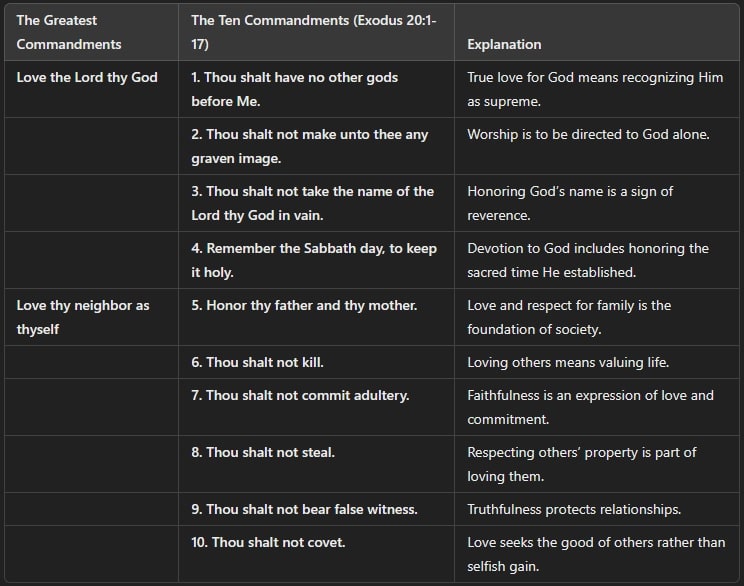
Jesus’ declaration in Matthew 22:37-40 summarizes the entire Law into two foundational commands:
📖 Matthew 22:37-40 – “Thou shalt love the Lord thy God with all thy heart, and with all thy soul, and with all thy mind. This is the first and great commandment. And the second is like unto it, Thou shalt love thy neighbour as thyself. On these two commandments hang all the law and the prophets.”
🔎 This was not a new law, but a divine clarification. The Ten Commandments given to Moses (Exodus 20:1-17) are divided into two categories:
✔ The first four (1-4) concern love for God.
✔ The last six (5-10) concern love for others.
Understanding “On These Two Commandments Hang All the Law and the Prophets” (Matthew 22:40)
📖 Matthew 22:40 – “On these two commandments hang all the law and the prophets.”
When Jesus made this statement, He revealed that the entire Old Testament—both the Law (Torah) and the Prophets (Nevi’im)—is built upon these two principles:
✔ Loving God with all your heart, soul, and mind.
✔ Loving your neighbor as yourself.
This means that every commandment, law, and prophetic message ultimately serves one of these two purposes: to align people with God in love or to guide them in loving others.
Breaking It Down: The Law & The Prophets
1️⃣ The Law (Torah) – The Foundation of Commandments
🔹 The Law (Torah) refers to Genesis through Deuteronomy, where God gave commandments to Israel.
🔹 The Ten Commandments (Exodus 20) summarize moral laws, and many civil and ceremonial laws flow from them.
🔹 Every command in the Law ultimately points to either love for God or love for others.
2️⃣ The Prophets (Nevi’im) – The Call to Return to Love
🔹 The Prophets (Isaiah, Jeremiah, Ezekiel, Daniel, and others) rebuked Israel when they failed to love God (idolatry) or love others (oppression, injustice).
🔹 Every prophetic warning was a call to return to these two great commandments.
🔄 The Connection to the Ten Commandments
Jesus was summarizing what was already revealed in the Torah:
📖 Deuteronomy 6:5 – “Thou shalt love the Lord thy God with all thine heart, and with all thy soul, and with all thy might.” (First four commandments)
📖 Leviticus 19:18 – “Thou shalt love thy neighbor as thyself.” (Last six commandments)
Thus, when Jesus said “on these two commandments hang all the law and the prophets,” He meant:
✔ The entire Old Testament is structured around these two principles.
✔ Every law given by God was designed to teach love for Him or love for others.
✔ Every prophetic rebuke was a call back to these foundational truths.
Key Takeaways
🔑 God invites all to His Kingdom, but many reject Him.
🔑 True greatness is found in loving God and others.
🔑 Jesus’ wisdom exposes hypocrisy and silences His opponents.
🔑 The Messiah is both David’s Son and David’s Lord.
Prophetic Patterns & Dual Fulfillment
🔮 The Wedding Feast & Israel’s Rejection – Echoes Isaiah 25:6-9, where God invites all to His banquet.
🔮 The Cornerstone Rejected – Fulfilled in Psalm 118:22-23, where the rejected stone becomes the foundation.
🔮 Love as the Foundation of the Law – Foretold in Deuteronomy 6:5 and Leviticus 19:18.
Historical & Cultural Context
📜 Marriage Feasts in Jewish Culture – Royal weddings were grand events, symbolizing honor and joy.
📜 Pharisees vs. Sadducees – The Pharisees upheld tradition, while the Sadducees denied resurrection and angels.
📜 Roman Taxation – Paying tribute to Caesar was a heavily debated topic among Jews.
Final Reflection: Are We Accepting God’s Invitation?
Matthew 22 confronts us with a choice—will we respond to God’s invitation with faith or rejection?
📌 Are we seeking wisdom from God, or trying to outthink Him?
📌 Do we truly love God with all our heart, soul, and mind?
📌 Are we living out love for our neighbors?
🚀 The invitation to the Kingdom is open—how will we respond?