
Most people celebrate Christmas without ever questioning where it came from. But behind the lights, carols, and nativity scenes lies a deeply rooted tradition steeped in ancient paganism. God calls His people to worship in spirit and truth—not through rituals borrowed from idol worship. This article reveals the historical and spiritual deception behind Christmas, so you can make an informed and prayerful decision about what it means to truly honor God.
“Learn not the way of the heathen.” – Jeremiah 10:2
Not in the Bible – The Silent Scriptures on Christmas
For a celebration so widespread and passionately defended, it may shock many to learn that Christmas is completely absent from the Bible. Not one verse commands or even suggests that believers should observe the birth of Christ as a holy day. In fact, nowhere in Scripture do we find Christ’s followers—even after His resurrection—commemorating His birth annually or ceremonially.
📖 Luke 22:19 – “This do in remembrance of me.”
👉 Jesus Himself told His disciples to remember His death, not His birth. The breaking of bread (communion) was instituted as a memorial of His sacrifice—not a nativity feast.
👉 The apostles preached Christ crucified (1 Corinthians 1:23), not Christ born. Their focus was on the cross, the resurrection, and the soon return—not seasonal observances.
👉 The Gospel writers don’t mention the date of Christ’s birth. If God intended His birthday to be honored, wouldn’t the exact date be made clear? Instead, it is left deliberately unknown—perhaps to keep us from doing exactly what the world now does: exalting the birth over the mission.
Even the account of the wise men is misunderstood:
🔹 They visited Jesus in a house, not a manger (Matthew 2:11).
🔹 They arrived well after His birth, not on the night He was born.
🔹 They brought gifts to honor the King, not to exchange with one another.
What began as a quiet, humble event in Bethlehem has now become a global commercial frenzy wrapped in glowing lights and sentimentality—but stripped of its biblical foundation.
The silence of Scripture on Christmas is not an oversight—it is a divine statement. God does not want His Son’s holy name attached to pagan festivals, false dates, or flesh-driven traditions. Worship must come from truth, not nostalgia.
📖 Ecclesiastes 7:1 – “A good name is better than precious ointment; and the day of death than the day of one’s birth.”
🔥 If we truly honor Christ, we must do it in the way He instructed, not through customs that never came from His lips.
December 25th – The Birthday of Pagan Gods, Not Christ
The date December 25th is revered by much of the world as the birth of Jesus Christ—but Scripture never identifies this as His birthday. In fact, a closer look at biblical clues strongly suggests Christ was not born in winter at all:
👉 Luke 2:8 tells us that shepherds were “abiding in the field, keeping watch over their flock by night.” This was highly unlikely in the cold, wet months of December. Shepherds in Israel typically stayed in the fields from spring to autumn.
👉 A winter census would have been difficult and impractical due to weather conditions, making it unlikely that Rome would have called one during this time (Luke 2:1–3).
So where does December 25th come from?
It was not chosen to honor Christ—but to preserve paganism. Long before Jesus’ birth, December 25th was already celebrated by various pagan cultures:
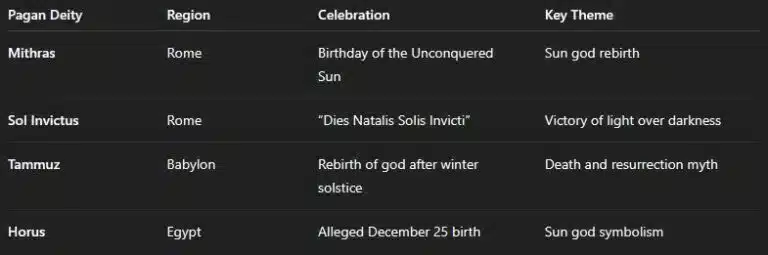
When Constantine legalized Christianity in the 4th century, he merged Christianity with the existing Roman festivals to unify his empire. Pagan rituals were “baptized” with Christian labels—and December 25th was rebranded as the birthday of Christ.
But no amount of rebranding can sanctify a counterfeit.
📖 2 Corinthians 6:17 – “Wherefore come out from among them, and be ye separate, saith the Lord, and touch not the unclean thing; and I will receive you.”
To continue observing December 25 as “holy” is to unknowingly honor a tradition that originated in sun worship and idolatry. It was never about Christ—it was about preserving power through compromise.
Today, many cling to this date with sincere hearts—but sincerity does not equal truth. The question is not how we feel, but what God has revealed.
📖 John 4:24 – “God is a Spirit: and they that worship him must worship him in spirit and in truth.”
The Tree, the Gifts, and the Greenery – Symbols of Ancient Idolatry
To the modern world, the Christmas tree stands as a symbol of warmth, joy, and tradition. Yet the roots of this decorated evergreen go far deeper than the average believer realizes—and they’re not rooted in Scripture.
🎄 The Evergreen Tree in Pagan Worship
Long before the birth of Christ, trees—particularly evergreens—were honored as sacred symbols in pagan cultures. Because they remained “alive” during winter while other trees appeared to die, they were seen as symbols of fertility, eternal life, and the sun’s victory over darkness.
In Babylon and later in Rome, evergreen trees were used in worship of gods such as:
👉 Tammuz – A counterfeit messiah in Babylonian myth, believed to be “reborn” at the winter solstice.
👉 Saturn (Rome) – During the festival of Saturnalia (Dec 17–23), Roman citizens decorated homes with greenery and lights, exchanged gifts, and engaged in revelry. Sound familiar?
📖 Jeremiah 10:2–4 – “Thus saith the Lord, Learn not the way of the heathen… For the customs of the people are vain: for one cutteth a tree out of the forest… they deck it with silver and with gold; they fasten it with nails and with hammers, that it move not.”
Many recognize this passage as an unmistakable description of the modern Christmas tree. While defenders argue this refers to idol carving, the language of adorning a tree from the forest with silver and gold clearly echoes today’s practice.
Gift-Giving – From Saturnalia to Shopping Sprees
At the heart of modern Christmas is the act of gift-giving. It’s presented as a symbol of love, kindness, and generosity. But where did this custom begin—and does it reflect biblical worship, or something far removed?
🎁 Pagan Roots: Saturnalia’s Tribute Offerings
Long before the birth of Jesus, the Roman festival of Saturnalia (held from December 17–23) featured widespread gift exchanges. These gifts were not meant to honor others selflessly, but were given as tributes to appease the god Saturn or curry favor with friends and political figures.
👉 Slaves and masters would trade places for a day.
👉 Candles, figurines, and fruit were common gifts.
👉 The focus was pleasure, misrule, and reversal of order, not holiness.
Gift-giving was central to this pagan festival, and many early church leaders condemned it for its wild celebrations and its undermining of Christian values.
Biblical Giving vs. Pagan Tradition
The Bible does teach giving—but the purpose, timing, and spirit are completely different:
📖 Acts 20:35 – “It is more blessed to give than to receive.”
📖 2 Corinthians 9:7 – “God loveth a cheerful giver.”
👉 Biblical giving is voluntary, not seasonal or compelled by tradition.
👉 It’s focused on the needs of others, especially the poor and suffering.
👉 It is not tied to specific days rooted in false worship or commerce.
The wise men did bring gifts to Jesus—but they were not engaging in a birthday celebration. They brought treasure to honor a King, not to exchange gifts with each other.
From Worship to Consumerism
Today, Christmas has become a global shopping frenzy. Billions are spent on gifts, decorations, and indulgences, often leading to:
⚠️ Financial debt
⚠️ Greed masked as generosity
⚠️ Stress and pressure to “keep up”
⚠️ Distraction from Christ and spiritual reflection
The original purpose of worship has been hijacked by marketing campaigns, sales deadlines, and glittering distractions.
🔥 A Sobering Thought:
If the gift-giving tradition was never commanded by God, originated in pagan idolatry, and has become a tool for greed and vanity, then why defend it in the name of Christ?
Would Jesus, born humbly and laid in a manger, be honored by lavish spending in His name, especially when the poor are neglected and worship is replaced with materialism?
📖 Proverbs 15:27 – “He that is greedy of gain troubleth his own house…”
Santa Claus – A Counterfeit God
In the eyes of millions of children, Santa Claus has become the central figure of Christmas. He sees all, rewards good behavior, punishes the bad, and delivers gifts from the sky. But behind the red suit and jolly laughter lies a deeper, more troubling truth—Santa is a direct counterfeit of God.
🎅 The Origins: From Saint Nicholas to Sinterklaas
The modern image of Santa evolved from Saint Nicholas, a 4th-century bishop known for his generosity. Over time, legend merged with folklore:
👉 In Europe, Sinterklaas rode a white horse and gave gifts.
👉 In Norse mythology, Odin rode through the sky with a long beard and judged behavior.
👉 In the 1800s, American poems and Coca-Cola ads transformed him into the Santa we know today.
This blending of myth, paganism, and commercialism created a character with godlike attributes—but without the holiness of God.
Santa Imitates God’s Attributes
Compare the traits of Santa to those of God, and the counterfeit becomes obvious:
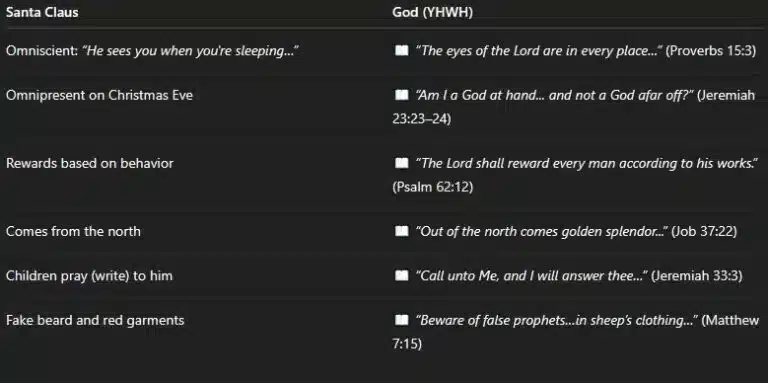
Santa replaces the fear of God with superstition, and shifts the focus from Christ to self-centered gifts.
Why It Matters
🚨 Santa teaches children to believe in lies before they’re even old enough to reason truthfully.
🚨 He eclipses Jesus in both home and culture, reducing the birth of the Savior to a side note.
🚨 He becomes a moral judge without holiness, teaching “be good and you’ll be rewarded,” not “repent and believe the Gospel.”
📖 Isaiah 5:20 – “Woe unto them that call evil good, and good evil…”
🔥 If Satan wanted to distract an entire generation from Christ, wouldn’t he dress up as something fun, magical, and harmless?
The Ultimate Question:
Would the God of truth endorse a tradition that teaches children to believe in a lie?
📖 Ephesians 4:25 – “Wherefore putting away lying, speak every man truth…”
Other Traditions – Mistletoe, Yule Logs, and Pagan Symbols
Beyond the tree and Santa, Christmas is wrapped in layers of customs with ancient pagan meanings. From mistletoe to yule logs, these seemingly innocent traditions carry symbolism tied to fertility rites, sun worship, and ancient idolatry—far removed from the gospel of Christ.
🌿 Mistletoe – A Fertility and Sun-Worship Symbol
Mistletoe was considered sacred by the Druids, an ancient Celtic priesthood. They believed it had magical powers, could cure illness, and was a symbol of fertility and sexual vitality.
👉 Kissing under the mistletoe comes from pagan fertility rites, not Scripture.
👉 It was used in winter solstice ceremonies, honoring the rebirth of the sun.
👉 Even today, it encourages a playful acceptance of romantic behavior, no matter the spiritual setting.
📖 Ephesians 5:11 – “And have no fellowship with the unfruitful works of darkness, but rather reprove them.”
Yule Logs – The Burning of the Sun God
The Yule log traces back to Norse and Germanic paganism, where a log was burned during the Yule festival to honor the returning sun.
👉 It was seen as a sacrifice to the gods of fire and fertility.
👉 Ashes were kept for protection and good luck in the year ahead.
👉 Today’s “yule” desserts and décor continue this tradition under a modern disguise.
📖 Deuteronomy 12:30–31 – “Take heed…that thou enquire not after their gods, saying, How did these nations serve their gods? even so will I do likewise.”
Wreaths, Bells, and Holly – Echoes of Ancient Worship
Many common Christmas symbols have deep pagan roots:
👉 Wreaths – Circular wreaths were sun symbols, representing the eternal cycle of nature—not the eternal life of Christ.
👉 Bells – Once used to ward off evil spirits during solstice festivals.
👉 Holly – Sacred to Saturn, the god honored during Saturnalia. Its red berries symbolized blood offerings and its sharp leaves represented male divinity.
Today they are sold as holiday décor, yet few realize what they originally meant.
Why It Matters
We are not called to mix the holy with the profane. What began as rituals to false gods now fills homes that claim Christ.
📖 2 Corinthians 6:17 – “Wherefore come out from among them, and be ye separate, saith the Lord…”
🔥 The issue is not just what these items once meant, but what they still carry spiritually. God never called His people to redeem paganism—He calls us to reject it.
Why Did the Church Adopt Christmas?
The Bible never commands the celebration of Christ’s birth—let alone on December 25. So how did this day, steeped in pagan rituals, become one of the most celebrated holidays in the Christian world?
🏛️ A Strategic Compromise
In the 4th century AD, under Emperor Constantine, Christianity began to merge with the Roman Empire. As paganism and Christianity collided, compromise became a tool for unity—but at a cost.
👉 December 25 was already celebrated as the birth of Sol Invictus, the Unconquered Sun.
👉 The church adopted the date to attract pagan converts, rebranding it as Christ’s birthday.
👉 Pagan customs like gift-giving, greenery, feasts, and lights were absorbed into the “Christian” version of the holiday.
📖 Daniel 7:25 – “And he shall…think to change times and laws…”
This was not a biblical decision. It was a political and cultural move—an attempt to make Christianity more appealing to the masses.
When Tradition Outweighs Truth
Over time, what began as syncretism (a blending of beliefs) became standard tradition. Few questioned the origin. Fewer still searched the Scriptures.
👉 The Reformers denounced Christmas for its unbiblical and pagan roots.
👉 The Puritans in England and early America banned it altogether.
👉 Even as late as the 1800s, it was considered a sinful celebration by many Protestants.
Yet today, it is seen as sacred.
📖 Mark 7:8–9 – “For laying aside the commandment of God, ye hold the tradition of men…”
The heart of the matter is this: God never asked for this day. And the way it came into the church reveals more about man’s desire for popularity than devotion.
🚨 A Warning From History
When the church trades purity for popularity, the result is confusion. Just as Israel once adopted the golden calf, saying it was “to the LORD” (Exodus 32:5), today many offer Christmas to Christ—but He never asked for it.
📖 Jeremiah 10:2 – “Thus saith the Lord, Learn not the way of the heathen…”
Mixing Truth with Paganism – Does God Accept It?
Many well-meaning believers say, “I’m not worshiping pagan gods—I’m celebrating Jesus.” But the critical question is not what we intend—it’s what God has said.
📖 God’s Clear Standard
From Genesis to Revelation, God is not silent about mixing holy and unholy practices. He calls His people to be set apart, not to blend with the world.
📖 Deuteronomy 12:30–31 – “Take heed to thyself… that thou inquire not after their gods, saying, How did these nations serve their gods? even so will I do likewise. Thou shalt not do so unto the Lord thy God…”
God warned Israel not to adopt the worship methods of pagan nations, even if the intent was to redirect it toward Him.
📖 2 Corinthians 6:17 – “Come out from among them, and be ye separate, saith the Lord…”
God doesn’t accept syncretism—the combining of His truth with pagan traditions. Purity of worship matters to Him.
Examples in Scripture
Throughout Scripture, God judged His people not only for outright idolatry but for mixing in practices He never commanded:
🔥 Nadab and Abihu offered “strange fire” (Leviticus 10:1–2). God had not commanded it—and they died.
🔥 King Saul mixed obedience with his own ideas—and lost the kingdom (1 Samuel 15:22–23).
🔥 Jeroboam created a new feast and made golden calves, calling them a way to worship God—but it led Israel into sin (1 Kings 12:28–33).
Mixing pagan elements with pure worship has never been accepted by God. Good intentions do not override His Word.
But Isn’t It Just a Personal Choice?
Modern culture encourages the idea that sincerity = acceptability. But God’s standard isn’t based on what “feels right.” He calls for obedience, not just emotion.
📖 Proverbs 14:12 – “There is a way which seemeth right unto a man, but the end thereof are the ways of death.”
He desires worship in spirit and in truth (John 4:24)—not a holiday cloaked in history’s darkest roots.
The Real Birth / The Real Worship God Wants – Spirit and Truth
The Bible never tells us the exact date of Jesus’ birth—and that in itself is revealing. If God wanted us to celebrate it, surely He would have told us when. Instead, He points us toward how to worship, not when.
Jesus Was Not Born in December
Though the world celebrates Christ’s birth on December 25th, this date has no biblical support. In fact, Scripture gives several clues that place His birth in a different season entirely:
👉 Luke 2:8 – “And there were in the same country shepherds abiding in the field, keeping watch over their flock by night.”
🔎 Shepherds in Israel wouldn’t be in the fields overnight during the cold, rainy winters of December.
👉 Luke 1 outlines the priestly duties of Zacharias, which help estimate the timeline of John the Baptist’s conception and, by extension, Jesus’ birth—most likely falling in the autumn, around the time of God’s biblical Feast of Tabernacles.
But the date isn’t the focus—God never told us to remember His Son’s birth. Instead, Jesus told us to remember His death and resurrection (Luke 22:19; 1 Corinthians 11:26).
Worship in Spirit and in Truth
📖 John 4:23–24 – “But the hour cometh, and now is, when the true worshippers shall worship the Father in spirit and in truth… God is a Spirit: and they that worship him must worship him in spirit and in truth.”
Christ’s birth was humble, pure, and heaven-directed—not draped in excess, pagan symbolism, or worldly celebration. Real worship isn’t about special dates or decorative displays—it’s about a heart surrendered to the truth of who God is and what He desires.
Why True Believers Must Reject Christmas
To the world, Christmas seems harmless—joyful songs, bright lights, gift-giving, family gatherings. But for those who have eyes to see and hearts open to truth, it becomes clear: this celebration is not about Christ at all—and never was.
The Call to Come Out
God doesn’t mix light with darkness.
📖 2 Corinthians 6:17 – “Wherefore come out from among them, and be ye separate, saith the Lord, and touch not the unclean thing; and I will receive you.”
The moment a believer realizes that Christmas is rooted in paganism, masked by tradition, and fueled by commercialism, a choice must be made: follow the crowd or follow Christ.
God Doesn’t Accept Pagan Mixtures
📖 Deuteronomy 12:30–31 – “Take heed to thyself… that thou inquire not after their gods, saying, How did these nations serve their gods? even so will I do likewise. Thou shalt not do so unto the Lord thy God…”
God has always rejected the blending of pagan practices with worship to Him. He desires purity—not imitation. To say “But I celebrate it for Jesus” misses the point. The golden calf in Exodus was built for the Lord (Exodus 32:5), but God called it idolatry. Our intentions do not override His commandments.
A Matter of Loyalty
Choosing to reject Christmas is not about legalism—it’s about loyalty. It’s about loving God enough to walk away from what the world embraces. It’s about lifting His truth above our traditions, even when it costs us comfort, relationships, or reputation.
📖 John 14:15 – “If ye love me, keep my commandments.”
A Set-Apart Life
Rejecting Christmas doesn’t mean rejecting joy, family, or thankfulness. It means finding better ways to honor God—ways that are rooted in truth, not tradition. It means celebrating His Son every day, not just in a season borrowed from sun worship and pagan myths.
Final Reflection – Who Are You Really Worshiping?
Christmas asks for your heart—but so does God.
At its core, this is not a debate about dates, decorations, or even doctrine. It’s a question of worship. Of allegiance. Of truth. Who receives the focus of your celebration? Who defines your traditions? Who sets the standard of your worship—God’s Word or the world?
📖 Matthew 15:8–9 – “This people draweth nigh unto me with their mouth, and honoureth me with their lips; but their heart is far from me. But in vain they do worship me, teaching for doctrines the commandments of men.”
This is the danger: worship that feels sincere—but is still vain in God’s eyes.
We must ask ourselves hard questions:
📌 Am I holding on to a tradition because it’s comfortable—or because it’s true?
📌 Would I still celebrate if I knew it had nothing to do with Christ?
📌 Do I care more about honoring the Savior—or fitting in with society?
The truth is not always popular—but it is always freeing. And those who love the truth will walk in the light, even if they must walk alone.
📖 John 4:23–24 – “The hour cometh, and now is, when the true worshippers shall worship the Father in spirit and in truth… God is a Spirit: and they that worship him must worship him in spirit and in truth.”
You don’t need a tree, gifts, or a nativity scene to celebrate Christ. You need a surrendered heart, a life set apart, and a willingness to follow Him even when it costs.
So who are you really worshiping?
That question echoes through eternity—and your answer matters more than you know.


