
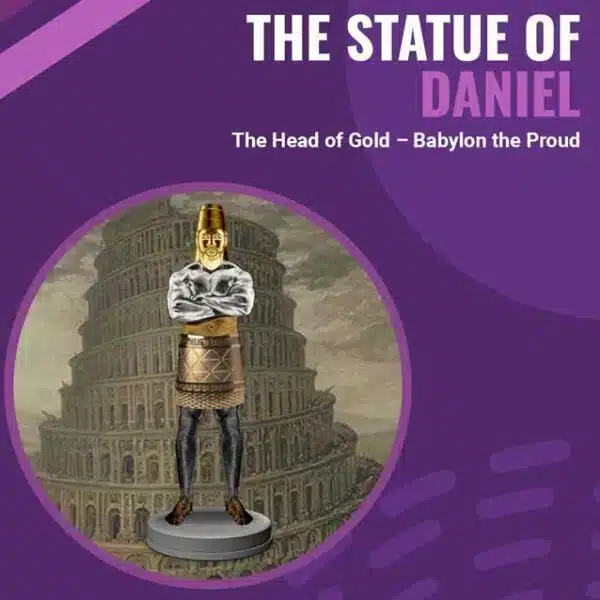
The Statue of Daniel — Head of Gold
The first kingdom in Daniel’s prophetic statue is the Head of Gold—Babylon. A kingdom of splendor, pride, and rebellion, Babylon represents more than just a historic empire; it is a symbol of man’s exaltation above God. From its beginnings at Babel to the mighty rule of Nebuchadnezzar, Babylon rose to dominance by power and pride, yet fell because of rebellion and defiance of the Most High.
📖 Proverbs 16:18 – “Pride goeth before destruction, and an haughty spirit before a fall.”
The Dream That Revealed Empires
📖 Daniel 2:31-32 – “Thou, O king, sawest, and behold a great image. This great image, whose brightness was excellent, stood before thee; and the form thereof was terrible. This image’s head was of fine gold.”
🔎 God gave King Nebuchadnezzar a prophetic dream revealing the rise and fall of world empires. The statue, made of various metals, represented successive kingdoms throughout history. The head of gold was not just decorative—it was symbolic of Babylon’s power, wealth, and dominance. It stood as a warning of what happens when pride replaces obedience.
Historical Snapshot – The Empire of Babylon
📍 Capital: Babylon (in modern-day Iraq)
📆 Reign: c. 605–539 BC
🏰 Notable Ruler: Nebuchadnezzar II
🎯 Achievements: Hanging Gardens, Ishtar Gate, massive walls, centralized law
🛡️ Legacy: Babylon was a cultural and military superpower known for its golden architecture, astrology, and conquest-driven dominance. It became the biblical archetype of pride and rebellion against God.
🔥 Babylon’s greatness in gold could not save it from divine judgment. Its fall is both history—and prophecy.
A Kingdom of Glory Built on Pride
📖 Daniel 2:37-38 – “Thou, O king, art a king of kings: for the God of heaven hath given thee a kingdom, power, and strength, and glory… Thou art this head of gold.”
🔎 Babylon was given glory—but it did not acknowledge the Giver. Nebuchadnezzar ruled a kingdom admired for its wealth, architecture, and influence. Gold covered the temples, adorned statues, and lined its walls. Yet its greatest flaw was not external—it was internal. Babylon’s glory led to arrogance, and that arrogance led to defiance.
🔸 Pride always precedes a fall. Nebuchadnezzar’s transformation from arrogant king to humbled beast (Daniel 4:30-33) stands as a stark lesson. “Is not this great Babylon, that I have built…?” he boasted—then fell under divine judgment. God showed him that no earthly king rules apart from Heaven’s permission.
🔸 The spirit of Babylon exalts self over God. This rebellion isn’t just personal—it becomes systemic. Babylon’s rulers set up idols and demanded worship (Daniel 3:1-6), commanding the people to bow or burn. The exaltation of human power and rejection of divine truth is the signature of every Babylonian system, both ancient and modern.
The Root Problem – Rebellion Against the Sovereignty of God
📖 Isaiah 14:13-14 – “I will ascend into heaven… I will exalt my throne above the stars of God… I will be like the most High.”
🔎 These words of Lucifer mirror the spirit that infected Babylon. Pride is not just self-centeredness—it is an attempt to dethrone God. When man places his own word above God’s, rebellion becomes religious. Babylon isn’t just a political empire—it’s a worldview that challenges God’s authority while demanding the allegiance of the masses.
🔸 Tower of Babel Origins – Babylon began with Babel—man’s attempt to ascend to Heaven by his own efforts (Genesis 11:4). God scattered them, not only in speech but in purpose. Yet Babylon rose again and again, reinventing its rebellion in new forms throughout history.
🔸 Modern Babylon still rebels. Today’s world continues to exalt science, reason, and government authority above God’s Word. Humanism, moral relativism, and ecumenical unity without truth are all dressed in gold—but built on rebellion.
Why Pride and Rebellion Are Spiritually Fatal
🔸 Pride blinds the soul to correction – Babylon fell because it refused to humble itself. Pride resists the Spirit’s voice and silences the conscience. When man exalts his own glory, he becomes incapable of repentance.
🔸 Rebellion leads to counterfeit worship – When God’s truth is rejected, a counterfeit fills the void. Babylon set up golden images and enforced false worship (Daniel 3:5-6). Today, the Beast system will do the same—calling good evil and evil good, and punishing those who refuse to bow.
🔹 God resists the proud – 📖 James 4:6 – “God resisteth the proud, but giveth grace unto the humble.” Babylon’s fall wasn’t just military—it was spiritual judgment. Every kingdom that exalts itself will be brought low.
Final Reflection – The Spirit of Babylon Today
📖 Revelation 18:7 – “She saith in her heart, I sit a queen, and am no widow, and shall see no sorrow.”
🔎 This is the modern cry of spiritual Babylon—confident, boastful, and blind. The final head of gold has many heads today: proud institutions, rebellious churches, corrupted governments, and compromised believers. The fall of ancient Babylon is a warning. The fall of spiritual Babylon is a prophecy soon to be fulfilled.
🔥 To follow Babylon is to fall with her. But to come out is to stand with Christ. Let this be a wake-up call: pride is not a harmless attitude—it is the seed of eternal destruction.
Babylon in Focus – Historical and Biblical Insights
🔹 Nebuchadnezzar is the only pagan king to write part of the Bible. His personal testimony is recorded in Daniel 4, where he recounts his dream, his judgment, and his eventual praise of the Most High God after living as a beast for seven years. It’s a rare moment of humility from one who once defied Heaven.
🔹 The Hanging Gardens of Babylon are considered one of the Seven Wonders of the Ancient World, though their exact existence remains debated. According to tradition, they were created by Nebuchadnezzar for his Median wife who longed for the green hills of her homeland.
🔹 The Ishtar Gate, decorated with dragons and bulls, was the ceremonial entrance to the inner city. It represents Babylon’s obsession with grandeur and pagan symbolism, and parts of it are now reconstructed in the Pergamon Museum in Berlin.
🔹 Babylon fell suddenly and unexpectedly in 539 BC to the Medes and Persians. According to Daniel 5, the fall came the same night as the infamous feast of Belshazzar when divine handwriting appeared on the wall.
🔹 Babylon’s religion deeply influenced future false systems. With roots in astrology, idol worship, and priestly rituals, it became the prophetic symbol of confusion, false unity, and rebellion against God in the book of Revelation.
Prophetic Bridge – From Gold to Silver
Babylon’s fall was not the end—but the beginning of a prophetic chain. Just as the head of gold gave way to the chest and arms of silver, a new power rose: Medo-Persia. It would be less glorious, yet more widespread.
God’s hand was behind every shift in power. As we journey to the next kingdom, the prophetic timeline continues… inching closer to the final stone that will break them all.
A Closing Prayer – A Heart Humbled Before the King
Heavenly Father,
Search my heart and strip away every trace of pride. Let me not follow the spirit of Babylon, which exalts man and silences truth. Help me to walk humbly, obey joyfully, and worship You alone.
I reject the golden image of this world—the temptations of power, popularity, and self. I choose instead to bow before the throne of Heaven.
Fill me with Your Spirit. Help me stand apart from Babylon’s ways and shine with the light of Your truth. May my loyalty be sealed in Heaven, and my name written in the Lamb’s Book of Life.
In Jesus’ holy name,
Amen.