
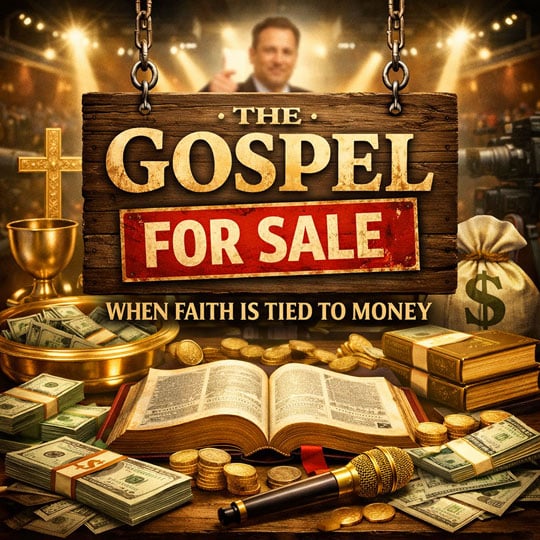
Across the world today, a dangerous distortion of the gospel is spreading—one that ties faith to money, obedience to financial gain, and blessing to what a person gives. It promises prosperity, success, and increase, often presenting God as one who can be moved or influenced through offerings. But this raises a serious question: Has the gospel of Christ been turned into a transaction?
📖 1 Timothy 6:5 – “Men of corrupt minds… supposing that gain is godliness: from such withdraw thyself.”
🔎 The Bible warned long ago that there would be those who equate financial gain with spiritual favor. This teaching suggests that wealth is a sign of God’s approval and that giving money can unlock blessings—but this is not the gospel preached by Christ or the apostles.
📖 Matthew 10:8 – “Freely ye have received, freely give.”
🔎 The true gospel is not bought, sold, or traded. It is a gift—freely given by God and meant to be shared without price. When money becomes the focus, the message itself is changed.
Today, many are told:
🔹 Give, and God will multiply your wealth
🔹 Sow a seed, and blessings will return to you
🔹 Financial offering proves your faith
These teachings appeal to desire, not repentance. They focus on what a person can gain, rather than what must be surrendered.
📖 Luke 16:13 – “Ye cannot serve God and mammon.”
🔎 Jesus made it clear—there is a line that cannot be crossed. When money becomes central to faith, something has already gone wrong. The heart begins to shift from seeking God to seeking gain.
📖 2 Peter 2:3 – “And through covetousness shall they with feigned words make merchandise of you…”
🔎 This is one of the clearest warnings in Scripture. False teachers would use persuasive language to turn people into a source of profit—using religion not to lead souls to God, but to benefit themselves.
💡 The true gospel calls for repentance, surrender, and transformation. A false gospel offers comfort, gain, and promises that appeal to the flesh.
What the True Gospel Actually Teaches
📖 Mark 1:14–15 – “Jesus came into Galilee, preaching the gospel… saying, The time is fulfilled… repent ye, and believe the gospel.”
🔎 The gospel that Jesus preached was not about wealth, success, or earthly gain—it was a call to repentance. It confronted sin, called for change, and pointed people back to God. This is the first and most important distinction: The true gospel deals with sin and salvation, not money and material blessing.
📖 Luke 9:23 – “If any man will come after me, let him deny himself, and take up his cross daily, and follow me.”
🔎 Following Christ requires self-denial, not self-advancement. The true gospel does not promise an easier life—it calls for surrender, sacrifice, and obedience.
🔹 It calls us to give up the world—not gain it
🔹 It leads through the cross—not comfort
🔹 It transforms the heart—not the bank account
📖 Matthew 6:19–20 – “Lay not up for yourselves treasures upon earth… But lay up for yourselves treasures in heaven…”
🔎 Jesus consistently redirected focus away from earthly wealth and toward eternal treasure. The prosperity message does the opposite—it centers attention on what can be gained now. This is a complete reversal of Christ’s teaching.
📖 Isaiah 55:1 – “Come… buy wine and milk without money and without price.”
🔎 Salvation cannot be purchased. It is not unlocked through giving, nor is it earned through offerings. God’s invitation is freely given—without cost. Any system that ties spiritual blessing to financial giving distorts this truth.
📖 Acts 8:18–20 – “Thy money perish with thee, because thou hast thought that the gift of God may be purchased with money.”
🔎 When Simon attempted to buy spiritual power, he was sharply rebuked. This moment clearly shows that spiritual things cannot be obtained through financial means. Yet today, many are taught the opposite—that giving unlocks blessing.
📖 Philippians 3:7–8 – “What things were gain to me, those I counted loss for Christ.”
🔎 The true gospel causes a shift in values. What was once considered gain becomes loss in comparison to knowing Christ.
🔸 The world seeks gain
🔹 The gospel calls for surrender
One builds self, the other transforms the soul
The Core Difference
The true gospel says:
👉 Repent
👉 Surrender
👉 Follow Christ
The false gospel says:
🔥 Give
🔥 Expect
🔥 Receive
💡 One leads to eternal life. The other appeals to earthly desire.
The Gospel for Profit – Making Merchandise of Souls
📖 2 Peter 2:3 – “And through covetousness shall they with feigned words make merchandise of you…”
🔎 This verse speaks directly to what we are seeing today. The warning is clear—there would be those who use persuasive, emotional, and carefully crafted words to turn people into a source of gain. The gospel would be used, not to save souls, but to profit from them.
This is not accidental—it is deliberate.
📖 Jeremiah 5:31 – “The prophets prophesy falsely… and my people love to have it so…”
🔎 One of the most sobering realities is that false teaching often thrives because it is welcomed. Messages that promise blessing, increase, and success are easier to receive than messages that call for repentance, sacrifice, and obedience.
🔹 People are drawn to what feels good
🔹 Truth is often rejected because it confronts
🔹 Deception spreads when it is embraced
💡 The danger is not only in false teachers—but in hearts that prefer comfort over truth.
📖 Micah 3:11 – “The heads thereof judge for reward… the prophets thereof divine for money…”
🔎 Even in the Old Testament, God warned about spiritual leaders who tied their message to financial gain. Their teaching became influenced by what people would give rather than what God had said.
This is the same pattern seen today:
🔹 Messages shaped to encourage giving
🔹 Promises tied to financial “seeds”
🔹 Blessings presented as a return on investment
📖 Matthew 7:15 – “Beware of false prophets… which come to you in sheep’s clothing…”
🔎 These teachers do not appear dangerous. They often speak of God, use Scripture, and present themselves as ministers of truth. But beneath the surface, the focus is not on salvation—it is on gain.
They may say:
🔹 “God wants to prosper you”
🔹 “Give, and you will receive back more”
🔹 “Your blessing is tied to your offering”
Yet these messages shift the focus from God’s will to personal gain.
📖 John 2:15–16 – “Make not my Father’s house an house of merchandise.”
🔎 When Jesus entered the temple and saw it turned into a place of buying and selling, He responded with righteous anger. Why? Because what was meant to be sacred had been turned into a system of profit.
💡 The same principle applies today—when the gospel becomes a means of gain, it is no longer the gospel.
📖 Titus 1:11 – “Teaching things which they ought not, for filthy lucre’s sake.”
🔎 Scripture reveals the motive behind much false teaching—money. When financial gain becomes the driver, truth is compromised.
🔹 Messages are softened
🔹 Sin is avoided
🔹 Conviction is replaced with encouragement
All to keep people comfortable—and giving.
The Deeper Deception
The most dangerous part of this system is not that it asks for money—it is that it redefines faith.
Instead of:
👉 trusting God
👉 surrendering to His will
👉 obeying His Word
Faith becomes:
🔥 giving to receive
🔥 expecting financial return
🔥 measuring blessing by wealth
💡 This transforms the gospel from a call to repentance into a system of exchange. When money becomes central to the message, the cross is no longer the focus.
📖 Galatians 1:7–8 – “There be some that trouble you, and would pervert the gospel of Christ…”
🔎 A perverted gospel is not always obvious—it often contains truth mixed with error. But the moment it shifts from salvation to gain, it has already departed from the truth.
False Miracles and Signs – When Power Does Not Equal Truth
📖 Matthew 24:24 – “For there shall arise false Christs, and false prophets, and shall shew great signs and wonders; insomuch that, if it were possible, they shall deceive the very elect.”
🔎 Jesus Himself warned that in the last days, deception would not come through obvious falsehood alone—but through powerful signs and wonders. These miracles will appear convincing, even to those who know Scripture.
This reveals something critical: Miracles alone are not proof of truth
📖 2 Thessalonians 2:9–10 – “Even him, whose coming is after the working of Satan with all power and signs and lying wonders…”
🔎 The Bible clearly teaches that not all supernatural power comes from God. There will be lying wonders—real manifestations of power used to support false teachings.
This is one of the greatest deceptions:
🔹 Power without truth
🔹 Signs without obedience
🔹 Wonders without righteousness
💡 The presence of power does not mean the presence of God.
📖 Revelation 13:13–14 – “And he doeth great wonders, so that he maketh fire come down from heaven on the earth in the sight of men…”
🔎 This prophecy shows a system that performs miracles in a public and undeniable way. Fire from heaven is one of the most powerful signs in Scripture—yet here it is used to deceive.
The result? People are led to follow what appears divine—but is not.
📖 Deuteronomy 13:1–3 – “If there arise among you a prophet… and giveth thee a sign or a wonder… thou shalt not hearken…”
🔎 Even in the Old Testament, God warned that a sign or wonder—even if it comes to pass—is not enough. The true test is whether the message aligns with God’s commandments.
🔹 Does it lead to obedience?
🔹 Does it uphold God’s law?
🔹 Does it point to truth?
If not, it is not from God—no matter how powerful it appears.
📖 Matthew 7:22–23 – “Many will say to me… have we not prophesied in thy name? and in thy name have cast out devils?… And then will I profess unto them, I never knew you…”
🔎 This is one of the most shocking passages in Scripture. These individuals:
🔹 performed miracles
🔹 cast out devils
🔹 did works in Christ’s name
And yet—they were not known by Him.
Why?
👉 Because they did not live in obedience.
The Connection to False Faith
When faith is built on:
👉 miracles
👉 emotional experiences
👉 visible power
instead of:
👉 truth
👉 obedience
👉 God’s Word
it becomes vulnerable to deception. False faith often seeks signs rather than truth.
📖 John 4:48 – “Except ye see signs and wonders, ye will not believe.”
🔎 Jesus rebuked those who based belief on miracles alone. True faith is not dependent on signs—it is grounded in truth. In the last days, many will follow what looks powerful, feels real, and appears divine—but only those grounded in Scripture will discern the difference.
🔹 Miracles can be imitated
🔹 Power can be counterfeited
🔹 Truth cannot be replaced
💡 If miracles can be used to deceive, and money can be used to manipulate, then the final question becomes: how do we discern what is true and what is false?
How to Discern True Faith from False Faith
📖 Isaiah 8:20 – “To the law and to the testimony: if they speak not according to this word, it is because there is no light in them.”
🔎 This is the clearest test in all of Scripture. No matter how powerful, convincing, or emotional a message may be—if it does not align with God’s Word, it is not truth.
🔹 Truth agrees with Scripture
🔹 Truth does not contradict God’s law
🔹 Truth stands even without signs or feelings
💡 The Word of God—not experience—is the final authority.
📖 John 14:15 – “If ye love me, keep my commandments.”
🔎 True faith produces obedience. It is not merely belief in words—it is a life that reflects God’s will.
False faith says:
🔥 believe only
🔥 no change needed
🔥 grace covers all without repentance
True faith says:
👉 love leads to obedience
👉 obedience flows from the heart
👉 faith transforms the life
📖 Matthew 7:16 – “Ye shall know them by their fruits.”
🔎 The fruit of a life reveals its source. Not what is said, but what is lived over time.
🔹 Does it produce humility or pride?
🔹 Does it lead to holiness or compromise?
🔹 Does it point to God or to self?
💡 Fruit cannot be faked forever—eventually, it is revealed.
📖 James 2:17 – “Faith, if it hath not works, is dead, being alone.”
🔎 A faith that does not result in action is not living faith. True belief always produces change.
🔹 A changed heart
🔹 A changed direction
🔹 A changed life
💡 If nothing changes, the faith is not real.
📖 1 John 2:3–4 – “Hereby we do know that we know him, if we keep his commandments…”
🔎 Knowing God is not proven by words or feelings—it is revealed through obedience.
This is one of the most direct tests:
👉 Do I follow what God says?
🔥 Or do I follow what feels right to me?
📖 Galatians 5:22–23 – “The fruit of the Spirit is love, joy, peace…”
🔎 True faith produces the fruit of the Spirit. This is not manufactured—it is the result of a life connected to God.
False faith may produce:
🔥 excitement
🔥 emotion
🔥 outward display
But true faith produces:
🔹 character
🔹 patience
🔹 self-control
🔹 love rooted in truth
The Final Test
When everything is stripped away—money, miracles, emotion—what remains?
👉 Truth
👉 Obedience
👉 Character
📖 John 17:17 – “Sanctify them through thy truth: thy word is truth.”
🔎 Truth is what sanctifies, not signs, not wealth, not experience.
Closing Summary
🔹 Test everything by Scripture
🔹 True faith produces obedience
🔹 Fruit reveals the source
🔹 Faith without change is not real
🔹 Truth—not experience—is the foundation
💡 True faith is not proven by what you receive—but by who you become. Many will follow what feels right, what looks powerful, and what promises gain—but only those grounded in truth will stand.
Final Reflection – A Faith That Cannot Be Bought
📖 Matthew 7:21–23 – “Not every one that saith unto me, Lord, Lord, shall enter into the kingdom of heaven… Many will say to me in that day… have we not… done many wonderful works? And then will I profess unto them, I never knew you…”
🔎 These are among the most sobering words ever spoken. They reveal that many will stand confident in what they believed, what they experienced, and what they did—yet still be unknown to Christ. Why? Because their faith was not rooted in truth and obedience.
📖 1 Timothy 6:9–10 – “They that will be rich fall into temptation… For the love of money is the root of all evil…”
🔎 When faith becomes tied to gain, it shifts the heart away from God. What begins as belief can slowly turn into pursuit—seeking blessing instead of seeking the One who blesses.
This is the great danger of a gospel for sale:
🔥 It promises what the flesh desires
🔥 It avoids what the soul needs
🔥 It replaces surrender with expectation
📖 Luke 18:8 – “When the Son of man cometh, shall he find faith on the earth?”
🔎 This question is not about religion—it is about true faith. Not the kind that gathers crowds, performs signs, or promises prosperity—but the kind that remains faithful, obedient, and grounded in truth.
A Personal Question
📖 2 Corinthians 13:5 – “Examine yourselves, whether ye be in the faith…”
🔎 This study is not about others—it is about each of us.
📌 Is my faith built on truth, or on what I hope to receive?
📌 Do I follow God when it costs me—or only when it benefits me?
📌 Am I seeking Christ—or what Christ can give me?
The Call Back to Truth
📖 Isaiah 55:1 – “Come… without money and without price.”
🔎 The true gospel has never been for sale. It cannot be bought, earned, or exchanged. It is freely given—but it calls for everything in return.
📖 Luke 14:33 – “Whosoever he be of you that forsaketh not all that he hath, he cannot be my disciple.”
🔎 This is the gospel many do not want to hear—but it is the one Christ preached.
💡 Final Thought
In the last days, many will follow a faith that looks right, feels powerful, and promises much—but only those grounded in truth will stand.
📖 John 4:24 – “They that worship him must worship him in spirit and in truth.”
✝️ The gospel is not for sale. It is not a transaction. It is a call—to repent, to surrender, and to follow Christ fully. The question is not what faith offers you…but whether your faith is truly from God.