
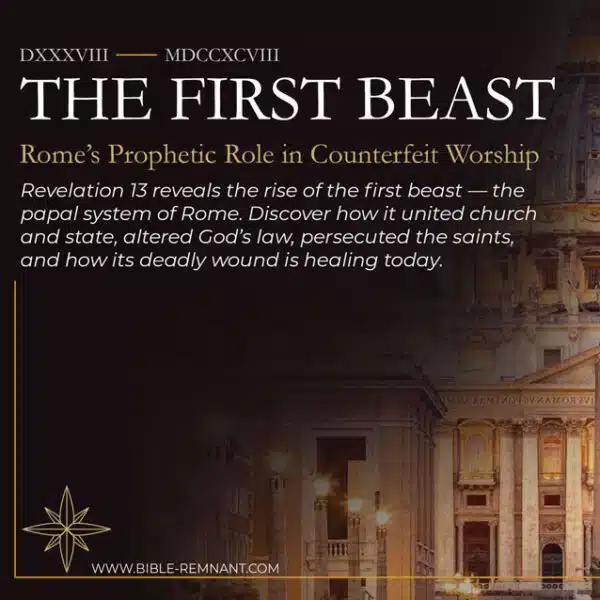
The First Beast – Rome’s Prophetic Role in Counterfeit Worship
The first beast of Revelation 13 is one of the most recognized and discussed prophecies in Scripture. It is a beast of great power and authority, both religious and political, that would rise from the sea and hold dominion over nations for a time. This beast is identified in the Bible as the papal system — a power that took its seat in Rome, persecuted God’s saints, and redefined God’s law to suit its purposes.
Daniel 7:25 – “And he shall speak great words against the most High, and shall wear out the saints of the most High, and think to change times and laws…”
The beast in Revelation 13 mirrors the little horn in Daniel 7, which arose after the fall of the Roman Empire and established papal supremacy. For over a thousand years, the papacy wielded vast political and religious influence, combining secular power with ecclesiastical authority, controlling kings and empires, and altering God’s law.
But prophecy says that this beast would receive a deadly wound — a period of decline, marked by the capture of Pope Pius VI in 1798. This wound would cause the papacy to lose political power, but Scripture warns the wound would heal, and the influence of the beast would be restored.
The first beast is Rome — not a singular person, but a system that united church and state, shaping the world’s power structures for centuries. Its deadly wound is healing, and its influence is returning. To understand this system is to understand the warning of Revelation 13.
Study Guides for Understanding Prophecy
To follow this study with clarity, we encourage you to first review these two foundational guides:
🔹 Prophecy Symbols Explained – A quick-reference guide to beasts, horns, crowns, women, waters, and other prophetic symbols.
🔹 Prophetic Time Unveiled – A complete study on how God measures time in prophecy, including the 70 weeks, the 1,260 years, and more.
⚠️ These two guides act as keys, unlocking the language of prophecy and helping us rightly interpret the messages of Daniel and Revelation.
The Rise of the First Beast – From Sea to Throne
📖 Revelation 13:1–2 – “And I stood upon the sand of the sea, and saw a beast rise up out of the sea, having seven heads and ten horns, and upon his horns ten crowns, and upon his heads the name of blasphemy. And the beast which I saw was like unto a leopard, and his feet were as the feet of a bear, and his mouth as the mouth of a lion: and the dragon gave him his power, and his seat, and great authority.”
🔎 John paints the scene with dramatic imagery. Out of the turbulent sea of nations, a new power emerges. It carries the features of Babylon (lion), Medo-Persia (bear), and Greece (leopard), yet it is distinct, a fusion of all that came before. Its authority is not its own—the dragon himself empowers it, giving it a throne and global influence.
This is not the birth of a mere nation. It is the unveiling of a system—a kingdom that wears the cloak of religion but rules with the authority of empire. To the world, it appears noble, even divine; but prophecy unmasks it as a beast rising to challenge God’s truth and oppress His people.
From this point forward, Revelation begins to explain its heads, horns, crowns, blasphemous names, and persecuting power. Each detail adds depth to the picture, showing that this beast is no ordinary empire, but the continuation of Satan’s war against Christ through history.
⚠️ The rise of the first beast is the rise of papal Rome, a system blending political power, religious authority, and satanic influence. Its story is told not just in history books but in prophecy itself.
The Authority of the First Beast – Power from the Dragon
📖 Revelation 13:2 – “And the dragon gave him his power, and his seat, and great authority.”
🔎 The beast does not rise by its own strength. Its throne, power, and authority are granted by the dragon—Satan himself (Revelation 12:9). This means the authority of the papal system is not just political or religious; it is satanic at its core.
How the Authority Worked in History
🔹 Religious Authority – Claimed power to forgive sins, define doctrine, and stand as God’s representative on earth.
🔹 Political Authority – Crowned and dethroned kings, controlled nations through alliances, and enforced decrees with civil power.
🔹 Spiritual Deception – Wove pagan traditions into Christianity, enforcing false worship while silencing truth.
🔹 Persecuting Power – Used courts, crusades, and inquisitions to destroy dissent and “wear out the saints” (Daniel 7:25).
Authority Built on Distorted Scripture
To cement its power, the papacy misused the Bible:
🔹 “Keys of the Kingdom” (Matthew 16:19) – Twisted to mean the pope held supreme authority to forgive sins and legislate for God, though Christ gave this promise to the church built on Himself, not Peter alone.
🔹 “Feed My Sheep” (John 21:17) – Interpreted as papal primacy over the church, rather than a call for all shepherds to care for God’s flock.
🔹 Tradition Over Scripture – Elevated church decrees above the Word of God, even boasting of its authority to change God’s law (Daniel 7:25).
🔎 In this way, the beast’s authority was cloaked in Scripture but rooted in distortion. What Christ gave as service became wielded as domination.
Key Insight
The authority of the beast was the authority of Satan working through a counterfeit system of worship. What Christ offered freely—salvation, forgiveness, and truth—the beast claimed to control, dispense, or withhold.
⚠️ The beast’s authority is not just about worldly power, but about usurping God’s authority. By twisting Scripture and demanding obedience to man-made traditions above God’s Word, it revealed the dragon’s hand behind the throne.
Misinterpretation of Matthew 16:18-19 — The Papacy’s Claim to Authority
📖 Matthew 16:18-19 – “And I say also unto thee, That thou art Peter, and upon this rock I will build my church; and the gates of hell shall not prevail against it. And I will give unto thee the keys of the kingdom of heaven: and whatsoever thou shalt bind on earth shall be bound in heaven: and whatsoever thou shalt loose on earth shall be loosed in heaven.”
The Papal Interpretation:
The papacy has long claimed this passage as proof that Peter was given supreme authority over the church, both spiritual and temporal. According to this interpretation, the “keys of the kingdom” mean that the pope, as Peter’s successor, has the power to forgive sins, define doctrine, and even alter God’s laws. The papacy uses this to justify its claims of infallibility (the pope cannot err in doctrine) and its role as the final authority in all spiritual matters.
However, this interpretation is completely out of context and misrepresents what Jesus was actually saying. Let’s break it down with biblical clarity.
Proper Context: Understanding the “Keys of the Kingdom”
🔹 The “Rock” — When Jesus says “upon this rock I will build my church”, He’s not referring to Peter himself (as the papacy asserts), but to the confession of faith Peter made just prior in Matthew 16:16, when he declared:
“Thou art the Christ, the Son of the living God.”
This confession — that Jesus is the Christ, the Son of God — is the true foundation of the Church, not Peter’s person. Jesus is the cornerstone (Ephesians 2:20), and the Church is built on Christ, not on a man.
📖 1 Corinthians 3:11 – “For other foundation can no man lay than that is laid, which is Jesus Christ.”
🔹 The “Keys of the Kingdom” — The “keys” are a metaphor for the authority to proclaim the gospel and bind and loose according to God’s will. The power to “bind and loose” was not given to Peter personally, but to the Church. In the very next chapter, Matthew 18:18, this authority to bind and loose is given to all the disciples (the Church), not just Peter.
📖 Matthew 18:18 – “Verily I say unto you, Whatsoever ye shall bind on earth shall be bound in heaven: and whatsoever ye shall loose on earth shall be loosed in heaven.”
🔎 This authority was not about individual control but about proclaiming the gospel — declaring what is true and right according to God’s will. Binding and loosing refers to the Church’s responsibility to declare what is forbidden (bind) and what is allowed (loose), but always according to the Word of God — not personal or ecclesiastical decree.
The Papacy’s Blasphemous Distortion
🔹 Personal vs. Collective Authority — The key misinterpretation here is that the papacy took this collective authority given to the Church and claimed it for Peter personally, and then extended it to the papacy, implying that only the pope has the authority to bind and loose. This is not what Jesus meant. The “keys of the kingdom” are not meant for one individual to control, but for the Church to proclaim Christ’s truth through His Word.
🔹 Blasphemy in Exalting a Man Over the Church — To take personal authority over the Church and assert that one man (the pope) can speak for God infallibly is to exalt man above Christ. In doing so, the papacy has usurped Christ’s authority, making the pope a mediator between God and man — something the Bible never supports (1 Timothy 2:5).
📖 1 Timothy 2:5 – “For there is one God, and one mediator between God and men, the man Christ Jesus.”
⚠️ The papacy’s claim to the “keys of the kingdom” is a blasphemous distortion of Christ’s words. The “keys” were never intended for one man to control, but for the Church to proclaim God’s truth. The authority given to Peter was a collective authority for the whole Church to declare what is true, binding and loosing based on God’s Word, not human tradition.
The Seven Heads – A Symbol of Power and Authority
📖 Revelation 17:9–10 – “The seven heads are seven mountains, on which the woman sitteth. And there are seven kings: five are fallen, and one is, and the other is not yet come; and when he cometh, he must continue a short space.”
🔎 The seven heads represent successive powers through which Satan has worked to oppose God and persecute His people. Prophecy gives us two layers of meaning:
-
Geographical – Rome itself is famously built on seven hills, making a direct connection to the seat of papal power.
-
Historical/Political – The heads also symbolize seven kings or ruling phases, a sequence of powers that lead up to and include the papacy.
The Historical Sequence – “Was, Is Not, and Yet Is”
📖 Revelation 17:10 – “And there are seven kings: five are fallen, and one is, and the other is not yet come; and when he cometh, he must continue a short space.”
🔎 The seven heads represent successive world powers through which Satan worked to oppress God’s people. John is shown this vision while Rome was the ruling power. By that point, five empires had already fallen, one was in power, and another was yet to come. This explains the prophetic language of the beast that “was, and is not, and yet is” (Revelation 17:8)—a system existing in different forms across history, resurfacing in the papal system.
The Seven Heads
🔹 Head 1 – Egypt – The first oppressor of God’s people, holding Israel in bondage (Exodus 1).
🔹 Head 2 – Assyria – Conquered the northern kingdom of Israel and scattered them (2 Kings 17:6).
🔹 Head 3 – Babylon – Destroyed Jerusalem and carried Judah into captivity (2 Kings 25:8–11).
🔹 Head 4 – Medo-Persia – Though they allowed Israel’s return, they also opposed God’s work through decrees against rebuilding (Ezra 4:6).
🔹 Head 5 – Greece – Through Alexander and later Antiochus Epiphanes, persecuted the Jews and defiled the temple (Daniel 8:9–12).
🔹 Head 6 – Pagan Rome – The empire in John’s day: ruled during Christ’s ministry, crucified Him, and persecuted the early church (Luke 23:33; Acts 12:1–3).
🔹 Head 7 – Papal Rome – Rose from Pagan Rome, uniting church and state, and reigned for 1,260 years (Revelation 13:5–7).
The Wounded and the Final Phase
📖 Revelation 13:3 – “And I saw one of his heads as it were wounded to death; and his deadly wound was healed: and all the world wondered after the beast.”
🔎 The prophecy of the deadly wound points directly to the papacy’s fall in 1798, when Napoleon’s general Berthier marched into Rome, abolished papal civil authority, and took Pope Pius VI captive. For the first time in over a thousand years, the papacy lost its temporal power. To the world, it appeared that the system that had dominated Europe was finished.
But prophecy is clear: the wound would not be permanent. John records that the wound would be healed, and the world would once again marvel at the beast’s power.
The Deadly Wound – 1798
🔹 End of 1,260 Years – The papacy’s temporal rule from A.D. 538 to 1798 fits prophecy exactly (Daniel 7:25; Revelation 13:5).
🔹 Berthier’s Capture – Pope Pius VI was taken prisoner and died in exile. Papal civil authority was broken, fulfilling the “deadly wound.”
🔹 Global Shift – Nations began separating church and state, and religious liberty gained new ground—briefly weakening Rome’s influence.
The Healing of the Wound – Our Day
🔹 1929 Lateran Treaty – Mussolini restored Vatican City as an independent state, reviving papal political authority.
🔹 Global Influence Restored – Today, the Vatican holds diplomatic relations with nearly every nation, wields influence at the UN, and is welcomed in political halls worldwide.
🔹 Religious Authority Rising – Ecumenical movements, interfaith alliances, and Christian nationalism are drawing churches and governments closer to Rome.
🔹 Final Fulfillment – Revelation warns that the restored papacy will again exercise global power, enforcing false worship and uniting church and state (Revelation 13:12–15).
Key Insights
🔹 Heads = successive powers through which Satan works against God’s people.
🔹 Mountains = a geographical link to Rome, the center of papal authority.
🔹 Kings = historical phases of oppressive empires, fulfilled in sequence.
🔹 The final head = papal Rome, wounded but restored before the end.
⚠️ The seven heads show us that history is not random—every empire that rose against God’s people was foretold. The final manifestation in papal Rome confirms prophecy’s accuracy and warns us to be ready for its restored influence in the last days.
The Ten Horns and Crowns – The Powers That Helped Establish Papal Authority
📖 Revelation 13:1 – “And I stood upon the sand of the sea, and saw a beast rise up out of the sea, having seven heads and ten horns, and upon his horns ten crowns, and upon his heads the name of blasphemy.”
🔎 The ten horns represent ten kingdoms that arose from the collapse of the Western Roman Empire. These kingdoms are symbolic of the political fragmentation that occurred after Rome fell, and they played a pivotal role in the establishment and consolidation of papal power. The horns represent powerful nations that helped the papacy gain control over Europe and the world.
The Rise of the Ten Horns – Political Fragmentation of Rome
🔹 The Fall of Rome – In 476 A.D., the Western Roman Empire was effectively brought to an end when the last Roman emperor, Romulus Augustulus, was deposed. With the empire’s collapse, Europe fractured into several barbarian kingdoms, which eventually formed the ten horns of the papal system.
🔹 The Barbarian Kingdoms – These kingdoms were initially Arian Christian tribes (e.g., Visigoths, Vandals, Ostrogoths), which resisted papal authority. However, the papacy gradually subdued them, either through military force, diplomacy, or religious influence. The conquest of the Arian kingdoms was essential for the papacy to consolidate its power in Europe.
The Ten Horns – The Kingdoms That Shape Papal Power
The ten horns represent the ten kingdoms that arose from the collapse of the Western Roman Empire. These kingdoms were initially barbarian tribes that invaded the Roman territories and later came under the influence and control of the papacy. Over time, these kingdoms were subdued through political, military, and religious influence by the papacy, which consolidated its authority in Europe.
🔹 The Visigoths – The Visigoths were one of the first tribes to challenge Rome and eventually settled in what is now Spain. They were Arian Christians at the time and were later converted to Catholicism by the papacy. They represent the first kingdom to be subjugated by papal influence.
🔹 The Vandals – The Vandals controlled parts of North Africa and the Mediterranean during the 5th century. They were also Arian Christians and were defeated by the Byzantine Empire with papal support, leading to their fall. The papacy gained political and religious influence in the region as a result.
🔹 The Ostrogoths – The Ostrogoths controlled Italy and were another Arian Christian tribe that opposed the papacy. Their defeat and the subsequent takeover of Italy by the Byzantines marked the papacy’s rise to power in Rome, making Italy the heart of papal authority.
🔹 The Franks – The Franks, under King Clovis, were one of the most important powers in Western Europe. After converting to Catholicism in the 5th century, they became strong allies of the papacy, leading to the Holy Roman Empire’s formation. The Franks cemented papal authority in France and Germany.
🔹 The Lombards – The Lombards invaded Italy in the 6th century and were initially Arian Christians. They were eventually defeated by the Franks and later came under papal influence. Their defeat solidified papal control over Italy and the Papal States.
🔹 The Anglo-Saxons – The Anglo-Saxons of England were converted to Catholicism in the 7th century through the papacy’s missionary efforts. Their conversion brought England into the papal sphere of influence, making the Anglo-Saxons a key part of the papal alliance in Europe.
🔹 The Burgundians – The Burgundians were a Germanic tribe that settled in what is now France and Switzerland. They were eventually converted to Catholicism and came under papal influence, becoming part of the Christianized nations supporting papal power.
🔹 The Heruli – The Heruli were one of the tribes that opposed papal rule and were subdued by the Eastern Roman Empire. Their defeat marked a key moment in the papacy’s consolidation of power in Europe.
🔹 The Alemanni – The Alemanni were a Germanic tribe that settled in modern-day Germany and Switzerland. Though initially pagan, they were gradually converted to Christianity and came under the papacy’s religious influence through missionary efforts and political alliances.
🔹 The Frisians – The Frisians were a pagan tribe located in what is now the Netherlands and Germany. Over time, they were converted to Christianity through papal missionary work and incorporated into the Christianized Europe that came under papal influence.
Ten Crowns – Kings Under Papal Authority
🔹 The Ten Crowns – These crowns represent the authority of the kings or kingdoms that gave their allegiance to the papacy. The papacy did not rise alone; it relied on the support of earthly kingdoms to extend its religious influence and political power. The crowns signify not only the royal power of these nations but also the papacy’s dominion over them.
📖 Daniel 7:24 – “And the ten horns out of this kingdom are ten kings that shall arise: and another shall rise after them; and he shall be diverse from the first, and he shall subdue three kings.”
🔎 The three horns that were subdued refer to the three Arian tribes (Heruli, Vandals, and Ostrogoths) that opposed the papacy and were removed in the 6th century. This subjugation allowed the papacy to gain total control over the European continent.
⚠️ The ten horns represent the kingdoms that arose from the fractured Roman Empire, each contributing to the rise of papal authority. The crowns represent the royal and political power these kingdoms wielded, which the papacy used to assert control over Europe and eventually, the world. As these horns were subdued and brought under papal authority, the papacy’s power solidified — and it is a power that, though temporarily wounded, continues to influence nations and shape global politics today.
The Blasphemous Names – The Papacy’s Claim to Divine Authority
📖 Revelation 13:1 – “And I stood upon the sand of the sea, and saw a beast rise up out of the sea, having seven heads and ten horns, and upon his horns ten crowns, and upon his heads the name of blasphemy.”
🔎 The name of blasphemy is a key symbol in understanding the true nature of the first beast. The papacy’s blasphemous name is more than just offensive words — it represents the claim to divine authority, the elevation of man to God’s place, and the alteration of God’s law. The papacy’s actions against God’s Word are blasphemous because they take God’s prerogatives and attribute them to a man.
The Papacy’s Claim to Divine Authority
🔹 Vicar of Christ – The papacy claims to be the Vicar of Christ, meaning “substitute for Christ” on earth. This title implies that the pope is the divinely appointed representative of Christ Himself, giving the pope the authority to forgive sins, rule over the Church, and dictate doctrine in place of Christ.
🔥 Blasphemy: This is blasphemous because it exalts man above Christ, putting a sinful man in the place of the perfect, sinless Savior. The papacy’s authority is claimed as equal to or even greater than Christ’s.
📖 Matthew 23:9 – “And call no man your father upon the earth: for one is your Father, which is in heaven.”
🔎 Jesus specifically forbids the use of earthly titles like “father” in a spiritual sense, yet the pope has elevated himself as the spiritual father of all Catholics, and even claims to have the authority to forgive sins on behalf of Christ. This is a direct contradiction of Jesus’ clear words in Matthew.
The Papacy’s Claim to Forgive Sins
🔹 Power to Forgive Sins – One of the most blasphemous claims of the papacy is the power to forgive sins, a role that belongs only to God. The pope is considered to have the divine authority to absolve sins, declare people saved or damned, and grant indulgences for both temporal and eternal punishment.
🔥 Blasphemy: The papacy’s claim to forgive sins directly undermines Christ’s atoning work. The Bible teaches that only Christ has the authority to forgive sins (Matthew 9:6). To claim this power is a blasphemous distortion of God’s authority.
📖 1 Timothy 2:5 – “For there is one God, and one mediator between God and men, the man Christ Jesus.”
🔎 The Bible makes it clear that Jesus Christ alone is the mediator between God and man. The papacy’s claim to mediate salvation through the pope is a blasphemous overreach of Christ’s unique role as our High Priest and Mediator.
The Papacy’s Alteration of God’s Law
🔹 Changing God’s Times and Laws – One of the most blasphemous acts of the papacy was its alteration of God’s law, particularly the Sabbath commandment. The papacy changed the seventh-day Sabbath to Sunday, claiming that the Church had the authority to alter God’s holy law. In doing so, it removed the second commandment (which forbids idol worship) from its list of commandments entirely and split the tenth commandment into two (to keep the total count at ten). This manipulation of God’s law was done to solidify papal authority over both spiritual and temporal matters, claiming divine prerogatives to change the moral law of God.
By elevating Sunday observance in place of the biblically commanded seventh day, the papacy substituted God’s law with man-made tradition. This alteration became one of the most significant tools the papacy used to enforce its agenda and assert its power over both religion and government, all while claiming divine authority to change what God had set in stone.
🔥 Blasphemy: This is a blasphemous act because it places human authority above God’s Word. God’s fourth commandment specifically commands us to keep the seventh day holy, but the papacy changed this to Sunday observance, which is now enforced in many parts of the world. The papacy’s reasoning was that it had the power to change times and laws, which is an outright challenge to God’s sovereignty.
📖 Daniel 7:25 – “And he shall speak great words against the most High, and shall wear out the saints of the most High, and think to change times and laws…”
🔎 Daniel’s prophecy warned that the little horn (papal Rome) would think to change God’s laws. The papacy’s alteration of the Sabbath is the clearest example of this blasphemous action. By elevating Sunday above the seventh day and enforcing it, the papacy directly attacked the law of God.
The Papacy’s Claim to Earthly Sovereignty
🔹 Supreme Ruler Over Earthly Kings – The papacy has claimed authority over kings and emperors, claiming that the pope’s decrees and excommunications held more weight than the decisions of earthly rulers. For centuries, the papacy could excommunicate kings and depose monarchs, a direct claim to sovereignty over all political rulers.
🔥 Blasphemy: The papacy’s claim to rule the kings of the earth was a blasphemous usurpation of God’s authority. God alone holds the power to set up and take down rulers (Daniel 2:21), and the papacy’s claim to overrule God’s ordained leaders is a dangerous distortion of biblical truth.
📖 Psalm 75:7 – “But God is the judge: he putteth down one, and setteth up another.”
🔎 Only God has the authority to raise up or cast down rulers, not any human institution, including the papacy. The blasphemous nature of the papacy’s claim to control kings shows its false sovereignty.
⚠️ The papacy’s blasphemous names reveal its claim to divine authority: the power to forgive sins, the right to alter God’s law, and the sovereignty over kings and nations. These claims undermine the authority of God’s Word and elevate a man to the place of Christ Himself, making the papacy one of the most blasphemous systems in history.
The Persecution of the Saints
📖 Revelation 13:7 – “And it was given unto him to make war with the saints, and to overcome them: and power was given him over all kindreds, and tongues, and nations.”
🔎 The persecution of the saints is a central theme in Revelation 13. The first beast is given the power to wage war against God’s people, particularly those who refuse to worship the beast and keep God’s commandments. Historically, the papacy has waged war against God’s faithful people, using both political power and religious authority to persecute those who dissented from papal teachings.
The Papacy’s Persecution During the Middle Ages
🔹 The Inquisition – One of the most infamous examples of papal persecution was the Inquisition. The papacy used this religious tribunal to root out heresy and dissent within the Church. Anyone suspected of holding non-Catholic beliefs (especially those who rejected papal authority) was subjected to torture and execution. Millions of Christians, Jews, and others were persecuted during the Inquisition for their refusal to conform to papal dogma.
🔥 Blasphemy: The papacy’s claim to control conscience led it to act as judge, jury, and executioner, demanding obedience to its authority rather than to the Word of God.
📖 Matthew 23:37 – “O Jerusalem, Jerusalem, thou that killest the prophets, and stonest them which are sent unto thee…”
🔎 Jesus Himself lamented the persecution of God’s messengers, who were rejected and killed by the very institutions meant to protect them. The papacy’s actions in persecuting dissenters reflect this rebellion against God’s messengers and His truth.
The Persecution of the Reformers
🔹 The Protestant Reformation – When Martin Luther nailed his 95 Theses to the door of the church in 1517, he challenged the papacy’s authority and its corruption of God’s Word. This sparked the Protestant Reformation, a movement that sought to return to biblical truth and reject the man-made traditions of the papacy.
📝 Papal Response: Instead of engaging in dialogue or reform, the papacy persecuted the Reformers, leading to wars, exiles, and executions. Luther, John Huss, and William Tyndale are just a few of the many who were martyred for their refusal to accept papal authority and for proclaiming the gospel as it is written in Scripture.
🔥 Blasphemy: The papacy’s reaction to the Reformation — rather than acknowledging correction — was to silence God’s messengers and enforce its false gospel with violence.
📖 Revelation 6:9–10 – “And when he had opened the fifth seal, I saw under the altar the souls of them that were slain for the word of God, and for the testimony which they held: and they cried with a loud voice, saying, How long, O Lord, holy and true, dost thou not judge and avenge our blood on them that dwell on the earth?”
🔎 The martyrs who died for the Word of God cried out for justice. The papacy’s persecution of these saints fulfilled the prophecy of Revelation — but in the end, God will avenge the blood of the saints.
The Papacy’s Persecution of Sabbath Keepers
🔹 The Sabbath Controversy – One of the most blasphemous acts of the papacy was the changing of God’s Sabbath from the seventh day (Saturday) to Sunday. This change was not simply an administrative decision; it was a symbol of papal authority. The Sabbath keepers, those who rejected Sunday and held fast to the biblical Sabbath, became targets of persecution.
🔥 Blasphemy: The papacy’s alteration of God’s law was not just about tradition — it was about asserting its power to change the law of God. The faithful Sabbath keepers who refused to comply with this change were branded as heretics and persecuted by both religious and civil authorities.
📝 Historical Example: In the 16th and 17th centuries, Anabaptists and Seventh-day Baptists were persecuted for their refusal to observe Sunday and instead keep the seventh-day Sabbath as commanded in Scripture.
📖 Exodus 20:8–10 – “Remember the sabbath day, to keep it holy. Six days shalt thou labor and do all thy work: But the seventh day is the sabbath of the LORD thy God: in it thou shalt not do any work…”
🔎 The Sabbath is a command of God, and the papacy’s change of the Sabbath, in opposition to God’s holy law, is one of the most significant forms of blasphemy the Church has committed. Those who kept God’s commandments were persecuted for their loyalty to Him.
The Final Persecution – The Last Days
🔹 Future Persecution – Prophecy warns that this pattern of persecution will repeat itself. In the last days, the Image of the Beast (united church and state) will enforce worship and persecution of the saints once more. Revelation 13:15 says that those who do not worship the beast will face the penalty of death.
🔥 Blasphemy: The final war against God’s people will not only be political but spiritual, as the enemy seeks to force allegiance to false worship, undermining God’s commandments and those who hold them.
🚨 Mark of the Beast: The mark of the beast (Sunday observance) will be the final test of loyalty, and those who remain faithful to the seventh-day Sabbath will face intense persecution.
📖 Revelation 13:15 – “And he had power to give life unto the image of the beast, that the image of the beast should both speak, and cause that as many as would not worship the image of the beast should be killed.”
⚠️ The papacy’s history is marked by the persecution of God’s faithful people, especially those who rejected its blasphemous claims and kept God’s commandments. This pattern of persecution will culminate in the last days when God’s people are tested in the final crisis of worship. The true remnant will stand faithful to God’s Word, and God will avenge the saints in the end.
Additional Chaos: Global Expansion of Persecution
The papal system did not confine its authority to Europe. Through Catholic monarchies—especially Spain and Portugal—it spread conquest, forced conversions, and persecution across the world. These expeditions, often cloaked as missions for Christ, were in truth campaigns of domination that extended papal influence:
🔹 1492 – Spain and the New World – After the Reconquista and the expulsion of Jews and Muslims, Spain launched Columbus’s voyage under papal blessing, opening the Americas to colonization and forced conversions.
🔹 1494 – Treaty of Tordesillas – Brokered by the pope, dividing the non-European world between Spain and Portugal for conquest and conversion.
🔹 1500s – Spanish Conquests in the Americas – Hernán Cortés in Mexico (1519–1521) and Francisco Pizarro in Peru (1532–1533) subdued vast civilizations, bringing them under Catholic rule by sword and baptism.
🔹 1540 – Jesuit Missions – The founding of the Jesuit order extended papal reach globally, blending education, missions, and political subversion.
🔹 1600s – The Inquisition Abroad – Spanish and Portuguese inquisitions spread into the colonies, persecuting Jews, Muslims, Protestants, and indigenous peoples.
In this way, the persecution of the saints expanded far beyond Europe. Entire nations and peoples were subdued under the banner of papal Rome, fulfilling prophecy that its power would dominate “peoples, and multitudes, and nations, and tongues” (Revelation 17:15).
⚠️ The persecution of the saints was not only a European tragedy—it was global. From Europe to the Americas, Africa, and Asia, papal power expanded by conquest, colonization, and coercion, leaving a trail of blood while claiming to serve Christ.
The Healing of the Deadly Wound
📖 Revelation 13:3 – “And I saw one of his heads as it were wounded to death; and his deadly wound was healed: and all the world wondered after the beast.”
🔎 The deadly wound represents a temporary loss of political power for the papacy — a wound that occurred in 1798, when Napoleon’s general Berthier captured Pope Pius VI and abolished the Papal States. This political downfall seemed to signal the end of papal dominance in Europe. However, Revelation foretells that the wound would be healed, and the papacy’s influence would be restored.
The Mortal Wound – Loss of Political Power
🔹 The Fall of the Papal States – In 1798, the papacy’s temporal power was struck down when Napoleon Bonaparte’s forces captured Pope Pius VI. This marked the end of papal political rule over the Papal States, leaving the Vatican a religious power without secular authority. This is the fulfillment of the prophecy of a “deadly wound” in Revelation 13:3.
🔹 The Impact on Papal Authority – While the papacy remained a spiritual authority, it lost its political control and much of its influence over nations. For over a century, the papacy’s political power remained diminished, and its ability to influence world affairs was greatly restricted.
The Healing of the Wound – Restoration of Papal Power
🔹 The Lateran Treaty (1929) – The Lateran Treaty signed in 1929 between the Vatican and the Kingdom of Italy restored Vatican City as a sovereign state, effectively healing the papacy’s deadly wound. This treaty gave the papacy political sovereignty over the Vatican, and for the first time since 1798, the papacy regained a seat of power. This was the beginning of the papacy’s political resurgence.
📖 Revelation 13:3 – “…and his deadly wound was healed: and all the world wondered after the beast.”
🔎 Since the signing of the Lateran Treaty, the Vatican has recovered its diplomatic influence and is once again a global player in politics, especially in moral and religious matters. The papacy has re-established its relationships with governments around the world, exerting moral and political influence over nations, particularly Catholic-majority countries.
🔹 Diplomatic Influence – In modern times, the Vatican plays a key role in international diplomacy. It has embassies in nearly every country, and the pope is a recognized head of state on the global stage. The papacy uses its influence in global politics to advocate for issues like peace, human rights, and religious freedom, but its influence can also serve to promote its religious agenda.
The Papacy’s Role in Prophecy Today
🔹 Global Influence – While the papacy no longer controls the Papal States, its spiritual influence continues to shape the lives of millions around the world. The Vatican has become a global religious center, with billions of adherents and political clout that can sway world events.
🔹 Interfaith Dialogue and Ecumenism – The papacy’s ecumenical efforts to unite various branches of Christianity and other world religions have further enhanced its global influence. The Vatican has led efforts for interfaith dialogue, which has paved the way for religious tolerance (at least on the surface) while advancing the papacy’s own teachings and authority.
🔹 Role in End-Time Prophecy – Revelation 13 prophesies that the beast’s influence will be restored, leading the world into false worship. The papacy will not just influence nations spiritually, but will unite them in false worship through the Image of the Beast, enforcing laws that contradict God’s law and forcing all to comply.
📖 Revelation 13:12 – “And he exerciseth all the power of the first beast before him, and causeth the earth and them which dwell therein to worship the first beast, whose deadly wound was healed.”
⚠️ The healing of the deadly wound refers to the restoration of the papacy’s influence in both religious and political realms. While it lost its temporal power in 1798, the papacy has been regaining global authority through diplomacy, religious influence, and its moral voice in international affairs. The final phase of the papacy’s prophetic role will involve leading the world into false worship, fulfilling the prophecy of Revelation 13.
Final Reflection – Standing Firm on God’s Word
The beginning of the healing of the deadly wound marks the resurgence of papal influence — a reminder that the first beast of Revelation 13 has not disappeared, but has shifted into new forms and is regaining its power in the world. While the papacy has already exerted spiritual authority, it will once again unite with worldly powers, enforcing worship contrary to God’s commandments.
📖 Revelation 14:12 – “Here is the patience of the saints: here are they that keep the commandments of God, and the faith of Jesus.”
🔎 As the Image of the Beast forms, the ultimate question will be: Whom will you worship? Will we stand firm, keeping God’s commandments and holding fast to the faith of Jesus, or will we bow to the false system that seeks to control our conscience?
⚠️ The healing of the deadly wound shows us the papacy’s return to power, but it also calls us to prepare for the final test of worship. As Christ’s followers, we are called to endure with patience, standing firm on God’s Word and refusing to bow to the dictates of man.
📌 Am I prepared to stand firm on God’s commandments, even when the world pressures me to conform?
📌 Have I made Jesus my true mediator, refusing any counterfeit authority that claims to take His place?
📌 In what areas of my life do I need to renew my loyalty to God’s law and reject man-made traditions?
📌 Do I recognize the signs of the Image of the Beast forming, and am I spiritually prepared for the final crisis?
🔎 This article has outlined the historical rise and current resurgence of the papacy and its influence. However, the battle is not over. The final test of loyalty will be about worship — worship of the true God versus false worship enforced by a church-state union. As we await the final fulfillment of these prophecies, let us stand firm in the faith and keep our eyes fixed on Jesus Christ, who is the author and finisher of our faith.
View the complete series: View Now