
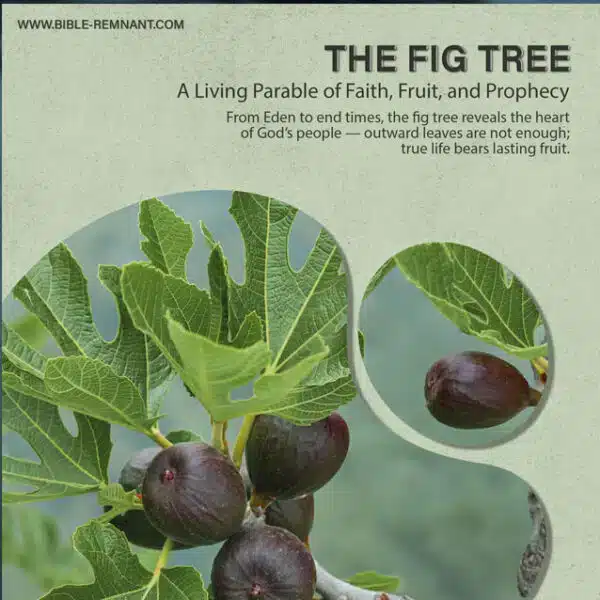
The Fig Tree in Scripture – Symbolism, Prophecy & Spiritual Lessons
Matthew 24:32–33 – “Now learn a parable of the fig tree; When his branch is yet tender, and putteth forth leaves, ye know that summer is nigh: so likewise ye, when ye shall see all these things, know that it is near, even at the doors.”
Throughout Scripture, the fig tree serves as both a warning and a witness. It represents nations, believers, and spiritual conditions — thriving when rooted in faith, but cursed when covered only in leaves. From Adam’s fig leaves in Eden to Jesus’ prophetic parable in Jerusalem, this tree stands as a living mirror of the human heart before God.
Luke 13:6–9 – “A certain man had a fig tree planted in his vineyard; and he came and sought fruit thereon, and found none.”
The fig tree’s story is more than horticulture — it’s holiness illustrated. God is the planter, His people the tree. He looks for fruit — not the appearance of religion, but the evidence of repentance. The absence of fruit reveals the tragedy of profession without power, faith without faithfulness.
The fig tree teaches us that spiritual life is measured not by leaves of outward form, but by fruit born from inward grace. And just as Jesus used it to reveal the nearness of His coming, so its lesson still calls every soul to readiness, repentance, and revival.
The Fig Tree in Eden – Covering Without Conversion
📖 Genesis 3:6–7 – “And when the woman saw that the tree was good for food… she took of the fruit thereof, and did eat, and gave also unto her husband with her; and he did eat. And the eyes of them both were opened, and they knew that they were naked; and they sewed fig leaves together, and made themselves aprons.”
🔎 The first mention of the fig tree in Scripture comes immediately after the fall of man — not as fruit for nourishment, but as leaves for covering. The fig leaves became humanity’s first attempt to deal with sin apart from God. They were the first garments of self-righteousness — outward coverings that could hide shame from one another but not from the eyes of the Lord.
📖 Isaiah 59:6 – “Their webs shall not become garments, neither shall they cover themselves with their works.”
🔎 Like the fig leaves, man’s works can never clothe the soul. Adam and Eve’s covering was a symbol of humanity’s ongoing attempt to fix what only God can restore. The leaves withered quickly — just as self-made righteousness cannot endure in the presence of holiness.
📖 Genesis 3:21 – “Unto Adam also and to his wife did the Lord God make coats of skins, and clothed them.”
🔎 God replaced their leaves with garments made through the shedding of blood — the first symbol of substitutionary sacrifice. In this act, the gospel was first preached. Humanity’s coverings (fig leaves) could only hide guilt; God’s covering (the lamb’s skin) atoned for it.
📖 Romans 3:22–23 – “Even the righteousness of God which is by faith of Jesus Christ unto all and upon all them that believe… for all have sinned.”
🔎 The fig leaves of self-effort still appear in every age — religious works, moral pride, or outward show that lack genuine surrender. But true righteousness is never sewn by human hands; it is received through faith in the blood of Christ.
💡 In Eden, the fig leaves marked the birth of self-righteousness — man’s futile attempt to stand before God without grace. Only when God provided the garment of His making was the sinner truly covered. The first covering failed, but the first sacrifice foreshadowed the cross.
📖 Revelation 3:18 – “Buy of me white raiment, that thou mayest be clothed, and that the shame of thy nakedness do not appear.”
🔎 The call to Laodicea echoes Eden’s lesson: outward religion is not enough. The fig leaves of form must be replaced with the righteousness of Christ — the only covering that lasts.
The Fig Tree and Israel – A Nation of Leaves Without Fruit
📖 Matthew 21:18–19 – “Now in the morning as he returned into the city, he hungered. And when he saw a fig tree in the way, he came to it, and found nothing thereon, but leaves only, and said unto it, Let no fruit grow on thee henceforward for ever. And presently the fig tree withered away.”
🔎 As Jesus approached Jerusalem, hungry in both body and spirit, He found a fig tree full of leaves but bearing no fruit. The leaves promised life, yet the tree was barren. This was no random act — it was a living parable. The tree represented Israel, which flourished in outward religion but lacked the inward fruit of righteousness.
📖 Luke 13:6–9 – “A certain man had a fig tree planted in his vineyard; and he came and sought fruit thereon, and found none.”
🔎 Through this parable, Christ revealed His longsuffering toward His people. God had planted Israel in the midst of the nations to bear fruit for His glory. He sent prophets — the “dresser of the vineyard” — pleading for repentance and fruit. But year after year, the nation offered leaves of profession without the fruit of obedience.
📖 Micah 7:1–2 – “Woe is me! for I am as when they have gathered the summer fruits… there is no cluster to eat: my soul desired the firstripe fruit. The good man is perished out of the earth.”
🔎 The prophets lamented the same spiritual drought. God sought a people of holiness and justice, but found corruption, pride, and hypocrisy. The fig tree — full in form but empty in substance — stood as the symbol of a people who honored God with their lips but denied Him with their lives.
📖 Matthew 23:27–28 – “Woe unto you, scribes and Pharisees, hypocrites! for ye are like unto whited sepulchres, which indeed appear beautiful outward, but are within full of dead men’s bones.”
🔎 Just as the tree had leaves but no fruit, so the religious leaders had ritual but no relationship. They offered sacrifices without surrender, prayers without purity, and worship without heart. The curse upon the fig tree was not petty punishment — it was prophecy fulfilled. Judgment had come upon a system that refused its Savior.
📖 Hosea 9:10 – “I found Israel like grapes in the wilderness; I saw your fathers as the firstripe in the fig tree at her first time.”
🔎 God had once delighted in His people — they were His firstfruits among the nations. But as idolatry and pride replaced faith and humility, the vineyard ceased to bear fruit. Jesus’ act on that final week before Calvary was a divine declaration: the season of empty religion was over; the fruitless tree would no longer stand.
💡 The withered fig tree stood as a warning — not only to Israel, but to every generation of believers. A church full of activity but lacking repentance is a tree full of leaves but without fruit. The form may look alive, but without abiding in Christ, it will wither from the roots.
📖 John 15:5–6 – “I am the vine, ye are the branches… he that abideth in me, and I in him, the same bringeth forth much fruit: for without me ye can do nothing.”
🔎 The secret of fruitfulness has never changed. Religion produces leaves; relationship produces fruit. The same Christ who judged the barren tree still looks for fruit in His vineyard today — fruit of repentance, love, obedience, and faith.
💡 Israel’s story is both a warning and a prophecy: those who bear only the appearance of faith will wither, but those who abide in the Living Vine will flourish eternally.
The Fig Tree and the Believer – Fruit That Remains
📖 John 15:5 – “I am the vine, ye are the branches: He that abideth in me, and I in him, the same bringeth forth much fruit: for without me ye can do nothing.”
🔎 The fig tree’s parable reaches its deepest meaning in the heart of every believer. The Lord does not seek leaves of appearance, but fruit of transformation. Faith without fruit is like a tree without life — beautiful to look at, but hollow within. To bear fruit, we must abide in Christ, the true Source of nourishment and growth.
📖 Luke 6:43–44 – “For a good tree bringeth not forth corrupt fruit… For every tree is known by his own fruit.”
🔎 True faith produces visible change. The fruits of repentance are not empty words or emotional moments — they are the character traits of Christ reproduced in us by the Holy Spirit: love, patience, humility, faith, and obedience. Leaves can deceive, but fruit reveals the root.
📖 Galatians 5:22–23 – “But the fruit of the Spirit is love, joy, peace, longsuffering, gentleness, goodness, faith, meekness, temperance.”
🔎 This is the harvest God desires — not religious performance, but inner renewal. The fruit of the Spirit grows only where the self is crucified. When pride and sin are pruned away, the life of Christ begins to blossom in the soul. That is why the Gardener sometimes cuts, digs, and disciplines — not to destroy, but to bring forth more fruit (John 15:2).
📖 Matthew 7:19–20 – “Every tree that bringeth not forth good fruit is hewn down, and cast into the fire. Wherefore by their fruits ye shall know them.”
🔎 God’s judgment is not based on profession, but on productivity. The barren fig tree was cursed because it bore no fruit despite years of divine patience. Likewise, every believer is called to yield evidence of spiritual life — not perfection, but direction; not performance, but persistence in faith.
📖 James 2:17 – “Even so faith, if it hath not works, is dead, being alone.”
🔎 The fruit of obedience is not a replacement for grace — it is the proof of grace. Works do not save us, but they reveal whether the life of Christ truly flows within. The Spirit that saves also sanctifies, and the faith that justifies also bears fruit that glorifies God.
📖 Psalm 1:3 – “He shall be like a tree planted by the rivers of water, that bringeth forth his fruit in his season; his leaf also shall not wither.”
🔎 The rooted believer does not fear drought or storm. Nourished by the Living Water, he bears fruit in every season — patience in trial, humility in success, endurance in persecution, and joy in sorrow. While many trees around him wither in worldliness, he remains green in grace.
💡 The fig tree’s lesson to every soul is simple but searching: God is not impressed by foliage — He is looking for fruit.
The leaves of attendance, titles, or ministry mean little if there is no inner life of the Spirit. To bear fruit that remains, we must remain in Christ. The sap of His Spirit must flow through every branch of our being.
📖 John 15:8 – “Herein is my Father glorified, that ye bear much fruit; so shall ye be my disciples.”
🔎 Fruitfulness is not optional for the disciple — it is the evidence of true discipleship. Every act of love, every moment of forgiveness, every word that draws another to Christ — these are eternal fruits that will never fade. The fig tree teaches that a life rooted in Christ will always flourish, even when the world’s season grows dark.
The Fig Tree as a Prophetic Sign – The End-Time Generation and Spiritual Awakening
📖 Matthew 24:32–33 – “Now learn a parable of the fig tree; When his branch is yet tender, and putteth forth leaves, ye know that summer is nigh: so likewise ye, when ye shall see all these things, know that it is near, even at the doors.”
🔎 Jesus spoke this parable during His great prophetic discourse on the Mount of Olives. Just as budding leaves signaled that summer was near, so the signs of the end — wars, deception, moral decay, and gospel proclamation — signal that His coming is close. But the fig tree itself carries a deeper prophetic meaning.
📖 Jeremiah 24:5–6 – “Thus saith the Lord, the God of Israel; Like these good figs, so will I acknowledge them that are carried away captive of Judah… for I will set mine eyes upon them for good, and I will bring them again to this land.”
🔎 In the Old Testament, Israel was repeatedly symbolized by the fig tree. When Jesus referred to its budding in Matthew 24, He hinted at the restoration of Israel — both nationally and spiritually. The rebirth of the nation in the 20th century stands as a remarkable fulfillment of prophecy, a visible sign that we live in the season of “the fig tree putting forth leaves.”
📖 Romans 11:25–27 – “Blindness in part is happened to Israel, until the fulness of the Gentiles be come in. And so all Israel shall be saved…”
🔎 The budding fig tree is more than political restoration — it points to spiritual awakening. The Lord will once again turn His mercy toward Israel, grafting them back into the olive tree of faith. The dry branches that once withered will live again, not through national pride but through repentance and faith in Christ, the true Messiah.
📖 Luke 21:29–31 – “Behold the fig tree, and all the trees; When they now shoot forth, ye see and know of your own selves that summer is now nigh at hand.”
🔎 Jesus added “and all the trees,” showing that while Israel’s restoration is central, it is also symbolic of a global spiritual awakening. In the final generation, the Holy Spirit will stir nations and individuals alike — reviving the true faith that bears fruit even in a dying world. The fig tree’s tender branches represent a new season of grace, repentance, and revival before the harvest.
📖 Joel 1:12 – “The vine is dried up, and the fig tree languisheth… because joy is withered away from the sons of men.”
🔎 The world today mirrors this prophetic picture — joyless religion, fruitless faith, and moral drought. Yet God is still calling His people to revival, to return to the Vine before it is too late. The fig tree’s budding reminds us that the time for harvest is near — the final call before the King returns.
📖 Mark 13:28–29 – “When ye see these things come to pass, know that it is nigh, even at the doors.”
🔎 Christ’s words echo through time with urgency. The buds of prophecy are blooming all around us — the rebirth of Israel, the rise of false prophets, the shaking of nations, and the global spread of the everlasting gospel. We are the generation standing beneath the budding fig tree.
💡 The message of the fig tree is twofold: The signs declare that Christ’s coming is near, and the Spirit calls His people to bear fruit before He arrives. The fig tree of prophecy is budding — but God still searches for fruit among His people.
📖 Revelation 22:12 – “And, behold, I come quickly; and my reward is with me, to give every man according as his work shall be.”
🔎 The season is short, the signs are clear, and the call is urgent: wake up, bear fruit, and abide in the Vine. The same Jesus who cursed the barren tree now calls His church to spiritual life before the harvest of the earth begins.
The Fig Tree in Prophecy and Judgment – The Shaking Before the Harvest
📖 Revelation 6:13 – “And the stars of heaven fell unto the earth, even as a fig tree casteth her untimely figs, when she is shaken of a mighty wind.”
🔎 John’s vision in Revelation connects the fig tree to the final shaking. The untimely figs — those not yet ripened by the Sun of Righteousness — represent souls unprepared for the coming storm. When the winds of trial blow, false professions will fall away. The branches that looked alive will be stripped bare, revealing the true condition of every heart.
📖 Joel 1:12 – “The vine is dried up, and the fig tree languisheth; the pomegranate tree, the palm tree also… because joy is withered away from the sons of men.”
🔎 This prophecy mirrors the state of the end-time world — a spiritual drought so severe that even God’s vineyard appears barren. The fruit of righteousness withers in a generation distracted by pleasure and pride. Yet amid that drought, God still calls His remnant to repentance and revival before the harvest.
📖 Luke 21:29–31 – “Behold the fig tree, and all the trees; When they now shoot forth, ye see and know of your own selves that summer is now nigh at hand.”
🔎 Christ’s parable reminds us that before every harvest comes a shaking — the breaking of branches and the separation of fruit from foliage. In prophetic language, “summer” represents the harvest of souls at the end of the age. The tender leaves symbolize renewal, but the shaking reveals what is real.
📖 Jeremiah 8:13 – “I will surely consume them, saith the Lord: there shall be no grapes on the vine, nor figs on the fig tree, and the leaf shall fade.”
🔎 Jeremiah’s lament captures the sorrow of divine judgment. God’s patience is long, but not endless. When His people persist in rebellion, He removes His protective presence. The fading leaves symbolize a church that once appeared alive but no longer bears the fruit of repentance.
📖 Haggai 2:19 – “Is the seed yet in the barn? yea, as yet the vine, and the fig tree, and the pomegranate, and the olive tree, hath not brought forth: from this day will I bless you.”
🔎 Even in judgment, mercy speaks. God still promises renewal to those who repent. The barren fig tree can bloom again if it is rooted anew in faith. The same Lord who cursed the tree of hypocrisy offers blessing to the tree of humility. Before the final harvest, the Gardener gives one last season of grace to produce fruit.
📖 Matthew 24:33–34 – “So likewise ye, when ye shall see all these things, know that it is near, even at the doors. Verily I say unto you, This generation shall not pass, till all these things be fulfilled.”
🔎 The final fig tree generation is living now — a world that has seen Israel restored, prophecy fulfilled, and truth proclaimed to the ends of the earth. But with knowledge comes accountability. The last generation will either bear the fruit of righteousness or fall as untimely figs when the shaking begins.
💡 The fig tree’s final lesson is this: every harvest ends with separation. The shaking is not to destroy the faithful, but to reveal them. When the winds of trial come, the true fruit of the Spirit will remain — humble, steadfast, and rooted in Christ.
📖 Revelation 14:15 – “Thrust in thy sickle, and reap: for the time is come for thee to reap; for the harvest of the earth is ripe.”
🔎 The world’s harvest is near. Every life is a branch on the tree of time — either bearing fruit unto eternal life or drying up under the weight of unbelief. The shaking is coming, but those who abide in Christ will not fall; their roots reach into the Living Water.
💡 The fig tree began in Eden as man’s covering of shame — it will end in Revelation as the measure of readiness. Only those clothed in the righteousness of Christ and bearing His fruit will stand when the storm has passed.
Final Reflection – Bearing Fruit Before the Harvest
📖 Luke 13:6–9 – “A certain man had a fig tree planted in his vineyard; and he came and sought fruit thereon, and found none… Then said he unto the dresser of his vineyard, Behold, these three years I come seeking fruit on this fig tree, and find none: cut it down; why cumbereth it the ground?”
🔎 The patient Gardener still walks among His vineyard today, looking for fruit among the trees He has nurtured. His mercy delays the axe, giving time for repentance. But time is not infinite — the final harvest draws near. Every believer, every nation, every church is being examined for fruit that testifies of life within.
📖 John 15:8 – “Herein is my Father glorified, that ye bear much fruit; so shall ye be my disciples.”
🔎 The purpose of grace is growth. Christ did not redeem us to remain barren, but to bear the fruits of righteousness — love that endures, faith that acts, and obedience that reflects His character. The barren tree shows that proximity to the vineyard is not enough; we must be rooted in the Vine Himself.
📖 Matthew 7:17–20 – “Even so every good tree bringeth forth good fruit… Wherefore by their fruits ye shall know them.”
🔎 The test of discipleship is not how high we grow, but what we bear. Leaves are impressive to men; fruit is precious to God. The fig tree warns us that it is possible to look alive while spiritually dead — to have the form of godliness but deny the power thereof.
📖 Revelation 22:2 – “And the leaves of the tree were for the healing of the nations.”
🔎 In the New Earth, trees will bear fruit every month — not to cover shame, but to heal what sin has broken. The contrast is divine poetry: the fig leaves of man’s failure replaced by the leaves of God’s restoration. What began in Eden’s fall will end in Heaven’s fullness.
📖 Galatians 6:8–9 – “For he that soweth to his flesh shall of the flesh reap corruption; but he that soweth to the Spirit shall of the Spirit reap life everlasting. And let us not be weary in well doing: for in due season we shall reap, if we faint not.”
🔎 The faithful will soon see their fruit ripen in glory. Each act of faith, each seed of kindness, each tear sown in prayer — all will be gathered by the hand of the Master. The final shaking will not destroy them; it will display them. Their roots go deep into the Living Water, and their branches stretch toward the coming Light.
📖 Philippians 1:11 – “Being filled with the fruits of righteousness, which are by Jesus Christ, unto the glory and praise of God.”
🔎 The true measure of righteousness is not in words or appearance, but in the fruit that only Christ can produce through a surrendered life. The fig tree that once withered in judgment will never again stand in God’s vineyard — but every redeemed soul will become a tree of life, bearing fruit forever in the presence of the Lamb.
📌 The fig leaves of Eden remind us: self-righteousness cannot save.
📌 The withered tree of Israel reminds us: profession without fruit ends in judgment.
📌 The budding fig tree of prophecy reminds us: the Lord’s return is near.
💡 The lesson is clear — the time to bear fruit is now. Let the Gardener prune, water, and shape your heart until your life reflects His nature. For soon, the harvest will come, and the cry will sound across eternity:
📖 Revelation 22:12 – “Behold, I come quickly; and my reward is with me, to give every man according as his work shall be.”
🕊️ May the Spirit find in us not the leaves of outward form, but the living fruit of inward faith. When the winds blow and the shaking begins, may our roots hold firm — for the true fig tree, planted by grace and nourished by truth, will stand forever in the garden of God. 🌿