
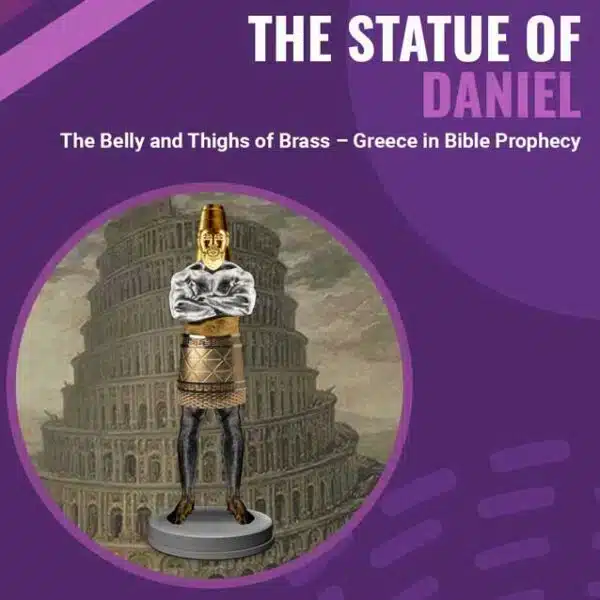
The Statue of Daniel — Belly and Thighs of Brass
Greece, represented by brass, reflects a kingdom of unmatched intellect, philosophy, and cultural influence. It was fast, fierce, and foundational in shaping the world’s way of thinking—but it was also flawed by pride, idolatry, and human reasoning over divine truth.
📖 1 Corinthians 1:22-24 – “For the Jews require a sign, and the Greeks seek after wisdom:
The Dream That Revealed Empires
📖 Daniel 2:31-33 – “Thou, O king, sawest, and behold a great image. This great image, whose brightness was excellent, stood before thee; and the form thereof was terrible. This image’s head was of fine gold, his breast and his arms of silver, his belly and his thighs of brass.”
🔎 In one divine moment, God unveiled the course of human history through a dream given to a pagan king. This was not just a political forecast—it was a spiritual map. Each material of the statue represented the rise and fall of empires, yet more importantly, it revealed the spiritual character of each kingdom. From Babylon’s prideful glory to Rome’s iron-fisted cruelty, the image was not only terrifying in appearance—it was terrifying in meaning.
🔹 God alone ordains kingdoms. Nebuchadnezzar was told that it was the “God of heaven” who had given him the kingdom (Daniel 2:37). No empire rises or falls without God’s knowledge. The dream was a reminder that earthly power is temporary, but divine authority is eternal.
🔹 Each empire builds on the last—but declines in value. From gold to iron mixed with clay, we see a progression not of strength, but of spiritual corruption. Though military power may increase, moral and spiritual integrity degrade. This is the signature of human government apart from God.
🔹 The stone cut without hands (📖 Daniel 2:34-35) will shatter them all. At the end of time, Christ’s kingdom will destroy the statue—not refine it. The kingdoms of this world are destined to fall. God is not reforming Babylon, Persia, Greece, or Rome—He’s replacing them with a kingdom that shall never pass away.
Historical Snapshot – The Empire of Greece
📍 Capital: Pella (later, Alexandria)
📆 Reign: c. 331–168 BC
⚔️ Notable Leader: Alexander the Great
🎓 Legacy: Birthplace of Western philosophy, classical education, and artistic influence
🌐 Expansion: Conquered vast territory from Greece to India in under a decade
📜 Language: Koine Greek became the international language, paving the way for the spread of the Gospel
🔥 Greece’s legacy wasn’t only in military triumphs—it was in ideas. Its influence outlived its rulers, shaping culture, education, and theology for centuries.
The Rise of Reason – Exalting Human Wisdom
📖 1 Corinthians 1:22-23 – “For the Jews require a sign, and the Greeks seek after wisdom: But we preach Christ crucified…”
🔎 As the third kingdom in Daniel’s prophecy, Greece brought with it more than conquest—it brought a cultural revolution. Where Babylon glorified splendor and Persia enforced law, Greece exalted the mind. Under Alexander the Great, the Greek Empire spread Hellenistic philosophy, science, and humanistic thought to every corner it touched. Athens, once a city of idols (Acts 17:16), became the seedbed of worldly wisdom and intellectual pride.
🔹 A Kingdom of Conquest and Culture – Alexander conquered faster than any before him. By age 32, he ruled from Macedonia to India. But it was what followed that mattered most: the infusion of Greek language, education, and thought into global society. Greek replaced God as the source of truth in many minds.
🔹 The Mind Became a God – Socrates, Plato, Aristotle—brilliant men, but flawed guides. They taught that reason alone could reach truth, and man could find answers apart from divine revelation. This elevated logic above faith, and philosophy above prophecy.
🔹 Paul Confronted It Directly – In Athens, Paul stood before the intellectual elite and declared their “unknown god” was the true Creator (Acts 17:22-31). Yet they mocked the resurrection—because human reason cannot grasp spiritual truth apart from the Spirit.
🔹 Why It Matters Today – The belly of brass lives on in universities, media, and secular theology. We still bow to logic, science, and debate more than to prayer, prophecy, or obedience. Many believe intelligence replaces revelation—but God says, “The wisdom of this world is foolishness with God” (1 Corinthians 3:19).
Prophetic Symbolism – The Leopard with Four Wings
📖 Daniel 7:6 – “After this I beheld, and lo another, like a leopard, which had upon the back of it four wings of a fowl; the beast had also four heads; and dominion was given to it.”
🔎 In Daniel’s vision of the beasts, the Greek empire was pictured as a leopard with four wings and four heads—a fitting symbol for a kingdom known for speed, precision, and fragmentation. Just as the belly and thighs of brass represented Greece in Nebuchadnezzar’s dream, this beast gave deeper spiritual insight into its character and legacy.
🔹 The Leopard – Swift and Strategic
Leopards are not just fast—they are stealthy hunters. Alexander the Great swept across the world stage like a storm, defeating the Persians in just a few years and never losing a battle. His conquest was sudden, shocking, and surgical. The leopard symbol reflects the rapid rise of Greece’s dominance.
🔹 Four Wings – Unmatched Speed
Wings represent swiftness, and four wings double the intensity. Alexander’s campaign moved faster than any empire before him. With a brilliant combination of military genius and relentless ambition, he created one of the largest empires in history in under a decade.
🔹 Four Heads – A Divided Legacy
When Alexander died unexpectedly at the age of 32, his empire fractured. Four of his generals divided the kingdom:
– Cassander (Macedonia)
– Lysimachus (Thrace & Asia Minor)
– Seleucus (Babylon/Syria)
– Ptolemy (Egypt)
This division fulfilled the prophecy of the four heads—one beast, multiple rulers, each playing a role in future biblical history (especially in the story of Israel and the rise of Rome).
🔹 Symbolic Message – Fast, Brilliant… but Divided
Though brilliant, Greece was built on fragile unity. Its core was philosophical strength, but its foundation lacked the eternal rock of truth. The leopard’s power was temporary. Its influence still lingers today in modern science, education, and worldview, but like the beast itself—it remains earthbound and destined to fall.
Final Warning – When Knowledge Becomes a God
📖 1 Corinthians 8:1 – “Knowledge puffeth up, but charity edifieth.”
🔎 The Greek empire was crowned not only with conquest—but with intellectual pride. Philosophy, science, art, and logic became the pillars of Greek thought. Men like Plato, Socrates, and Aristotle were revered not just as thinkers—but as near-prophets of reason. Greece showed us what happens when the mind is exalted above the Spirit.
🔹 Knowledge Without God Breeds Arrogance
The danger of Greek influence wasn’t knowledge itself—but the worship of it. When man begins to trust in his own wisdom more than God’s Word, he falls into the same deception that led to Eden’s fall: “Ye shall be as gods, knowing…” (Genesis 3:5). Knowledge apart from love and truth puffs up—it does not heal, redeem, or restore.
🔹 Modern Parallels – The New Temples of Academia
Today, universities and scientific institutions often mirror ancient Athens. Truth is subjective. Faith is mocked. Morality is fluid. And the pursuit of knowledge has become a god unto itself. But no amount of data can save the soul. No discovery can erase sin. No philosophy can replace the cross.
🔹 The Remnant Will Be Called Fools
Just as Paul faced ridicule in Athens (Acts 17:18–32), those who speak God’s truth today are labeled backward, uneducated, cult members, or extreme. But in heaven’s eyes, it is the fool who says in his heart, ‘There is no God’ (Psalm 14:1). The wisdom of this world is foolishness with God (1 Corinthians 3:19).
🔹 The True Fear of the Lord
📖 Proverbs 9:10 – “The fear of the Lord is the beginning of wisdom: and the knowledge of the holy is understanding.” Greece had knowledge, but it lacked fear. It had brilliance, but no reverence. And so it fell—like every empire that builds on sand instead of stone.
Final Reflection – When Brilliance Isn’t Enough
📖 Matthew 11:25 – “I thank thee, O Father… because thou hast hid these things from the wise and prudent, and hast revealed them unto babes.”
🔎 Greece dazzled the world with brilliance—but brilliance alone cannot save. The story of the belly and thighs of brass is more than history—it’s a spiritual mirror. God is not impressed by intellect, empires, or eloquence. He looks for humility, obedience, and faith.
🔹 Wisdom is good—but not when it replaces the Word.
Greece reminds us that when education and reasoning become divorced from spiritual truth, they become tools of deception. The human mind, without the Spirit, will always invent gods in its own image.
🔹 God chooses the humble.
The same Lord who confounded the philosophers with the simplicity of the gospel (1 Corinthians 1:27) is still doing so today. He does not need the mighty—He uses the meek.
🔹 Brilliance can blind—but truth opens eyes.
The Greeks sought knowledge; the Jews sought signs—but few sought Christ. Today, the same temptations exist: signs, science, and self. But truth still comes by hearing—and hearing by the Word of God (Romans 10:17).
📌 What have you built your faith upon—your reasoning or His revelation?
📌 Do you trust in your education—or in His eternal Word?
📌 Will you follow the world’s wisdom—or walk by the Spirit of truth?
Greece in Focus – Historical and Biblical Insights
🔹 Alexander the Great conquered the known world by age 30, demonstrating the speed and reach of Greece’s military might—reflected prophetically by the leopard with wings (Daniel 7:6).
🔹 Greek became the universal language of the empire, laying the groundwork for the New Testament to be written and spread across the world with rapid impact.
🔹 Philosophers like Socrates, Plato, and Aristotle shaped Western thought, exalting reason, ethics, and human potential above divine revelation—fueling the very mindset Paul later confronted (Acts 17:22-23).
🔹 Greece was fractured into four kingdoms after Alexander’s death, exactly as foretold by prophecy (Daniel 8:8). These four horns or divisions would battle for power, ushering in future empires.
🔹 The Hellenization of the world influenced religion, education, and culture, leaving a legacy that persists even in modern systems of thought, architecture, and governance.
🔹 Antiochus IV Epiphanes, one of the later Greek rulers, desecrated the temple in Jerusalem, foreshadowing the abomination of desolation and setting patterns that Revelation would later echo.
Prophetic Bridge – From Greece to Rome
📖 Daniel 2:40 – “And the fourth kingdom shall be strong as iron: forasmuch as iron breaketh in pieces and subdueth all things…”
🔎 As Greece fractured and declined, Rome rose—not just with military power, but with administrative order, legal systems, and roads that connected the ancient world. This transition wasn’t just geopolitical—it was prophetically appointed.
🔹 The iron legs of the statue follow the belly and thighs of brass (Greece), symbolizing a harder, more brutal world power. Where Greece ruled by philosophy and culture, Rome ruled by force and law.
🔹 Rome absorbed Greek culture but intensified control, merging philosophical traditions with political absolutism. This iron rule would set the stage for both the birth of Christ and the rise of spiritual Babylon later prophesied in Revelation.
🔹 Prophecy tracks continuity, not just of empires, but of the spirit of rebellion and exaltation. From Babylon’s pride to Greece’s exaltation of reason, and now to Rome’s legal tyranny, the statue becomes clearer with every layer.
🔥 Greece’s fall was not the end—Rome would take the stage next, fulfilling the next phase of Daniel’s vision and setting the foundation for the end-time system we are warned to avoid.
A Closing Prayer – A Mind Surrendered to Christ
Heavenly Father,
I come before You not in the strength of my intellect, but in the weakness of my heart—longing to know truth, not just facts. Let not the wisdom of this world blind me to the wisdom that comes from above. Cleanse my thoughts, purify my motives, and renew my mind.
Where I have trusted in reasoning more than revelation, forgive me. Where I have leaned on philosophy instead of prophecy, correct me. I surrender my mind to You—let it be filled with the knowledge of Christ, who is the wisdom of God and the power of God.
Help me not to follow the crowd or worship human ideas, but to follow the Lamb wherever He goes. May I seek truth above applause, and righteousness over recognition. Let my thoughts be held captive to Christ alone.
In Jesus’ holy name,
Amen.