
From Eden’s garden to Calvary’s cross and into the New Jerusalem, trees are more than background—they tell the story of redemption. Each tree in Scripture carries a message: life, choice, covenant, judgment, and restoration. In their roots, branches, and fruit, God has written eternal truths that reveal His plan for humanity and point us back to Christ, the Tree of Life.
Biblical Symbolism of Trees – From Eden to Eternity
From the first pages of Genesis to the final chapters of Revelation, trees stand as more than mere scenery—they are living symbols woven into God’s story of redemption. The Bible presents trees as witnesses of choice in Eden, markers of covenant on the mountains, instruments of judgment, and symbols of eternal life in the New Jerusalem.
📖 Proverbs 3:18 – “She is a tree of life to them that lay hold upon her: and happy is every one that retaineth her.”
🔎 Trees represent more than growth—they mirror the human soul, reflect God’s covenant, and point to Christ Himself. In this study, we will uncover their meaning, trace their prophetic role, and see how even false systems have tried to counterfeit their eternal promise.
This journey will reveal:
🌿 The Tree of Life – symbol of God’s gift of immortality.
🌿 The Tree of Knowledge of Good and Evil – the test of obedience.
🌿 The Fig Tree, Olive Tree, and Vine – powerful pictures of Israel and God’s people.
🌿 The Cross as a Tree – the ultimate reversal of Eden’s curse.
🌿 The Tree of Life in Revelation – God’s eternal plan restored.
🌿 Counterfeit Trees – how Satan mimics immortality and divine presence.
By the Spirit’s leading, we will see that trees in the Bible are not background details—they are prophetic symbols of choice, covenant, judgment, and everlasting life.
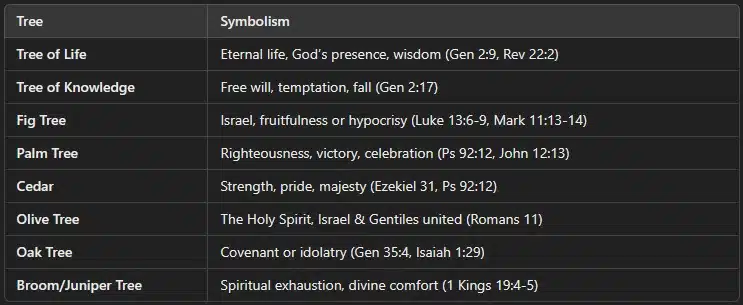
Symbolic Meaning – Quick Reference

The Tree of Life – God’s Gift of Eternal Communion
📖 Genesis 2:9 – “And out of the ground made the LORD God to grow every tree that is pleasant to the sight, and good for food; the tree of life also in the midst of the garden…”
🔎 The Tree of Life stood in Eden as more than just a physical plant—it was the visible sign of eternal life flowing directly from God. Eating from it meant communion with the Creator, sustained by His presence. When Adam and Eve sinned, they lost access to this tree, and by extension, to eternal life in their own strength.
📖 Genesis 3:22–24 – “And now, lest he put forth his hand, and take also of the tree of life, and eat, and live for ever: therefore the LORD God sent him forth from the garden of Eden… So he drove out the man; and he placed at the east of the garden of Eden Cherubims, and a flaming sword… to keep the way of the tree of life.”
🔎 This reveals something profound: eternal life is not inherent to man—it is a gift maintained by God’s presence. When man sinned, God in mercy barred the way. If they had eaten while in rebellion, they would have lived forever in sin—a nightmare of unending corruption.
But God never abandoned the plan. The Tree of Life reappears at the end of the story.
📖 Revelation 22:2 – “In the midst of the street of it, and on either side of the river, was there the tree of life, which bare twelve manner of fruits… and the leaves of the tree were for the healing of the nations.”
🔎 What was lost in Eden will be restored in the New Jerusalem. Access to the Tree of Life is restored, but only through the blood of Christ. In fact, the Cross itself can be seen as the true Tree of Life—for it is there Christ gave His life so that we might live forever.
📖 Acts 5:30 – “The God of our fathers raised up Jesus, whom ye slew and hanged on a tree.”
🌳 The Tree of Life teaches us that immortality is only in Christ (1 John 5:11). Man searches for fountains of youth, secret wisdom, or self-salvation, but true eternal life is a gift given only to those who abide in Him.
The Tree of Knowledge of Good and Evil – The Test of Love and Loyalty
📖 Genesis 2:17 – “But of the tree of the knowledge of good and evil, thou shalt not eat of it: for in the day that thou eatest thereof thou shalt surely die.”
🔎 Unlike the Tree of Life, this tree was not about nourishment but about choice. God placed it in Eden to give man the opportunity to exercise free will—obedience born of love, not force. Without the possibility of disobedience, true love could not exist.
📖 Genesis 3:6 – “And when the woman saw that the tree was good for food, and that it was pleasant to the eyes, and a tree to be desired to make one wise, she took of the fruit thereof, and did eat…”
🔎 Here lies the tragedy of the human story. The temptation was not hunger but distrust of God’s Word. Satan painted God as withholding something good, and Adam and Eve chose independence over trust. By reaching for the fruit, man grasped for wisdom apart from God and plunged the world into sin.
The New Testament explains the consequence clearly:
📖 Romans 5:12 – “Wherefore, as by one man sin entered into the world, and death by sin; and so death passed upon all men, for that all have sinned.”
🔎 This tree reminds us that every soul faces the same test: will we trust God’s Word, or believe the serpent’s lies?
But praise God—the second Adam, Jesus Christ, faced the test and overcame.
📖 Philippians 2:8 – “And being found in fashion as a man, he humbled himself, and became obedient unto death, even the death of the cross.”
🔎 Where the first Adam reached for forbidden fruit, the second Adam surrendered Himself upon a tree to undo the curse. The Cross is the reversal of Eden’s failure.
🌳 The Tree of Knowledge of Good and Evil shows us that true freedom is not the right to sin, but the power to obey. It is a reminder that the path of life comes only through trusting God’s voice above all else.
The Olive Tree – Covenant People and Spirit Anointing
📖 Romans 11:17 – “And if some of the branches be broken off, and thou, being a wild olive tree, wert grafted in among them, and with them partakest of the root and fatness of the olive tree.”
🔎 The olive tree is one of the most enduring biblical symbols of God’s covenant people. Israel is pictured as the cultivated tree, but branches were broken off through unbelief, making room for Gentiles to be grafted in by faith. This shows the beauty of God’s plan—one family of believers, rooted in Christ, nourished by His promises.
📖 Jeremiah 11:16 – “The LORD called thy name, A green olive tree, fair, and of goodly fruit…”
🔎 The olive tree also yields oil—an emblem of the Holy Spirit. The anointing oil that consecrated priests and kings, the lamps of the tabernacle that burned continually, all pointed to the Spirit’s power flowing through God’s people. Without the oil, the tree is lifeless; without the Spirit, the church is powerless.
📖 Zechariah 4:11–12 – “What be these two olive branches… which through the two golden pipes empty the golden oil out of themselves?”
🔎 This vision links the olive tree with God’s supply of Spirit to accomplish His work—not by might, nor by power, but by His Spirit.
🌳 The Olive Tree reminds us that salvation is not about heritage, but about connection to the Root—Christ Himself. Grafted in by faith, we bear fruit by the Spirit’s oil, shining light into a dark world.
The Fig Tree – Outward Show or True Fruit
📖 Matthew 21:19 – “And when he saw a fig tree in the way, he came to it, and found nothing thereon, but leaves only, and said unto it, Let no fruit grow on thee henceforward for ever. And presently the fig tree withered away.”
🔎 The fig tree often symbolizes Israel, but more broadly it represents religion without fruit. A leafy tree looks alive, yet if it bears no figs, it is useless. Jesus cursed the barren tree as a living parable—outward profession without inward transformation cannot stand before God.
📖 Jeremiah 8:13 – “I will surely consume them, saith the LORD: there shall be no grapes on the vine, nor figs on the fig tree, and the leaf shall fade…”
🔎 This is a sobering reminder: God looks for fruit, not foliage. Leaves may deceive people, but God searches the heart. The fruit He desires is repentance, obedience, and the likeness of Christ in daily life.
📖 Luke 13:6–9 – “Behold, these three years I come seeking fruit on this fig tree, and find none: cut it down; why cumbereth it the ground?”
🔎 The parable of the barren fig tree shows God’s patience—He gives time, nourishment, and opportunity for fruit to grow. But if after all this, there is still none, judgment follows.
🌳 The fig tree challenges us to examine our walk. Are we showing only leaves—appearance, tradition, and words? Or are we producing the fruit of the Spirit that reveals true life in Christ?
The Cedar of Lebanon – Strength Rooted in God
📖 Psalm 92:12 – “The righteous shall flourish like the palm tree: he shall grow like a cedar in Lebanon.”
🔎 Cedars of Lebanon were known for their height, strength, and endurance. Their wood was prized for temple building (1 Kings 6:9–10), symbolizing permanence and holiness. Just as cedars stood tall and unshaken by storms, the righteous who are rooted in God’s presence remain steadfast through trials.
📖 Ezekiel 31:3 – “Behold, the Assyrian was a cedar in Lebanon with fair branches… and his top was among the thick boughs.”
🔎 Assyria was compared to a towering cedar—but pride brought its downfall, showing that strength without humility collapses. Cedars can represent both the righteous flourishing under God’s care (Psalm 92:13) and the mighty who fall when they trust in themselves.
📖 Hosea 14:5–6 – “He shall grow as the lily, and cast forth his roots as Lebanon. His branches shall spread, and his beauty shall be as the olive tree, and his smell as Lebanon.”
🔎 When God restores His people, He makes them like cedars—firm, fruitful, and fragrant. Their lives become a testimony of stability and holiness in a world of shifting sands.
🌳 The cedar teaches us that spiritual growth is not about outward size or influence but deep roots in God’s presence. Pride topples, but humility strengthens.
The Mustard Seed/Tree – From Small Beginnings to Great Harvest
📖 Matthew 13:31–32 – “The kingdom of heaven is like to a grain of mustard seed, which a man took, and sowed in his field: which indeed is the least of all seeds: but when it is grown, it is the greatest among herbs, and becometh a tree, so that the birds of the air come and lodge in the branches thereof.”
🔎 The mustard seed, though tiny, grows into a tree large enough to provide shelter. This illustrates how God’s kingdom starts small—Christ’s humble birth, a few disciples, a cross of shame—but grows into a global movement bringing hope and refuge to the nations.
📖 Zechariah 4:10 – “For who hath despised the day of small things?”
🔎 God delights in starting with what looks insignificant. He multiplies the seed of faith, turning it into a testimony that draws others to Himself. What begins as a whisper of truth grows into a great witness across the world.
📖 Acts 1:8 – “Ye shall be witnesses unto me both in Jerusalem, and in all Judaea, and in Samaria, and unto the uttermost part of the earth.”
🔎 The mustard tree foreshadows the church’s expansion. From one seed—the risen Christ—the gospel branches out to cover the earth, offering shelter and salvation.
🌳 What looks small in your life—your prayers, your faith, your obedience—can grow into something mighty if entrusted to God. His kingdom is not measured by size at the start but by the fruit and refuge it produces in the end.
When Trees Point the Wrong Way – The Battle Over Symbols
From the beginning, trees have been more than wood and leaves—they’ve been sacred markers of life, covenant, and eternal destiny. That’s why Satan has always sought to hijack them. If God plants a tree to symbolize His truth, the enemy plants a counterfeit to deceive.
📖 Genesis 3:22 – “And now, lest he put forth his hand, and take also of the tree of life, and eat, and live for ever…”
🔎 Satan has always been a counterfeiter. What God designed as a holy symbol, the enemy twists into a false promise. From Eden until today, trees have been used not only as symbols of life and covenant—but also as tools of deception in paganism, mysticism, and false religion.
The Tree of Life — Counterfeited in False Immortality
In Eden, the Tree of Life represented eternal life with God through obedience. After sin, God blocked man’s access (Genesis 3:22). But Satan replaced it with counterfeits—mystery religions of Egypt and Babylon, occult teachings of hidden knowledge, and New Age doctrines promising “ascension” or “inner godhood.” ❌ All of these offer immortality without repentance or Christ.
The Evergreen Tree — Pagan Fertility & Sun Worship
Evergreens, which never shed their leaves, became symbols of immortality and power in pagan worship. Babylonians, Norse peoples, and others decorated them in solstice rituals tied to the rebirth of the sun. This led to Asherah poles, sacred groves, and eventually traditions like the modern Christmas tree.
📖 Jeremiah 10:3–4 warns of these practices: “One cutteth a tree… they deck it with silver and with gold.”
Sacred Trees in Pagan Religions
Nearly every false religion has its “world tree”:
🌳 Yggdrasil in Norse mythology.
🌳 Bodhi tree of Buddhism.
🌳 Druidic oaks of Celtic worship.
🌳 Spiritual trees in African and Native traditions.
📖 Deuteronomy 12:2–3 – God commanded Israel to destroy such groves. These trees became symbols of access to the divine—without the cross, without Christ.
Trees in Witchcraft & New Age Practices
Wicca, witchcraft, and New Age movements often use tree imagery in rituals, spells, and teachings of “universal connection.” They call humanity “branches of the divine” apart from Christ.
📖 John 15:5 – “Without me, ye can do nothing.”
The Modern Repackaging — Eco-Spirituality
Today, tree symbolism has been woven into global religion and climate spirituality. Earth worship, Gaia doctrines, and the “green gospel” place creation above the Creator.
📖 Romans 1:25 – “They worshipped and served the creature more than the Creator…”
🌳 The True Tree Was a Cross — The first sin was tied to a tree in Eden. Redemption came through a tree at Calvary. Restoration will come at the Tree of Life in eternity (Revelation 22:14). Satan may twist the symbol, but every true “tree of life” belongs to God.
Christ the True Tree
Every tree in Scripture points us to Christ. Where Adam fell under a tree, Jesus triumphed upon one. Where nations exalt themselves like proud cedars, Christ stooped low in humility, becoming obedient even unto death—death on a tree (Philippians 2:8, Acts 5:30).
🌳 The First Sin Came by a Tree — In Eden, man reached for the forbidden tree and fell into death.
🌳 Salvation Came by a Tree — At Calvary, Christ bore our curse on the cross, turning the tree of death into the tree of life (Galatians 3:13).
🌳 Eternal Life Comes by a Tree — In the New Jerusalem, the Tree of Life will bear fruit for the redeemed forever (Revelation 22:2).
📖 Galatians 3:13 – “Christ hath redeemed us from the curse of the law, being made a curse for us: for it is written, Cursed is every one that hangeth on a tree.”
🔎 Satan counterfeits with sacred groves, idols, and false symbols of immortality—but he cannot counterfeit the cross. The tree that once symbolized shame became the eternal emblem of victory.
🕊️ When you see trees in Scripture, remember—they all point to the One who gave His life on the tree, so you could eat freely of the Tree of Life forever.
Final Reflection – Trees Tell the Story
From Genesis to Revelation, trees are more than scenery—they are divine symbols marking life, death, judgment, and restoration. They whisper the story of humanity and shout the story of redemption.
🌳 Trees = Life and Death — Eden’s forbidden tree brought death, but the Tree of Life in Revelation (Revelation 22:14) offers eternal healing.
🌳 Trees = Man — Scripture compares us to trees: either rooted and fruitful, or barren and ready for judgment (Matthew 7:17).
🌳 Trees = Kingdoms — Empires rise like mighty cedars, yet God cuts them down when they exalt themselves (Ezekiel 31:3–14).
🌳 Trees = Restoration — At last, the Tree of Life will spread its leaves for “the healing of the nations” (Revelation 22:2).
📖 Matthew 7:17 – “Even so every good tree bringeth forth good fruit; but a corrupt tree bringeth forth evil fruit.”
🔎 The question remains: What tree are you? What fruit are you bearing?
📌 Are you rooted in Christ or tangled in the roots of Babylon?
📌 Does your life produce fruit that glorifies God—or only leaves with no fruit?
📌 When judgment comes, will you stand like the righteous cedar or fall like the proud nations?
📌 Are you looking forward to the Tree of Life, restored in eternity, or clinging to the counterfeits of this world?
🕊️ May your life be a tree planted by the rivers of living water, bearing fruit for the glory of the One who hung on a tree to redeem us.