
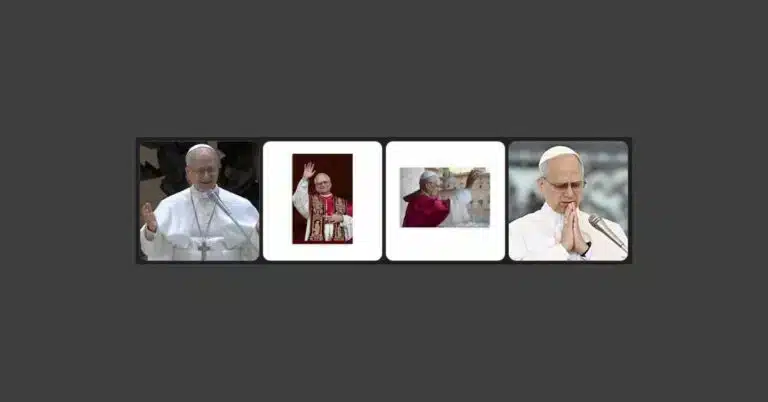
Pope Leo XIV – A Modern Revival
Two popes. One agenda.
What Leo XIII began in 1888, Leo XIV may now complete. The encampment of spiritual Rome has returned—this time not to test, but to enforce. Are we ready?
When History Echoes Prophecy
In 1888, attempts were made to pass national Sunday laws not only in the United States, but also in parts of Europe, where similar movements were gaining momentum under the influence of the papacy and allied religious reformers. While it failed, the event marked a pivotal moment in prophetic history. Behind the scenes, Pope Leo XIII had issued an encyclical—Rerum Novarum—that would lay the foundation for Rome’s renewed influence over civil legislation.
This was not just a historical event. It was a spiritual encampment, a test run of Rome’s end-time agenda foretold in Scripture. And now, under Pope Leo XIV, the same pattern is reemerging.
Just as Rome surrounded ancient Jerusalem twice—once as a warning, and again for destruction—so too spiritual Rome appears to be making its second approach. The time to discern the signs has never been more urgent.
The Legacy of Pope Leo XIII – Architect of a Global Shift
Pope Leo XIII, who served from 1878 to 1903, was no ordinary pontiff. He was a philosopher, a political strategist, and a theologian with one primary goal: to restore Rome’s moral and civil influence over a rapidly modernizing world. His reign marked a deliberate shift—from religious authority limited to church matters to one that shaped nations, laws, and labor.
At the heart of this effort was his 1891 encyclical, Rerum Novarum (“Of New Things”). Framed as a response to rising tensions between capital and labor, the document addressed economic injustice and the need for social reform. But deeper within its pages was a more subtle agenda:
🔸 A push to recognize Sunday as a necessary day of rest for workers, not just religiously, but as a civil and moral necessity.
🔸 A call for governments to uphold religious values in their legislation and structure.
🔸 A framework for blending church authority with state power, offering the Church as the moral compass for society.
This was a veiled revival of Rome’s ancient ambition—to rule not just in spirit, but in state.
While many praised Leo XIII for his intellectual depth and social concern, prophecy-watchers saw something else: the beast was stirring again.
📖 Revelation 13:3 – “And his deadly wound was healed: and all the world wondered after the beast.”
Leo XIII laid the groundwork for this healing. His words echoed through Protestant nations. His doctrines found their way into civil codes. And his timing—just before the failed 1888 Sunday law in America—was no accident.
🔥 He wasn’t just a pope—he was a forerunner of enforcement.
1888 – The First Encampment of Modern Rome
The late 1800s saw rising unrest—socially, economically, and spiritually. It was within this turbulent backdrop that the United States saw its first serious push toward legislated Sunday observance, backed by religious and political voices alike.
The centerpiece of this effort was the Blair Sunday Rest Bill, introduced to the U.S. Senate in 1888. The bill proposed the enforcement of Sunday as a national day of rest, under the guise of protecting workers and family values. While promoted as neutral and humanitarian, its religious undertones were unmistakable—a clear attempt to impose Rome’s day of worship on a Protestant nation.
🔸 National Reformers, supported by both Protestant clergy and Catholic interests, lobbied hard to give civil teeth to religious observance.
🔸 Pope Leo XIII’s recent moral language in Rerum Novarum subtly reinforced the case for Sunday laws globally.
But something remarkable happened.
A humble voice stood against the tide: Alonzo T. Jones, a Seventh-day Adventist delegate, addressed the U.S. Senate Committee and delivered a bold, articulate defense of religious liberty. He exposed the unconstitutional nature of the bill and its violation of freedom of conscience.
📖 Galatians 5:1 – “Stand fast therefore in the liberty wherewith Christ hath made us free…”
Jones’ speech carried weight. The bill, once heavily supported, began to lose momentum. Public sentiment shifted. What seemed inevitable fizzled under the pressure of truth. The attempt to nationalize Sunday failed—but it left a blueprint for future enforcement.
📖 Luke 21:20 – “When ye shall see Jerusalem compassed with armies, then know that the desolation thereof is nigh.”
The “compassing” happened. Rome tested the waters. But desolation was held back—because truth was proclaimed and God’s hand stayed the final blow. The first encampment ended in retreat.
The time was not yet.
Leo XIV – The Second Siege Begins
Now, over a century later, another pope rises bearing the same name—Leo, Latin for lion. The name alone is a signal—a deliberate echo of Pope Leo XIII’s legacy. And Pope Leo XIV has already confirmed his admiration for his predecessor’s vision.
In public interviews and papal addresses, Pope Leo XIV has praised Rerum Novarum as “a foundation for the Church’s modern social witness,” signaling his intent to continue uniting moral authority with civil reform.
📖 Daniel 8:25 – “By peace shall he destroy many…”
🔎 The push for unity, rest, and moral order comes wrapped in the language of peace—but its fruit lead to compulsion.
In his early messages, Pope Leo XIV has:
🔥 Urged global leaders to consider a weekly rest day for the sake of the Earth and family cohesion.
🔥 Tied mental health and digital burnout to the need for “communal Sabbath values.”
🔥 Stressed the need for “moral clarity in an age of confusion,” repeating themes found in Rerum Novarum.
The parallels are undeniable:
🔸 Leo XIII used labor and social crisis to push Sunday rest.
🔸 Leo XIV uses environmental and technological crisis to resurrect it.
Both wear the robe of morality—but beneath it lies Rome’s ultimate goal: to reclaim authority over conscience.
This is not merely a religious revival—it is a resurgence of prophetic Rome, more sophisticated and far-reaching than ever before. Where Leo XIII prepared the framework, Leo XIV may ignite the fulfillment. The second encampment has begun—and this time, the siege will not withdraw.
When spiritual Rome regains her seat through civil power—backed by policy, not persuasion—the final prophetic events will unfold.
Final Reflection – The Remnant Must Be Awake
History is not random. It is prophetic. The movements of Pope Leo XIII and Pope Leo XIV are not isolated acts of leadership—they are echoes of ancient patterns repeating with divine warning.
The first encampment in 1888 was Rome’s trial run. A test. It was repelled by truth, liberty, and the voice of the faithful. But now, in our generation, the second siege has begun—more refined, more global, more cloaked in virtue.
📖 Ecclesiastes 1:9 – “There is no new thing under the sun.”
This siege is not around a physical city, but around the minds, hearts, and freedoms of God’s people. The weapons are no longer swords—but laws, policies, digital control, and subtle compromise.
And yet, the call remains the same:
📖 Matthew 24:15–16 – “When ye therefore shall see the abomination of desolation… then let them which be in Judaea flee into the mountains.”
Flee—spiritually, mentally, and morally—from systems that exalt tradition over truth, unity over conviction, and man’s word over God’s commandments.
📖 Isaiah 8:20 – “To the law and to the testimony: if they speak not according to this word, it is because there is no light in them.”
The remnant must not sleep. The alarm is sounding again. The lion walks once more—but so does the Lion of the tribe of Judah, and His voice is calling His people out of Babylon.
📖 Revelation 18:4 – “Come out of her, my people…”
Let us be those who stand—not with tradition, but with truth. Not with Leo, but with the Lamb. And may we follow Him wherever He leads, with unwavering courage and unshakable faith.
Let the remnant rise.