
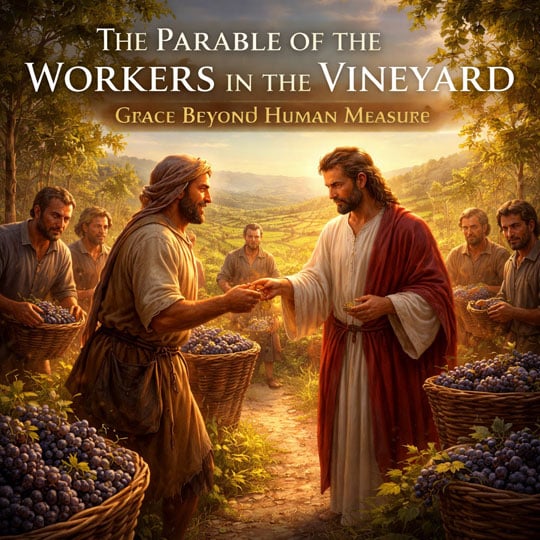
There are moments in Scripture where Jesus challenges not just what we believe—but how we think. The Parable of the Workers in the Vineyard is one of those moments. It reaches beyond surface understanding and confronts the natural instincts of the human heart—our sense of fairness, reward, and what we believe is deserved.
At first glance, the story seems simple: laborers are hired at different times throughout the day, yet all receive the same wage. But beneath this simplicity lies a powerful revelation. This parable is not about labor—it is about grace. It is not about hours worked—but about the heart of the One who rewards.
In a world that measures value by effort, time, and achievement, Jesus reveals a kingdom that operates by an entirely different standard. A standard where the last can be first, where the least expected receive the same reward, and where generosity overrides human calculation.
This parable exposes a quiet struggle within us—the tension between fairness and grace. It reveals how easily comparison can take root, how quickly gratitude can turn into complaint, and how often we measure ourselves against others rather than recognizing the gift we have been given.
But more than exposing the heart, this parable illuminates the character of God.
🔹 He is not unjust—He is generous.
🔹 He is not unfair—He is merciful.
🔹 He does not give less than promised—He gives beyond what is deserved.
And in that truth, we are invited to see the kingdom not through the lens of what is earned…but through the light of what is freely given. Because in the end, the greatest reward is not what we receive…but that we were called into the vineyard at all.
The Call to the Vineyard – Grace Begins with Invitation
📖 Matthew 20:1–2 – “For the kingdom of heaven is like unto a man that is an householder, which went out early in the morning to hire labourers into his vineyard. And when he had agreed with the labourers for a penny a day, he sent them into his vineyard.”
🔎 The work begins with a call—not human initiative.
The laborers do not seek out the vineyard first—the householder goes out to find them. This reveals a foundational truth: salvation and service begin with God’s invitation. It is not man reaching upward—but God reaching outward.
🔎 Early morning – the first response to grace.
Those hired early represent those who respond quickly to God’s call. Whether early in life or early in understanding, they enter the vineyard with clarity of agreement and expectation.
🔎 The agreed wage – a just and promised reward.
The laborers agree to a penny (denarius), a fair day’s wage. This shows that God is never unjust. What He promises, He fulfills. There is no deception in His calling—only faithfulness.
🔎 The vineyard – the place of purpose.
To be called into the vineyard is to be brought into God’s work, His truth, and His kingdom. It is not simply about labor—it is about participation in something greater than oneself.
🔥 Deeper Insight:
Before the question of reward ever arises, Jesus establishes something critical: Being called into the vineyard is itself an act of grace. The laborers did not earn their place—they were chosen for it. They were not owed opportunity—it was given. And this shifts the entire perspective of the parable. Because the focus is not first on what we receive…but on the fact that we were invited at all.
The Late Call – Grace Beyond Timing
📖 Matthew 20:3–7 – “And he went out about the third hour, and saw others standing idle in the marketplace, And said unto them; Go ye also into the vineyard, and whatsoever is right I will give you. And they went their way. Again he went out about the sixth and ninth hour, and did likewise. And about the eleventh hour he went out, and found others standing idle, and saith unto them, Why stand ye here all the day idle? They say unto him, Because no man hath hired us. He saith unto them, Go ye also into the vineyard; and whatsoever is right, that shall ye receive.”
🔎 The call continues throughout the day.
The householder does not stop after the first group. He goes out again… and again… and again. This reveals the persistent nature of God’s grace. He continues calling, seeking, and inviting—far beyond what man would expect. This means God has not stopped calling you. No matter where you’ve been, how long you’ve waited, or how far you feel from Him—He is still coming into the marketplace of your life. He is still searching, still inviting, still speaking. His grace is not a one-time offer—it is a pursuing presence.
🔎 Different hours—same invitation.
Some are called early, others later, and some at the very end of the day. This reflects the reality of life: people come to truth at different times—early in life, later in life, or even in their final moments. Yet the invitation remains open. Your timing does not disqualify you. You may look at others and think, “They started earlier… they’ve done more… they’re further ahead.” But God is not measuring your life against theirs. Whether you’ve walked with Him for years—or you’re just now hearing His call—the invitation is the same. You are not behind… you are being called now.
🔎 “Whatsoever is right” – trust replaces agreement.
Unlike the first group, these laborers do not negotiate a wage. They trust the goodness of the householder. This reveals a deeper level of faith—not based on contract, but on confidence in the character of the one who calls. Not everything with God is explained upfront. There are moments where He simply says, “Follow Me.” And the question becomes—do we need to understand everything… or do we trust Him enough to obey? True faith is not built on knowing the outcome—it is built on knowing the One who leads.
🔎 The eleventh hour – grace at the edge of time.
Those called at the final hour represent the most unexpected recipients of grace. With almost no time left in the day, they are still invited. This shatters human assumptions about worthiness and timing. You may feel like you’ve wasted time, missed opportunities, or gone too far. But this parable speaks directly into that fear. Even at the edge of the day—even when time feels nearly gone—God still calls. Grace does not expire the way we think it does.
🔎 Idle—but not unwilling.
When asked why they stood idle, they answered, “Because no man hath hired us.” This reveals they were not resistant—they were simply waiting. And when the call came, they responded. Sometimes the issue is not rebellion—but waiting without direction. There are people who aren’t rejecting God—they’re just waiting to be called, to be shown, to be invited. And when that moment comes, everything changes. If your heart is open, even quietly… God sees it. And when He calls, your response matters more than your past.
🔥 Deeper Insight:
This section reveals something profound: Grace is not limited by time. Whether early or late, long-serving or newly called—God’s invitation remains the same. He does not measure worth by when you arrive… but by whether you respond. Because in the kingdom of God…It is never too early to enter. And it is never too late to be called. Grace is not limited by when you start…but revealed in whether you respond.
The Reward Given – Grace That Defies Expectation
📖 Matthew 20:8–10 – “So when even was come, the lord of the vineyard saith unto his steward, Call the labourers, and give them their hire, beginning from the last unto the first. And when they came that were hired about the eleventh hour, they received every man a penny. But when the first came, they supposed that they should have received more; and they likewise received every man a penny.”
🔎 The order is intentional—last to first.
The householder reverses expectation. Those who worked the least are paid first. This is not random—it is revealing. God often works in ways that overturn human thinking, forcing us to confront what we truly believe about fairness, grace, and worth. This is where God challenges how you think. We naturally expect reward to follow effort, time, and sacrifice. But God’s kingdom does not operate on human systems. When He moves differently than expected, it reveals whether we trust His ways… or only agree with them when they make sense to us.
🔎 The same reward—regardless of time.
Those who worked one hour receive the same as those who worked all day. This is the moment that unsettles the natural mind. It challenges the idea that reward should always match effort. Instead, it reveals that what is given is based on the generosity of the giver—not the calculation of the worker. This is where grace confronts your sense of fairness. Something inside us says, “That’s not right.” And that reaction exposes something deeper—we often believe we deserve more based on what we’ve done. But grace was never about deserving. It was always about receiving what could never be earned.
🔎 Expectation begins to shift the heart.
When the first laborers see what the others receive, something changes within them. “They supposed that they should have received more.” Comparison begins. What once felt fair now feels lacking—not because their wage changed, but because their perspective did. This is how quickly gratitude can turn. At the start of the day, they were content. The agreement was clear. The wage was fair. But the moment they looked at others… everything changed. Not because they were treated unjustly—but because comparison reshaped their perception.
🔎 The danger of comparison.
The moment we measure ourselves against others, we lose sight of what we’ve been given. Gratitude begins to fade, and entitlement takes its place. The issue is no longer the gift—but how it compares. This is a battle every believer faces. It may not always be spoken—but it is felt.
“Why them?”
“Why not me?”
“I’ve done more… I’ve waited longer…”
And in that moment, the focus shifts from God’s goodness… to our own sense of worth.
🔥 Deeper Insight:
This moment reveals a hidden struggle within the human heart: We are often content with grace…until we see it given to someone else. What once felt like blessing can begin to feel like injustice—not because God has been unfair…but because we have shifted from gratitude to comparison. This moment reveals something many don’t want to face: We are comfortable with grace…until it is given equally to someone we think deserves less. That is where the heart is exposed. The reward did not reveal injustice…It revealed the condition of the heart. And that same question still stands today.
The Master’s Response – Grace Defended, the Heart Exposed
📖 Matthew 20:11–13 – “And when they had received it, they murmured against the goodman of the house, Saying, These last have wrought but one hour, and thou hast made them equal unto us, which have borne the burden and heat of the day. But he answered one of them, and said, Friend, I do thee no wrong: didst not thou agree with me for a penny?”
🔎 Murmuring reveals what was hidden.
The complaint did not exist at the beginning—it surfaced at the end. When expectations were challenged, what was beneath the surface came out. This is often how the heart is revealed—not in ease, but when things don’t go as expected. This is where the heart speaks honestly. It may not always come out in words—but it shows up in attitude, frustration, or quiet resentment. When God’s ways don’t align with our expectations, what rises up within us reveals what we truly believe.
🔎 “Thou hast made them equal unto us.”
This is the core issue—not the wage, but the equality. The laborers were not upset about what they received—they were upset that others received the same. This exposes a deeper struggle: comparison tied to identity. We often measure our value by what separates us from others. But in God’s kingdom, grace levels what pride tries to elevate. And when equality is given where we expected distinction… the heart is tested.
🔎 “I do thee no wrong.”
The master responds calmly, clearly, and justly. He reminds them: the agreement was honored. Nothing was taken from them. Nothing was withheld. The problem was never injustice—it was perception. This is a powerful truth for us today. God has never been unjust with you. He has never given you less than what He promised. But when we focus on others instead of Him, it can feel like we’ve been treated unfairly—even when we haven’t.
🔎 “Friend…” – a response of grace, not anger.
The master does not rebuke harshly—he responds with calm authority. Even in their complaint, he addresses them with patience. This reflects the heart of God. Even when we misunderstand Him… even when we question Him… He responds with truth, not rejection. He corrects, but He does not cast away.
🔥 Deeper Insight:
This moment reveals something many overlook: The greatest danger is not working in the vineyard…but working with the wrong heart. It is possible to serve God…and still struggle with pride, comparison, and entitlement. The master did not fail the workers…The moment simply revealed what was already within them. And that same moment… still happens today.
📖 Isaiah 55:8–9 – “For my thoughts are not your thoughts… neither are your ways my ways, saith the Lord.”
🔎 God’s ways do not follow human logic. What seems unequal to us may be perfectly just in Him—because His ways are rooted in grace, not comparison.
The Generosity of God – Grace Is Not Earned
📖 Matthew 20:13–16 – “But he answered one of them, and said, Friend, I do thee no wrong: didst not thou agree with me for a penny? Take that thine is, and go thy way: I will give unto this last, even as unto thee. Is it not lawful for me to do what I will with mine own? Is thine eye evil, because I am good? So the last shall be first, and the first last: for many be called, but few chosen.”
🔎 God’s goodness—not human fairness—is the standard.
The master makes it clear: nothing unjust has occurred. The agreement was honored. The wage was fair. The issue was never injustice—it was comparison with generosity. This is where our thinking must shift. We often measure God through the lens of fairness… but God reveals Himself through goodness. He does not operate by giving everyone exactly the same based on effort—He gives freely based on His nature.
🔎 “I will give… even as unto thee.”
The master’s decision is not based on pressure—it flows from his own will. His generosity is intentional, not accidental. This reveals the heart of God. Grace is not something God is forced to give—it is something He desires to give. He is not reluctant in mercy… He is abundant in it.
🔎 “Is thine eye evil, because I am good?”
This question cuts directly to the heart. The problem is not the master’s goodness—it is how that goodness is perceived. This exposes a hidden struggle. When someone else receives grace, blessing, or opportunity… does something within us resist it? Not because it is wrong—but because it feels undeserved? That reaction reveals more about us… than about God.
🔎 The “evil eye” – when comparison corrupts perception.
In Scripture, the “evil eye” represents jealousy, envy, and distorted vision. It is the inability to see goodness clearly because the heart is measuring instead of receiving. This is a subtle but serious danger. We can look directly at God’s goodness… and still see it wrongly—because comparison has clouded our view.
🔎 “The last shall be first…” – the kingdom reversal.
Jesus ends with a principle that overturns human systems. In God’s kingdom, position is not determined by timing, effort, or status—but by grace. This is not about lowering the first—it is about lifting the last. God does not take from one to give to another. He gives freely to all. But His generosity often offends those who believe they have earned more.
🔥 Deeper Insight:
This parable reveals something foundational: God is not running a system of wages…He is revealing a kingdom of grace. The moment we begin to think in terms of earning…we step out of alignment with His heart.
📖 Ephesians 2:8–9 – “For by grace are ye saved through faith… not of works, lest any man should boast.”
🔎 Salvation itself is the greatest example—nothing we receive from God is earned. It is given freely, fully, and undeservedly.
🔹 God’s grace is not measured.
🔹 It is not calculated.
🔹 It is not earned.
🔥 It is given. And the question is not whether He is fair…but whether we are willing to receive His goodness as it truly is.
Final Reflection – Will You Receive Grace or Resist It?
There is a quiet beauty in this parable that shines beyond the tension… beyond the questions… beyond even the challenge it brings. It reveals a God who is not searching for ways to withhold—but for ways to give. A God who goes out again and again… not because He must… but because He desires that none be left standing outside the vineyard.
Whether early in the morning… or at the edge of the day…
🔹 His call is the same.
🔹 His heart is the same.
🔹 His grace is the same.
And in that truth, there is peace. Because this parable is not just about laborers and wages—it is about a Father who continues to invite, continues to receive, and continues to give beyond what we could ever earn.
So wherever you find yourself today—early, late, or somewhere in between—the door is still open. The call is still going out. And the vineyard is still waiting. Step into it… not to earn…but to receive.
📖 Matthew 20:16 – “So the last shall be first, and the first last: for many be called, but few chosen.”
🔎 This parable does not end with explanation—it ends with a reversal. Everything we naturally expect is turned upside down. And in that reversal, Jesus leaves us with a question that reaches beyond the vineyard… and into our own hearts.
📖 Romans 5:20 – “…where sin abounded, grace did much more abound:”
🔎 Grace is not limited. It is not carefully distributed in measured portions. It overflows. It reaches further than we expect, gives more than we think is fair, and extends even to those we may not believe deserve it.
📖 Jonah 4:1–2 – “But it displeased Jonah exceedingly, and he was very angry… for I knew that thou art a gracious God, and merciful…”
🔎 Even Jonah struggled with this truth. He rejoiced in grace for himself—but resisted it when it was given to others. This reveals something deeply human: we love receiving mercy… but often struggle to accept how freely it is given.
📌 Do you rejoice when grace reaches others… or question why it reached them?
📌 Have you ever felt that your effort, time, or sacrifice should result in more?
📌 Are you serving God out of love… or measuring what you should receive in return?
📌 Have you fully received grace… or are you still trying to earn what has already been given?
📖 Isaiah 55:6–7 – “Seek ye the Lord while he may be found… let the wicked forsake his way… and he will have mercy upon him…”
🔎 The invitation is still open. Whether early or late, whether long-serving or newly called—God is still inviting, still receiving, still showing mercy.
🔹 Some entered early…
🔹 Some entered late…
🔹 But all were invited.
And that is the heart of the parable.
📖 Ephesians 2:4–5 – “But God, who is rich in mercy… even when we were dead in sins, hath quickened us together with Christ…”
🔎 None of us entered the vineyard because we deserved to. We were called. And that call itself was grace.
🔥 So do not compare.
🔥 Do not measure.
🔥 Do not resist what God freely gives.

