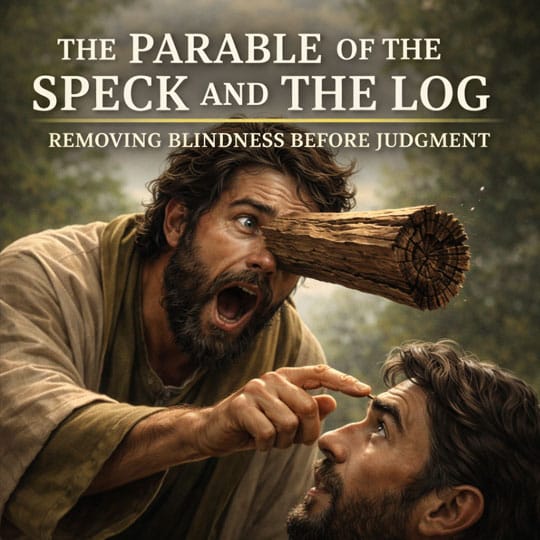
Few teachings of Jesus are more quoted—and more misunderstood—than His words on judgment. In a world quick to say “judge not,” this parable cuts through confusion and reveals a deeper truth: the issue is not whether we judge, but how we see.
The Parable of the Speck and the Log is not a call to silence discernment—it is a call to purify it. It confronts the dangerous condition of spiritual blindness, where one attempts to correct others while remaining unaware of their own greater faults. In just a few lines, Jesus exposes hypocrisy, challenges pride, and redirects the heart toward humility and truth.
At its core, this parable is about vision. It reveals that before we can see clearly to help another, we must first allow God to deal with what is within us. Without that process, even our attempts to do good can become distorted—turning correction into condemnation and truth into pride.
In a time where judgment is either misused or completely avoided, this teaching stands as a necessary balance. It calls believers not to abandon discernment, but to approach it with honesty, self-examination, and a heart aligned with God.
Because the greatest danger is not seeing fault in others…it is failing to see what blinds us within. And until that blindness is removed, everything we think we see…will be distorted.
The Command Before Correction – Judgment Begins Within
📖 Matthew 7:1–2 – “Judge not, that ye be not judged. For with what judgment ye judge, ye shall be judged: and with what measure ye mete, it shall be measured to you again.”
🔎 “Judge not” is not a command to ignore truth.
These words are often used to silence discernment—but that is not what Jesus is teaching. He is not removing the responsibility to recognize right from wrong. He is addressing the condition of the heart that judges without humility, without self-examination, and without mercy. This means the issue is not judgment—but how you judge. God does not call His people to blindness. He calls them to clarity. But clarity without humility becomes harsh, and truth without grace becomes destructive. Jesus is not forbidding judgment—He is purifying it.
🔎 The standard you use will return to you.
Jesus immediately follows with a warning: “with what judgment ye judge, ye shall be judged.” This reveals a spiritual law—how we measure others becomes the measure applied to us. This should cause us to pause. Are we quick to condemn? Slow to show mercy? Harsh in our assessments? The same lens we use to examine others… will be turned back on us.
🔎 Judgment reveals your understanding of grace.
The way a person judges others often reflects how they understand God’s mercy toward themselves. Those who forget how much they’ve been forgiven tend to judge more severely. Those who walk in humility tend to judge with care, truth, and compassion. This is where the heart is exposed. Do we see others through the lens of justice alone… or through the lens of mercy we ourselves have received?
🔎 God is addressing the heart before the action.
Before Jesus speaks of the speck or the log, He deals with the root issue—the spirit of judgment itself. Why? Because correction without the right heart does more harm than good. This is a foundational truth. Right actions with the wrong heart are still wrong. Even truth, when delivered in pride, becomes distorted.
🔥 This opening command reveals something critical: God is not trying to stop you from seeing clearly…He is preparing you to see rightly. Because without humility…even truth becomes dangerous in our hands.
📌 Do you seek to understand before you judge… or react quickly?
📌 Is your correction rooted in love… or in being right?
📌 Do you measure others by grace… or by expectation?
📌 If the same standard you use were applied to you… would it bring mercy or judgment?
📖 James 2:13 – “For he shall have judgment without mercy, that hath shewed no mercy; and mercy rejoiceth against judgment.”
🔎 Mercy is not weakness—it is alignment with the heart of God. And where mercy is absent, judgment becomes dangerous.
🔥Deeper Insight:
Before you look outward…God calls you inward. Because the way you see others…begins with how clearly you see yourself.
The Log in Your Own Eye – The Danger of Hidden Blindness
📖 Matthew 7:3–4 – “And why beholdest thou the mote that is in thy brother’s eye, but considerest not the beam that is in thine own eye? Or how wilt thou say to thy brother, Let me pull out the mote out of thine eye; and, behold, a beam is in thine own eye?”
🔎 The focus is misplaced from the start.
Jesus asks a piercing question: “Why beholdest thou the mote… but considerest not the beam…?” The issue is not that the speck is seen—but that the greater problem within is ignored. This reveals a dangerous tendency. We often see small faults in others with clarity… while remaining blind to greater issues within ourselves. Not because they are hidden—but because we have not taken the time to truly examine our own hearts.
🔎 The “beam” – a condition too large to ignore.
The imagery is extreme on purpose. A beam is not a small flaw—it is something massive, obstructing vision entirely. Jesus is showing that the problem within is not minor—it is significant and blinding. This is not exaggeration—it is exposure. What we minimize within ourselves… God sees clearly. And what we overlook within… often distorts everything we see around us.
🔎 Blindness does not remove confidence.
What makes this moment so striking is that the person with the beam still attempts to correct another. They are not hesitant—they are confident. This is where danger increases. Spiritual blindness does not always feel like blindness. In fact, it often feels like clarity. A person can be completely unaware of their own condition while actively pointing out the faults of others.
🔎 “How wilt thou say…?” – the question of qualification.
Jesus challenges the right to correct while remaining uncorrected. Not because correction is wrong—but because correction without self-awareness lacks authority and truth. This is a sobering reality. The ability to see clearly in others is directly tied to whether we have allowed God to deal with us first. Without that, even accurate observations can become harmful.
🔥 Deeper Insight:
This section reveals something many avoid: The greatest blindness is not failing to see others clearly…it is failing to see ourselves truthfully. And until that changes…Everything we think we see in others will be filtered through distortion.
📌 Are you quicker to notice flaws in others than in yourself?
📌 Have you allowed God to reveal what may be hidden within you?
📌 Do you approach others from a place of humility… or assumption?
📌 Is your vision shaped by truth… or by unexamined areas of your own heart?
📖 Psalm 139:23–24 – “Search me, O God, and know my heart… and see if there be any wicked way in me…”
🔎 True clarity begins not with examining others—but with inviting God to examine you.
🔥 Before you remove what is small in another…God calls you to face what is large within yourself. Because only then…can you begin to see clearly.
The Speck in Your Brother’s Eye – Misplaced Focus
📖 Matthew 7:3–4 – “…the mote that is in thy brother’s eye… Let me pull out the mote out of thine eye…”
🔎 The speck is real—but it is not the primary issue.
Jesus does not deny the existence of the speck. There is something in the brother’s eye that needs to be addressed. But the problem is not that it is seen—it is that it is prioritized over something far greater. This is where focus becomes distorted. We can become fixated on the visible faults of others while remaining blind to deeper issues within ourselves. The smaller issue becomes the center of attention… while the greater issue is ignored.
🔎 “Let me pull it out” – the appearance of helpfulness.
The statement sounds caring, even righteous. It appears to be an act of service—to help remove something harmful from another. But intention must be examined. Is the desire truly to help… or to correct from a place of superiority? Is it love…or is it pride disguised as concern?
🔎 Correction without clarity becomes harmful.
Trying to remove a speck requires precision, care, and clear vision. Without clarity, even a small attempt to help can cause greater damage. This is deeply spiritual. When we try to correct others without first being corrected ourselves, we risk wounding instead of restoring. Even truth, when delivered from the wrong place, can push people further away rather than draw them closer to God.
🔎 The danger of focusing outward before looking inward.
There is something in the human heart that naturally shifts attention away from self and onto others. It is easier to see what is wrong elsewhere than to confront what is within. But this creates imbalance. When outward focus replaces inward examination, correction loses its foundation. It becomes surface-level, reactive, and often rooted in comparison rather than truth.
🔥 Deeper Insight:
This moment reveals a subtle but powerful danger: We can become passionate about fixing others…while avoiding the work God is trying to do in us. And in doing so…We mistake activity for righteousness.
📌 Do you seek to help others… or to point out what is wrong?
📌 Is your correction rooted in love and humility… or in being right?
📌 Have you allowed God to correct you before correcting others?
📌 Are you focused on restoration… or on exposure?
📖 Galatians 6:1 – “Brethren, if a man be overtaken in a fault, ye which are spiritual, restore such an one in the spirit of meekness; considering thyself…”
🔎 True correction is not harsh—it is careful, humble, and aware of one’s own need for grace.
🔥 The speck may be small…but how you approach it reveals something great. Because the goal is not to expose…but to restore.
Hypocrisy Exposed – When Correction Becomes Corruption
📖 Matthew 7:5 – “Thou hypocrite, first cast out the beam out of thine own eye; and then shalt thou see clearly to cast out the mote out of thy brother’s eye.”
🔎 Jesus names it plainly—hypocrisy.
There is no softening here. Christ identifies the condition directly. To correct another while ignoring a greater issue within is not just an oversight—it is hypocrisy. This is a serious spiritual warning. Hypocrisy is not simply saying one thing and doing another—it is presenting a false image of righteousness while remaining unchanged within. It is appearing clear… while being blind.
🔎 “First cast out the beam…” – the required order.
Jesus does not forbid correction—He establishes the order. First, deal with what is within. Then, and only then, will you be able to help another rightly. This reveals a path—not a prohibition. God is not saying “never correct”—He is saying “be corrected first.” True authority to help others comes from having walked through correction yourself.
🔎 Clarity comes after humility.
“Then shalt thou see clearly…” Vision is restored only after the beam is removed. Until that happens, perception remains distorted. This is where transformation happens. When we allow God to deal with us first, something changes. Pride gives way to humility. Harshness becomes gentleness. Correction becomes compassion.
🔎 Correction restored to its true purpose.
Once clarity is gained, the purpose of correction is no longer to expose—but to restore. The focus shifts from being right… to helping someone see. This is the difference between flesh and Spirit. Flesh corrects to elevate self. Spirit corrects to restore others.
🔥 Deeper Insight:
This moment reveals a foundational truth: God is far more concerned with who you are…than what you point out in others. Because if the heart is not right…even truth becomes corrupted.
📌 Have you allowed God to correct what is within you first?
📌 Do you approach others from humility… or from assumption?
📌 Is your correction shaped by love… or by pride?
📌 Are you seeking to restore… or to expose?
📖 Romans 2:1 – “Therefore thou art inexcusable… for wherein thou judgest another, thou condemnest thyself…”
🔎 When we judge without self-examination, we reveal the very condition we overlook.
🔥 Hypocrisy is not just seeing wrongly…it is correcting wrongly while being blind. But when the heart is humbled…clarity returns—and restoration becomes possible.
Seeing Clearly – True Judgment Restored
📖 Matthew 7:5 – “…and then shalt thou see clearly to cast out the mote out of thy brother’s eye.”
🔎 Clarity is the goal—not silence.
Jesus does not end with “do not correct”—He ends with “see clearly.” This is critical. The purpose of removing the log is not to stop judgment entirely, but to restore it to its proper place. This means God wants you to see rightly. Discernment is not the problem—distortion is. When the heart is purified and the vision is clear, judgment becomes aligned with truth rather than driven by pride.
🔎 True judgment begins with humility.
Once the beam is removed, something changes within. The person who once judged harshly now understands their own need for grace. This transforms how you see others. You no longer approach them from a place of superiority—but from shared brokenness. You don’t stand above them—you come alongside them.
🔎 Correction becomes restoration.
With clear vision, the purpose shifts. It is no longer about pointing out flaws—it is about helping someone see and be restored. This reflects the heart of Christ. Jesus never corrected to shame—He corrected to heal. Truth, when delivered rightly, does not crush—it frees.
🔎 Clarity produces compassion.
When God deals with your heart first, it softens you. You become more patient, more careful, more aware of how easily you yourself could fall. This guards against harshness. The clearer you see your own need for grace, the more gently you extend it to others.
🔎 Righteous judgment is Spirit-led, not self-driven.
True discernment is not reactive or emotional—it is guided by God. It is rooted in truth, expressed in love, and carried out with humility. This is what Jesus is restoring. Not the removal of judgment…but the purification of it.
🔥 Deeper Insight:
This final teaching reveals the balance many miss: God does not call you to ignore sin…He calls you to address it rightly. And the difference between the two…is the condition of your heart.
📌 Do you seek clarity from God before correcting others?
📌 Has God’s work in your life shaped how you approach others?
📌 Is your goal to be right… or to help someone see clearly?
📌 Do others feel condemned by your words… or restored through them?
📖 John 7:24 – “Judge not according to the appearance, but judge righteous judgment.”
🔎 Jesus Himself commands righteous judgment—but only when it is aligned with truth, humility, and clear vision.
🔥 When the heart is right…the vision becomes clear. And when the vision is clear…judgment becomes restoration, not condemnation.
Final Reflection – Will You See Clearly or Continue Blind?
There is a quiet weight to this parable that lingers long after the words are read.
🔹 It is not loud… but it is piercing.
🔹 Not complex… but deeply revealing.
Because in just a few lines, Jesus shifts the focus from others… to you.
Before the speck.
Before the correction.
Before the judgment…
There is the mirror.
📖 Matthew 7:5 – “First cast out the beam out of thine own eye…”
🔎 This is where everything begins. Not with fixing others—but with allowing God to deal with what is within you. Until that happens, everything you see will carry distortion.
📖 Lamentations 3:40 – “Let us search and try our ways, and turn again to the Lord.”
🔎 True clarity begins with honest examination. Not surface-level reflection—but a willingness to let God reveal what we would rather ignore.
📖 1 Corinthians 11:31 – “For if we would judge ourselves, we should not be judged.”
🔎 There is a grace in self-examination. When we allow God to correct us, we are spared from the deeper consequences of remaining unchanged.
📌 Are you more focused on what is wrong in others… or what God is trying to reveal in you?
📌 Have you allowed Him to search your heart… or have you avoided what He might uncover?
📌 Do you approach others with humility… or with quiet confidence in your own perspective?
📌 If your vision were examined today… would it be clear or clouded?
📖 Psalm 26:2 – “Examine me, O Lord, and prove me; try my reins and my heart.”
🔎 This is the posture of one who truly desires to see. Not defending… not hiding… but inviting God to refine.
🔥 The world says: look outward.
🕊️ Christ says: begin within.
🔥 The world says: point it out.
🕊️ Christ says: remove what blinds you first.
🔥 The world says: judge quickly.
🕊️ Christ says: see clearly.
📖 James 1:23–24 – “…he is like unto a man beholding his natural face in a glass… and straightway forgetteth what manner of man he was.”
🔎 The Word of God is a mirror. But seeing is not enough—what matters is whether we respond to what is revealed.
🔥 So pause.
Before the next opinion…
Before the next correction…
Before the next judgment…
Look within.
📖 Proverbs 4:25 – “Let thine eyes look right on, and let thine eyelids look straight before thee.”
🔎 When your vision is aligned with truth, your path becomes clear. And when your heart is right, your actions will follow.
🔹 Remove the log.
🔹 Restore your sight.
🔹 Then walk in truth.
🔥 Because the greatest danger is not that others have flaws…it is that we remain blind while trying to fix them. And the greatest freedom…is finally seeing clearly.