
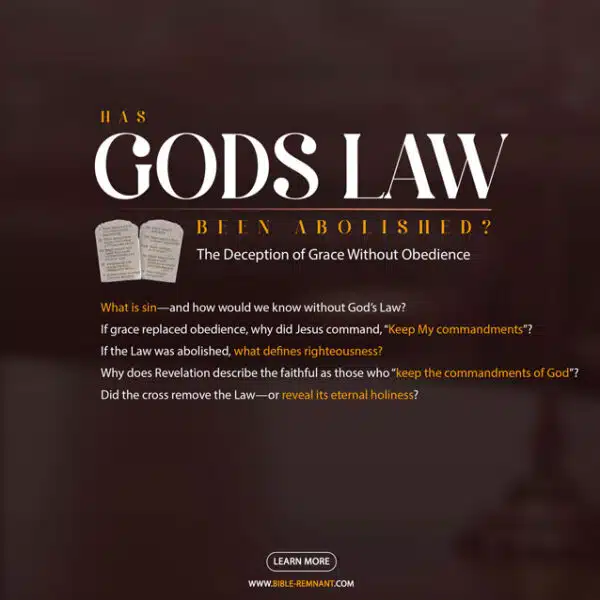
Has God’s Law Been Abolished? The Deception of Grace Without Obedience
For centuries, many have taught that God’s Law ended at the cross—that grace made obedience obsolete. Yet the Bible tells a very different story. From Genesis to Revelation, God’s commandments reveal His character, define sin, and point us to our need for a Savior.
📖 Romans 3:31 – “Do we then make void the law through faith? God forbid: yea, we establish the law.”
Grace does not erase God’s standard—it empowers us to live it. The modern gospel of “believe but don’t obey” is not freedom; it is deception. Christ did not come to release mankind from obedience, but from the condemnation of sin. His death magnified the Law’s holiness, proving that its demands could only be satisfied through divine love and perfect sacrifice.
The Lie That the Law Was Abolished
📖 Matthew 5:17–18 – “Think not that I am come to destroy the law, or the prophets: I am not come to destroy, but to fulfil. For verily I say unto you, Till heaven and earth pass, one jot or one tittle shall in no wise pass from the law, till all be fulfilled.”
🔎 From the very lips of Christ comes a declaration that shatters centuries of confusion. Yet countless pulpits still preach that His death ended obedience—that faith cancels duty. This distortion began soon after the apostles fell asleep, when philosophy mingled with faith and human reasoning sought to free itself from divine authority.
How the Deception Took Root
🔹 Early believers faced persecution; compromise with paganism promised peace.
🔹 Rome exalted tradition above Scripture, redefining grace as license.
🔹 The Reformers recovered salvation by faith—but many stopped short of restoring obedience.
🔹 Modern Christianity inherited a half-truth: justification without sanctification.
📖 Romans 6:1–2 – “What shall we say then? Shall we continue in sin, that grace may abound? God forbid.”
🔎 Paul’s words leave no room for confusion. Grace was never permission to sin—it is the power to overcome it. To claim the Law was abolished is to declare that sin itself no longer exists, for “sin is the transgression of the law” (1 John 3:4).
What This Lie Produces
🔹 A powerless gospel that excuses disobedience.
🔹 Churches filled with profession but lacking transformation.
🔹 A world that calls rebellion “freedom” and holiness “legalism.”
📖 Psalm 119:142 – “Thy righteousness is an everlasting righteousness, and thy law is the truth.”
⚠️ The enemy’s greatest success has not been open hatred of God, but counterfeit love divorced from obedience. The cross was never the end of the Law—it was its vindication. The blood that flowed from Calvary proved that God’s Law cannot be changed, only fulfilled through perfect sacrifice.
The Eternal Nature of God’s Law
📖 Psalm 111:7–8 – “The works of his hands are verity and judgment; all his commandments are sure. They stand fast for ever and ever, and are done in truth and uprightness.”
🔎 God’s Law is not a temporary code—it is the moral constitution of His kingdom. Before Sinai thundered, before Moses ascended the mountain, the principles of that Law were already woven into the fabric of creation. Adam and Eve knew right from wrong long before the Ten Commandments were written on stone, because God’s Law was first written on the heart.
The Law Reflects God’s Character
🔹 The Law is holy – because God is holy (Romans 7:12).
🔹 The Law is righteous – because God is righteous (Psalm 119:172).
🔹 The Law is unchanging – because God changes not (Malachi 3:6).
🔹 The Law is spiritual – revealing the heart, not just the hand (Romans 7:14).
📖 Romans 3:20 – “By the law is the knowledge of sin.”
🔎 If the Law defines sin, to abolish it would erase the very standard by which evil is exposed. Without it, humanity would be left blind—unable to discern rebellion from righteousness. The Law acts as a mirror, revealing the stain of sin that only the blood of Christ can cleanse.
📖 Ecclesiastes 12:13–14 – “Fear God, and keep his commandments: for this is the whole duty of man. For God shall bring every work into judgment, with every secret thing, whether it be good, or whether it be evil.”
🔎 God’s Law existed in heaven before humanity fell, and it will govern the redeemed throughout eternity. It is the expression of divine love in action—showing how love to God and love to man are inseparable. To remove the Law is to remove love’s boundaries.
⚠️ The devil has always sought to detach love from law. But the everlasting covenant unites them forever. The Law reveals God’s holiness; grace restores man’s harmony with it. Heaven and earth will pass away before one letter of that sacred Law fails.
📖 Isaiah 40:8 – “The grass withereth, the flower fadeth: but the word of our God shall stand for ever.”
What Is Sin If Not Transgression?
📖 Romans 3:23 – “For all have sinned, and come short of the glory of God.”
🔎 Before we can understand grace, we must understand sin—and before we can understand sin, we must understand the Law. The modern church often speaks of forgiveness but rarely defines what we are being forgiven for. Scripture gives no uncertainty on this point: sin is the transgression of God’s Law.
Without a Law, there can be no sin, no guilt, and no need for a Savior. The fact that Christ came to save sinners is living proof that the Law still defines righteousness and that it remains the standard by which every soul is measured.
The Biblical Definition of Sin
📖 1 John 3:4 – “Whosoever committeth sin transgresseth also the law: for sin is the transgression of the law.”
📖 Romans 7:7 – “I had not known sin, but by the law: for I had not known lust, except the law had said, Thou shalt not covet.”
📖 James 2:10–11 – “For whosoever shall keep the whole law, and yet offend in one point, he is guilty of all. For he that said, Do not commit adultery, said also, Do not kill.”
🔎 The Bible defines sin with unmistakable precision. It is not merely moral failure or human imperfection—it is law-breaking. The Law acts as the divine mirror revealing our defects, but it offers no power to cleanse. Only through the gospel of Christ can the sinner be forgiven and restored to obedience.
🔹 The Law identifies what is right and wrong.
🔹 The Law exposes the sinner’s condition.
🔹 The Law drives us to Christ for mercy and renewal.
📖 Romans 3:20 – “By the law is the knowledge of sin.”
If the Law Were Gone, Sin Would Not Exist
📖 Romans 4:15 – “For where no law is, there is no transgression.”
📖 Romans 5:13 – “Sin is not imputed when there is no law.”
📖 Hebrews 10:26 – “For if we sin wilfully after that we have received the knowledge of the truth, there remaineth no more sacrifice for sins.”
🔎 If the Law were abolished, there could be no transgression—yet sin continues, and the world still groans under its curse. Every confession, every repentance, every prayer for forgiveness testifies that the Law remains in effect. Without it, grace would lose its meaning, and the cross would lose its purpose.
🔹 The existence of sin proves the existence of the Law.
🔹 The cross of Christ confirms that God’s Law cannot be changed—only satisfied.
🔹 The gospel does not erase the Law but reconciles man to it through the righteousness of Christ.
📖 Romans 8:3–4 – “God sending his own Son in the likeness of sinful flesh, and for sin, condemned sin in the flesh: that the righteousness of the law might be fulfilled in us.”
⚠️ To claim that God’s Law is abolished is to deny the very definition of sin—and to empty the gospel of its power. The Law reveals our guilt; grace provides our pardon. Together they lead the sinner to repentance and the saint to holiness. Without the Law, there would be no conviction; without grace, no redemption. But through Christ, both justice and mercy stand in perfect harmony forever.
📖 Psalm 119:142 – “Thy righteousness is an everlasting righteousness, and thy law is the truth.”
Christ and the Law – Fulfillment, Not Abolition
📖 Matthew 5:17–19 – “Think not that I am come to destroy the law, or the prophets: I am not come to destroy, but to fulfil. For verily I say unto you, Till heaven and earth pass, one jot or one tittle shall in no wise pass from the law, till all be fulfilled. Whosoever therefore shall break one of these least commandments, and shall teach men so, he shall be called the least in the kingdom of heaven.”
🔎 Christ’s words leave no room for doubt—He came not to abolish the Law but to reveal its true meaning. In a world burdened by tradition and hypocrisy, Jesus magnified the Law beyond outward observance to the very thoughts and intents of the heart. The Pharisees guarded the letter; Christ restored the Spirit behind it.
📖 Isaiah 42:21 – “The Lord is well pleased for his righteousness’ sake; he will magnify the law, and make it honourable.”
🔎 Jesus did exactly that. Through His life of perfect obedience, He elevated the Law to its rightful honor—showing that it is not a list of restrictions but a revelation of divine love. When He touched the leper, forgave the sinner, or restored the broken, He embodied the mercy and justice that the Law was designed to uphold.
📖 Romans 8:3–4 – “God sending his own Son in the likeness of sinful flesh, and for sin, condemned sin in the flesh: that the righteousness of the law might be fulfilled in us, who walk not after the flesh, but after the Spirit.”
🔎 The word fulfilled does not mean “ended.” It means completed in purpose—to bring the Law to its fullness through obedience powered by love. Christ lived that perfection on our behalf, not so that we could ignore the Law, but so that we could walk in harmony with it through the Spirit.
📖 John 15:10 – “If ye keep my commandments, ye shall abide in my love; even as I have kept my Father’s commandments, and abide in his love.”
🔎 Christ’s obedience was not an isolated act—it is the pattern for every believer. His followers are called to reflect His life, not merely admire it. To claim the Law no longer matters is to deny the very mission of the Messiah, who died to uphold its justice and rose to empower our obedience.
📖 Romans 3:31 – “Do we then make void the law through faith? God forbid: yea, we establish the law.”
⚠️ The cross did not abolish the Law; it proved its eternal authority. Sin demanded death, and Christ bore that penalty—not to release us from obedience, but to restore our power to obey. The Savior’s cry “It is finished” was not the end of the Law—it was the end of sin’s dominion over the obedient heart.
📖 Philippians 2:13 – “For it is God which worketh in you both to will and to do of his good pleasure.”
Paul’s Writings Misunderstood
📖 2 Peter 3:15–16 – “Even as our beloved brother Paul also according to the wisdom given unto him hath written unto you… in which are some things hard to be understood, which they that are unlearned and unstable wrest, as they do also the other scriptures, unto their own destruction.”
🔎 From Peter’s own warning, we learn that many would misread Paul’s words and turn grace into an excuse for sin. Today that prophecy is fulfilled. Verses like “ye are not under the law, but under grace” (Romans 6:14) and “Christ is the end of the law” (Romans 10:4) are torn from context and used to justify lawlessness. Yet when read in light of the whole counsel of God, Paul’s message stands in harmony with Christ’s: faith establishes the Law, not abolishes it.
📖 Romans 6:14–15 – “For sin shall not have dominion over you: for ye are not under the law, but under grace. What then? shall we sin, because we are not under the law, but under grace? God forbid.”
🔎 To be under the law means to be under its condemnation—guilty, sentenced, and powerless to escape. Grace removes the guilt, not the guideline. It rescues us from the Law’s penalty, not its principles. Grace does not free us from obedience; it frees us for obedience.
📖 Romans 10:4 – “For Christ is the end of the law for righteousness to every one that believeth.”
🔎 The Greek word for end (telos) means goal or purpose. Christ is the goal of the Law—its perfect embodiment. The Law points us to Him, and He fulfills it by writing it upon our hearts. Through faith, believers no longer seek righteousness by works but by union with the One who is righteousness itself.
📖 Galatians 3:24–25 – “Wherefore the law was our schoolmaster to bring us unto Christ, that we might be justified by faith. But after that faith is come, we are no longer under a schoolmaster.”
🔎 Paul compared the Law to a teacher who shows the student his ignorance and leads him to the Master. Once the student finds Christ, the lesson isn’t destroyed—it’s fulfilled. The same Law that drove us to the cross now guides us in sanctification.
📖 Romans 7:12 – “Wherefore the law is holy, and the commandment holy, and just, and good.”
🔎 Paul’s testimony remains clear: the Law is holy, sin is the problem, and grace is the solution. The apostle never preached liberty from the Law but liberty from sin’s dominion. Those who twist his words to teach otherwise repeat the ancient lie, “Ye shall not surely die.”
📖 1 John 2:4 – “He that saith, I know him, and keepeth not his commandments, is a liar, and the truth is not in him.”
⚠️ True faith never contradicts obedience. Paul’s gospel of grace does not erase the Law—it inscribes it upon the heart through the Holy Spirit. To misunderstand Paul is to misunderstand the entire plan of salvation. The same hand that wrote of grace also declared, “Do we then make void the Law through faith? God forbid.”
📖 Romans 3:31 – “Yea, we establish the law.”
Grace and Obedience – Partners in Salvation
📖 Titus 2:11–12 – “For the grace of God that bringeth salvation hath appeared to all men, teaching us that, denying ungodliness and worldly lusts, we should live soberly, righteously, and godly, in this present world.”
🔎 Grace does not overlook sin—it overcomes it. It is not a cloak for rebellion, but the divine power that transforms the heart. The same grace that pardons the sinner also purifies the saint. When rightly understood, grace and obedience walk hand in hand, revealing the perfect harmony between faith and works.
📖 Ephesians 2:8–10 – “For by grace are ye saved through faith; and that not of yourselves: it is the gift of God: not of works, lest any man should boast. For we are his workmanship, created in Christ Jesus unto good works, which God hath before ordained that we should walk in them.”
🔎 Salvation is never earned, yet true faith always bears fruit. Grace saves us from sin, not in sin. It restores what sin destroyed—the image of God within the soul. Where the Law reveals guilt, grace writes obedience on the heart.
📖 Hebrews 8:10 – “This is the covenant that I will make with the house of Israel after those days, saith the Lord; I will put my laws into their mind, and write them in their hearts.”
🔎 The new covenant does not erase the Law—it internalizes it. Under grace, obedience becomes delight instead of duty, the spontaneous response of love rather than fear. The Spirit empowers what the flesh could never accomplish.
📖 James 2:17–18 – “Even so faith, if it hath not works, is dead, being alone. Yea, a man may say, Thou hast faith, and I have works: shew me thy faith without thy works, and I will shew thee my faith by my works.”
🔎 Faith without obedience is an empty profession. The living faith of the redeemed soul always results in action—kindness, purity, honesty, and obedience to God’s commandments. True grace produces faithful hearts that reflect heaven’s character on earth.
📖 Romans 6:17–18 – “But God be thanked, that ye were the servants of sin, but ye have obeyed from the heart that form of doctrine which was delivered you. Being then made free from sin, ye became the servants of righteousness.”
🔎 Grace makes us free—but not free to transgress. It liberates us from sin’s slavery and enrolls us in the service of righteousness. The believer who abides in Christ does not obey to earn favor; he obeys because he has found favor. Obedience becomes the language of love.
📖 1 John 5:3 – “For this is the love of God, that we keep his commandments: and his commandments are not grievous.”
⚠️ Grace without obedience is deception; obedience without grace is despair. But when united, they reveal the beauty of redemption. Grace forgives the past, empowers the present, and secures the future—making the Law no longer an enemy, but a friend written on the heart of the redeemed.
📖 Romans 8:4 – “That the righteousness of the law might be fulfilled in us, who walk not after the flesh, but after the Spirit.”
The Final Controversy – Commandments and the Faith of Jesus
📖 Revelation 14:12 – “Here is the patience of the saints: here are they that keep the commandments of God, and the faith of Jesus.”
🔎 The book of Revelation closes the story of redemption with a call back to obedience. At the end of time, when the world unites in rebellion against God’s authority, a faithful remnant stands apart. They do not trust in their own righteousness but in the righteousness of Christ—and because they love Him, they keep His commandments.
📖 Revelation 12:17 – “And the dragon was wroth with the woman, and went to make war with the remnant of her seed, which keep the commandments of God, and have the testimony of Jesus Christ.”
🔎 The great controversy between Christ and Satan is ultimately a war over worship and obedience. Satan’s hatred of the Law reveals his hatred of its Author. His first lie in Eden questioned God’s authority, and his last deception will do the same. Every soul will choose between loyalty to God’s Word and allegiance to man’s traditions.
📖 Matthew 24:12–13 – “And because iniquity shall abound, the love of many shall wax cold. But he that shall endure unto the end, the same shall be saved.”
🔎 Lawlessness breeds lovelessness. As iniquity increases, genuine love grows cold because love cannot exist without the boundaries of truth. The saints endure because they are anchored in both—the Law written on the heart and the faith fixed on Christ.
📖 Romans 7:22–25 – “For I delight in the law of God after the inward man… O wretched man that I am! who shall deliver me from the body of this death? I thank God through Jesus Christ our Lord.”
🔎 The final generation will echo Paul’s gratitude. Delivered from sin’s dominion, they will honor the very Law the world despises. Their obedience is not legalism—it is loyalty. Their faith is not self-reliance—it is surrender. Their victory testifies that the gospel restores what sin destroyed: the image of God within man.
📖 Ecclesiastes 12:13–14 – “Fear God, and keep his commandments: for this is the whole duty of man. For God shall bring every work into judgment, with every secret thing, whether it be good, or whether it be evil.”
⚠️ The closing scenes of earth’s history will separate true faith from counterfeit religion. Those who follow the Lamb will honor both grace and obedience; those who follow the beast will exalt grace without law. The choice before humanity is the same as it was in Eden—trust and obey, or doubt and disobey. Heaven still calls: “Here is the patience of the saints.”
📖 John 14:15 – “If ye love me, keep my commandments.”
Commonly Misused Verses & Their True Meaning
Many verses are taken out of context to argue that the Law is no longer binding. Here, we examine these scriptures in their proper biblical and historical context so that truth may silence confusion and grace may restore obedience.
Romans 6:14 – “Not Under the Law, But Under Grace”
🔍 Some claim this verse means believers are no longer subject to God’s Law.
💡 Context & True Meaning:
🔹 Paul contrasts grace and sin, not grace and obedience.
🔹 Being “under the Law” means being under its penalty and condemnation, not free from its authority.
🔹 Grace removes the guilt of sin, not the duty to obey.
📖 Romans 3:31 – “Do we then make void the law through faith? God forbid: yea, we establish the law.”
Colossians 2:14 – “Blotting Out the Handwriting of Ordinances”
🔍 Some argue this means the entire Law of God was nailed to the cross.
💡 Context & True Meaning:
🔹 The “handwriting of ordinances” refers to the record of our sin debt, not God’s moral Law.
🔹 Christ’s sacrifice removed the record of guilt that stood against us, not the commandments that define righteousness.
🔹 The ceremonial laws and temple ordinances, which foreshadowed Christ’s sacrifice, met their fulfillment at the cross—but the moral Law remains eternal.
📖 Isaiah 59:2 – “Your iniquities have separated between you and your God.”
Christ removed this separation, not the standard that defines it.
Galatians 3:13 – “Christ Hath Redeemed Us From the Curse of the Law”
🔍 This verse is often cited to argue that the Law itself is a curse to be discarded.
💡 Context & True Meaning:
🔹 The curse is not the Law—it is the penalty for breaking it.
🔹 Christ bore the punishment we deserved, redeeming us from condemnation.
🔹 The Law still stands as the measure of righteousness; it is sin that brings the curse.
📖 Deuteronomy 27:26 – “Cursed be he that confirmeth not all the words of this law to do them.”
Christ removed the curse of disobedience, not the command to obey.
Matthew 5:17 – “I Am Not Come to Destroy, But to Fulfill”
🔍 Some claim “fulfill” means “to end or abolish.”
💡 Context & True Meaning:
🔹 The Greek word plēroō means to fill full or to complete in meaning, not to terminate.
🔹 Jesus fulfilled prophecy and revealed the Law’s deeper spiritual intent.
🔹 The Sermon on the Mount magnified obedience beyond outward actions to inward motives.
📖 Matthew 5:18 – “Till heaven and earth pass, one jot or one tittle shall in no wise pass from the law.”
Heaven and earth still stand—so does the Law.
John 13:34 – “A New Commandment I Give Unto You”
🔍 Some claim that Jesus replaced the Ten Commandments with a single new law of love.
💡 Context & True Meaning:
🔹 Love is not new—it is the foundation of all commandments.
🔹 The newness lies in the example of Christ’s love: sacrificial, humble, divine.
🔹 Love fulfills the Law by inspiring obedience, not replacing it.
📖 Matthew 22:37–40 – “On these two commandments hang all the law and the prophets.”
📖 Romans 13:8–10 – “Love is the fulfilling of the law.”
Love is the motive behind obedience, not a substitute for it.
Paul & The Law – Did He Teach Against It?
💡 Context & True Meaning:
🔹 Paul upheld the Law as holy and righteous, never obsolete.
🔹 He taught salvation by grace through faith—but that faith produces obedience.
🔹 His writings condemn legalism, not the Law itself.
📖 Romans 7:12 – “Wherefore the law is holy, and the commandment holy, and just, and good.”
📖 Acts 24:14 – “Believing all things which are written in the law and in the prophets.”
📖 Romans 3:31 – “Do we then make void the law through faith? God forbid: yea, we establish the law.”
What the Bible Clearly Teaches About the Law
📖 Psalm 119:160 – “Thy word is true from the beginning: and every one of thy righteous judgments endureth for ever.”
🔎 From Genesis to Revelation, the Word of God speaks with one voice concerning His Law—it is holy, eternal, and rooted in love. Far from being a temporary code given to one nation, the Law reflects the very nature of God Himself. It reveals His justice, mercy, and unchanging standard of righteousness for all people in every age.
The Law Reflects God’s Character
📖 Psalm 19:7 – “The law of the Lord is perfect, converting the soul: the testimony of the Lord is sure, making wise the simple.”
📖 Malachi 3:6 – “For I am the Lord, I change not.”
🔎 The Law reveals who God is—perfect, just, and unchanging. Because God’s character does not change, neither does the moral standard that flows from it. The Ten Commandments are not arbitrary rules but the expression of divine love in action. To transgress them is to resist His character; to keep them is to walk in harmony with His will.
🔹 The Law is perfect because its Author is perfect.
🔹 The Law is unchanging because God is unchanging.
🔹 The Law is holy because it reveals the holiness of God.
📖 Romans 7:12 – “Wherefore the law is holy, and the commandment holy, and just, and good.”
Sin Is Defined by the Law
📖 1 John 3:4 – “Whosoever committeth sin transgresseth also the law: for sin is the transgression of the law.”
📖 Romans 7:7 – “I had not known sin, but by the law: for I had not known lust, except the law had said, Thou shalt not covet.”
🔎 Without the Law, there is no knowledge of sin. The Law acts as a mirror—revealing the dirt upon the soul but offering no power to cleanse it. Only through this mirror do we see our need for a Savior. The cross, therefore, does not nullify the Law; it magnifies it, showing the terrible price of transgression and the depth of God’s mercy.
🔹 The Law exposes sin; grace removes it.
🔹 The Law condemns sin; Christ redeems the sinner.
🔹 The Law defines righteousness; the Spirit empowers obedience.
📖 Romans 3:20 – “By the law is the knowledge of sin.”
The Law Is Written on the Heart Under the New Covenant
📖 Jeremiah 31:33 – “I will put my law in their inward parts, and write it in their hearts; and will be their God, and they shall be my people.”
📖 Hebrews 8:10 – “I will put my laws into their mind, and write them in their hearts: and I will be to them a God, and they shall be to me a people.”
🔎 The promise of the new covenant is not the removal of the Law, but its relocation—from stone tablets to living hearts. God’s Spirit engraves His will within the believer so that obedience becomes natural, joyful, and Spirit-led. This is the very work of grace—to transform rebels into sons and daughters who delight in God’s commandments.
🔹 The old covenant wrote the Law on stone; the new covenant writes it on hearts.
🔹 The old covenant demanded obedience; the new covenant enables it.
🔹 The old covenant revealed condemnation; the new covenant brings transformation.
📖 Ezekiel 36:26–27 – “A new heart also will I give you, and a new spirit will I put within you… and cause you to walk in my statutes, and ye shall keep my judgments, and do them.”
⚠️ The testimony of Scripture is unified: God’s Law stands forever as the foundation of His government, the definition of sin, and the standard of holy living. It was not abolished by grace but affirmed and empowered through it. The same Spirit who inspired the Law now writes it within those redeemed by the blood of the Lamb.
📖 Psalm 119:44–45 – “So shall I keep thy law continually for ever and ever. And I will walk at liberty: for I seek thy precepts.”
Jesus as Our Example – Did He Follow God’s Law?
📖 1 Peter 2:21–22 – “Christ also suffered for us, leaving us an example, that ye should follow his steps: who did no sin, neither was guile found in his mouth.”
🔎 Many have tried to portray Jesus as a reformer who loosened God’s Law or replaced it with something new. Yet Scripture affirms that Christ was sinless—and since sin is defined as transgression of the Law (1 John 3:4), His perfect obedience stands as eternal proof that God’s commandments remain holy, just, and good.
Jesus Kept the Sabbath and the Commandments
📖 Luke 4:16 – “And he came to Nazareth, where he had been brought up: and, as his custom was, he went into the synagogue on the sabbath day, and stood up for to read.”
📖 John 15:10 – “If ye keep my commandments, ye shall abide in my love; even as I have kept my Father’s commandments, and abide in his love.”
🔎 Sabbath observance was not merely a Jewish tradition—it was Christ’s custom. From childhood to Calvary, Jesus honored every precept of the Ten Commandments. His obedience was not mechanical but relational; it flowed from love for His Father and love for mankind. To walk as Jesus walked is to honor the same Law He kept.
🔹 Jesus worshiped on the Sabbath as Creator and Redeemer.
🔹 He lived in harmony with all Ten Commandments, including honoring His Father and mother, speaking truth, and showing mercy.
🔹 His obedience was an example, not an exception.
📖 1 John 2:6 – “He that saith he abideth in him ought himself also so to walk, even as he walked.”
Christ, Our Sacrificial Lamb – Removing the Punishment, Not the Law
📖 John 1:29 – “Behold the Lamb of God, which taketh away the sin of the world.”
📖 Isaiah 53:5 – “He was wounded for our transgressions, he was bruised for our iniquities: the chastisement of our peace was upon him; and with his stripes we are healed.”
📖 Hebrews 9:22 – “Without shedding of blood is no remission.”
🔎 Jesus bore the penalty of sin, not the Law itself. His death did not abolish righteousness—it upheld it. The wages of sin demanded death, and Christ paid that price. If the Law could be set aside, the cross would have been unnecessary. The fact that the Son of God died for transgression proves that the Law’s standard cannot be altered.
🔹 Sin still exists because the Law still defines it (1 John 3:4).
🔹 Christ’s sacrifice canceled our debt, not the divine standard that revealed it.
🔹 His blood upholds the authority of the Law while extending mercy to the repentant.
📖 Romans 8:3–4 – “God sending his own Son in the likeness of sinful flesh, and for sin, condemned sin in the flesh: that the righteousness of the law might be fulfilled in us.”
Addressing Common Misinterpretations
🛑 Mark 2:23–28 – The Disciples Picking Grain on the Sabbath
🔎 Jesus was not breaking the Sabbath when His disciples plucked grain; He was restoring its purpose. He reminded the Pharisees that the Sabbath was made for man’s blessing, not bondage. Acts of necessity and mercy were always lawful. Christ’s response pointed back to David’s example (1 Samuel 21:6) and showed that compassion is in perfect harmony with God’s Law.
🛑 Matthew 12:10–12 – Healing on the Sabbath
🔎 Far from profaning the Sabbath, Jesus magnified it by revealing its spirit—mercy and restoration. “It is lawful to do well on the Sabbath days,” He declared. The Sabbath is a day for doing good, not for idleness or rigid rule-keeping.
📖 Isaiah 58:13–14 – “If thou turn away thy foot from the sabbath, from doing thy pleasure on my holy day… and shalt honour him, not doing thine own ways… then shalt thou delight thyself in the Lord.”
The Sabbath was always meant to be a delight—a sanctuary in time where humanity communes with its Creator.
🛑 Matthew 9:10–13 – Eating with Sinners
🔎 Jesus did not break any commandment by dining with sinners; He fulfilled His mission of mercy. “They that be whole need not a physician, but they that are sick.” He entered their company not to partake in sin but to call them to repentance (Luke 5:32).
📖 Hebrews 4:15 – “For we have not an high priest which cannot be touched with the feeling of our infirmities; but was in all points tempted like as we are, yet without sin.”
🔎 Christ’s sinlessness confirms that He never transgressed even the least of God’s commandments. Every act of His life testified that obedience is possible through divine power. His followers are called to reflect the same spirit of faithfulness and love.
⚠️ Jesus did not abolish the Law—He revealed its beauty. In His life, the commandments were no longer cold inscriptions on stone, but living principles written in flesh and blood. Through Him, obedience becomes relationship; holiness becomes joy; and the Law becomes what it always was—love made visible.
📖 John 15:10 – “If ye keep my commandments, ye shall abide in my love; even as I have kept my Father’s commandments, and abide in his love.”
Early Christians & the Law – Biblical and Historical Evidence
📖 Jude 1:3 – “It was needful for me to write unto you, and exhort you that ye should earnestly contend for the faith which was once delivered unto the saints.”
🔎 The earliest believers did not view obedience to God’s Law as legalism but as loyalty. They understood that salvation was through faith in Christ alone, yet that faith produced lives patterned after His example. Scripture and history alike confirm that the early church continued to honor God’s commandments long after the cross.
Biblical Evidence of Early Christians Keeping the Law
📖 Acts 13:42–44 – “And when the Jews were gone out of the synagogue, the Gentiles besought that these words might be preached to them the next sabbath… and the next sabbath day came almost the whole city together to hear the word of God.”
🔎 Even among Gentile converts, Sabbath observance remained part of the believers’ worship. Paul did not teach them to abandon the day blessed at creation and kept by Christ. Instead, both Jews and Gentiles met together on the seventh day to hear the gospel—the same pattern followed by Jesus Himself.
📖 Acts 21:20 – “Thou seest, brother, how many thousands of Jews there are which believe; and they are all zealous of the law.”
🔎 The early Jerusalem church—thousands strong—remained devoted to God’s Law. These believers understood that the Law pointed to Christ and that faith established, not abolished, obedience. Their zeal was not for ritual but for righteousness.
📖 1 Corinthians 7:19 – “Circumcision is nothing, and uncircumcision is nothing, but the keeping of the commandments of God.”
🔎 Paul distinguished between ceremonial shadows and moral truth. Circumcision, temple rites, and sacrifices passed away in Christ, but the commandments—rooted in God’s unchanging nature—remained binding for all who walk in the Spirit.
📖 Romans 2:13 – “For not the hearers of the law are just before God, but the doers of the law shall be justified.”
🔎 Righteousness was never earned by works, yet Paul declared that true faith produces obedience. The Law, once written on stone, was being written in hearts renewed by grace.
🔹 The apostles kept the Sabbath and taught others to do the same.
🔹 They upheld the Ten Commandments as the moral foundation of the gospel.
🔹 They preached Christ crucified as the fulfillment—not the abolition—of divine law.
Historical Evidence of Early Christian Obedience
📖 2 Thessalonians 2:7 – “For the mystery of iniquity doth already work.”
🔎 Even in the apostolic age, forces were rising that sought to replace God’s authority with man’s traditions. Yet many believers continued to uphold the commandments despite mounting opposition from both pagans and political religion.
🔹 Eusebius (4th Century A.D.) – The church historian recorded that many early followers of Christ “continued to observe the Sabbath” and distinguished themselves from converts who compromised with Roman customs.
🔹 Epiphanius (4th Century A.D.) – Wrote about groups of believers, often called Nazarenes or Ebionites, who remained faithful to God’s commandments and Sabbath observance while holding firm belief in Christ as the Messiah.
🔹 Roman Persecution Records – Historical accounts reveal that early Christians were punished for refusing to participate in state rituals honoring pagan gods, rejecting emperor worship, and abstaining from foods considered unclean under the Law. Their obedience was a mark of allegiance to the God of Scripture, not to the empire of men.
📖 Acts 5:29 – “Then Peter and the other apostles answered and said, We ought to obey God rather than men.”
🔎 The faithful stood firm when obedience to God brought persecution. They feared God more than Caesar, understanding that true liberty is found only in submission to divine authority.
🔹 Their steadfastness preserved the pure gospel before it was diluted by compromise.
🔹 Their example testifies that God’s commandments were not a burden but a banner of loyalty and love.
🔹 Their courage calls today’s believers to stand in the same faith once delivered to the saints.
📖 Revelation 14:12 – “Here is the patience of the saints: here are they that keep the commandments of God, and the faith of Jesus.”
⚠️ The witness of both Scripture and history is clear—the first believers walked as Christ walked. They kept the commandments of God through faith in Jesus, even when it cost them their lives. The same Spirit that sustained them now calls us to follow in their steps: faithful, obedient, and unashamed of the everlasting Law of God.
Final Reflection – A Call to Faithful Obedience
📖 John 14:15 – “If ye love me, keep my commandments.”
🔎 The Law of God was never a burden — it was always a blessing. It defines love, exposes sin, and points the soul to Christ. Yet today, the world preaches a gospel of comfort without conviction, grace without obedience, and faith without fruit. But heaven’s message remains unchanged: the faith that saves also sanctifies. True grace does not free us from the Law — it frees us from sin’s power so that we may live in harmony with it.
📖 Romans 6:16–18 – “Know ye not, that to whom ye yield yourselves servants to obey, his servants ye are to whom ye obey… Being then made free from sin, ye became the servants of righteousness.”
🔎 The Law and the gospel are not enemies but allies. The Law reveals our need for a Savior; the gospel provides Him. The cross does not nullify the Law — it confirms it, for only an unchangeable Law required so great a sacrifice. To walk in grace, therefore, is to walk in obedience through the power of Christ’s indwelling Spirit.
📖 Hebrews 8:10 – “I will put my laws into their mind, and write them in their hearts: and I will be to them a God, and they shall be to me a people.”
🔎 This is the covenant promise — God’s Law restored within His people. The same Spirit that wrote the commandments in stone now writes them in the hearts of the redeemed. The final generation will not merely profess faith in Jesus; they will reflect His character through faithful obedience.
📌 Am I living by the grace that transforms, or the grace that excuses?
📌 Have I treated God’s Law as an enemy instead of a mirror revealing His righteousness?
📌 Is my obedience driven by love or by fear of loss?
📌 Will I be found among those who “keep the commandments of God and the faith of Jesus”? (Revelation 14:12)
⚠️ The deception of a lawless gospel is spreading quickly, yet the call of Christ still rings clear: “Follow Me.” To follow Him is to walk as He walked — in humility, holiness, and obedience. Heaven’s final message to a lawless world is not new — it is the everlasting gospel calling men back to the faith once delivered to the saints.
📖 Revelation 22:14 – “Blessed are they that do his commandments, that they may have right to the tree of life, and may enter in through the gates into the city.”
🔎 True holiness is not found in profession, but in transformation. The Spirit leads every child of God to delight in His commandments, not to debate them. As it was in Eden, so it shall be again — a redeemed people living in perfect harmony with their Creator.
📖 Psalm 40:8 – “I delight to do thy will, O my God: yea, thy law is within my heart.”