
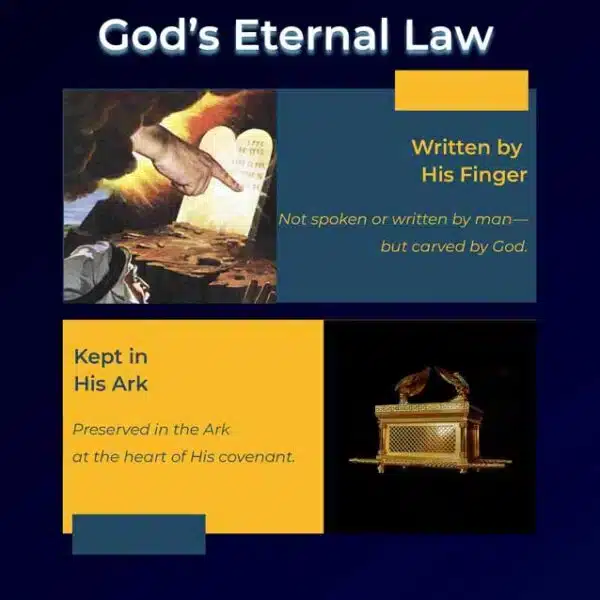
God’s Eternal Law – Written by His Finger, Kept in His Ark
📖 Exodus 31:18 – “And He gave unto Moses… two tables of testimony, tables of stone, written with the finger of God.”
🔎 The Ten Commandments were not spoken by prophets or scribes—they were audibly declared by God (Exodus 20) and personally written by His own hand. Unlike the laws Moses wrote in a book, the Ten Commandments were placed inside the Ark of the Covenant (Deuteronomy 10:2), symbolizing their eternal authority and holy origin.
They are moral in nature, applying to all people, in all times, in all places—covering worship, reverence, rest, respect, honesty, and purity. Even before Sinai, sins like murder, lying, and adultery were already condemned—showing the moral law existed before Israel (Genesis 4:8; 39:9).
The New Testament repeatedly affirms the Ten Commandments:
🔹 📖 Romans 7:12 – “The law is holy, and the commandment holy, and just, and good.”
🔹 📖 1 John 3:4 – “Sin is the transgression of the law.”
🔹 📖 Revelation 14:12 – “Here is the patience of the saints: here are they that keep the commandments of God…”
Jesus did not come to abolish this law, but to magnify and fulfill it through His life, death, and resurrection—writing it upon the heart of the believer (Hebrews 8:10).
🔥 The Ten Commandments are eternal, universal, and moral—not symbolic or ceremonial. They reveal God’s character, and breaking them is sin.
The Mosaic Law – A Temporary System Pointing to Christ
📖 Hebrews 10:1 – “For the law having a shadow of good things to come, and not the very image of the things…”
🔎 While God’s Ten Commandments were written by His finger on stone and placed inside the Ark, the Mosaic Law was written by Moses in a book and placed beside the Ark of the Covenant (📖 Deuteronomy 31:26). This distinction matters.
🔹 The Mosaic Law included civil rules, ceremonial rituals, dietary restrictions, temple services, priesthood duties, and feast observances.
🔹 It was designed specifically for ancient Israel as part of their theocratic covenant and sacrificial system.
🔹 Its purpose was to govern Israel, emphasize the seriousness of sin, and teach dependence on a coming Savior.
Though it served a divine purpose, it was temporary—a shadow of Christ’s ministry and atonement:
📖 Colossians 2:16–17 – “Let no man therefore judge you… in meat, or in drink… or of the sabbath days: which are a shadow of things to come; but the body is of Christ.”
When Christ died on the cross, the veil of the temple was torn (Matthew 27:51), signaling the end of the sacrificial system and the fulfillment of the ceremonial law in Him:
Many use this Colossians 2:16–17 to claim the weekly Sabbath was abolished, but Paul is referencing ceremonial sabbaths—feast days connected to meat and drink offerings, not the Seventh-day Sabbath of the Ten Commandments.
The Greek word for “sabbath days” is σάββατον (sabbaton), and in this plural usage and paired with feast-related ordinances, it points to yearly festival sabbaths like:
🔹 The Day of Atonement
🔹 The Feast of Trumpets
🔹 The Feast of Unleavened Bread
(See Leviticus 23 for a list of these ceremonial sabbaths).
📖 Ephesians 2:15 – “Having abolished in his flesh the enmity, even the law of commandments contained in ordinances…”
🔎 The Mosaic Law pointed forward to Jesus. Once the reality came, the shadows no longer held authority.
🔥 The Mosaic Law was temporary, national, and symbolic—pointing to Christ’s work. It was fulfilled at the cross, but God’s eternal moral law remains.
Comparing the Two – Eternal Law vs. Temporary Law
📖 Malachi 3:6 – “For I am the LORD, I change not…”
There is a clear and consistent difference in Scripture between God’s Eternal Moral Law (the Ten Commandments) and the Temporary Ceremonial Laws given to Israel through Moses. One reveals God’s unchanging character—the other pointed forward to Christ’s redemptive work.
Here’s a side-by-side breakdown: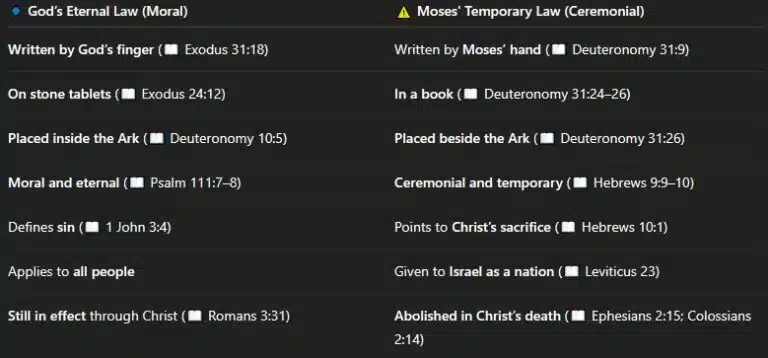
The Moral Law is rooted in God’s character, and therefore unchanging.
📖 Romans 7:12 – “Wherefore the law is holy, and the commandment holy, and just, and good.”
The Ceremonial Law, on the other hand, was a shadow (Hebrews 10:1)—a temporary system of sacrifices, offerings, and rituals that found their fulfillment in Jesus Christ, the true Lamb of God.
🔥 Trying to blend or confuse these two has led to massive doctrinal error. But once clearly separated, the truth shines brightly:
✅ God’s Moral Law remains the standard of righteousness.
❌ The Ceremonial Law was fulfilled and removed at the cross.
Jesus and the Law – How He Lived and Taught It
📖 1 Peter 2:21–22 – “Christ also suffered for us, leaving us an example, that ye should follow his steps: who did no sin, neither was guile found in his mouth.”
🔎 Jesus didn’t merely speak truth—He embodied it. He is not only our Savior, but our example. His perfect life was a demonstration of God’s Law written in the heart. He never broke a single commandment, and He called His followers to walk as He walked—not out of fear, but out of love.
📖 John 15:10 – “If ye keep my commandments, ye shall abide in my love; even as I have kept my Father’s commandments, and abide in his love.”
🔎 Far from abolishing the Ten Commandments, Jesus upheld them, deepened their meaning, and lived them out perfectly. He taught that lust is adultery in the heart (Matthew 5:27–28), that hate is murder in seed form (Matthew 5:21–22), and that love is the fulfillment of the Law—not the replacement of it.
📖 Matthew 5:17 – “Think not that I am come to destroy the law, or the prophets: I am not come to destroy, but to fulfil.”
🔎 When Jesus was asked about the greatest commandment, His answer pointed directly to the Old Testament foundation of God’s Eternal Law:
📖 Matthew 22:37–40 – “Thou shalt love the Lord thy God with all thy heart… This is the first and great commandment. And the second is like unto it, Thou shalt love thy neighbour as thyself. On these two commandments hang all the law and the prophets.”
These were not “new” commandments but direct quotes from:
🔹 Deuteronomy 6:5 – “Thou shalt love the Lord thy God…”
🔹 Leviticus 19:18 – “Thou shalt love thy neighbour as thyself.”
Christ didn’t replace the law—He revealed its true essence: love. All Ten Commandments hang from love. The first four express love toward God; the last six, love toward others. This is the heart of covenant obedience.
📖 Romans 13:10 – “Love worketh no ill to his neighbour: therefore love is the fulfilling of the law.”
🔎 To follow Christ is not simply to believe in His death—it is to walk in His steps, bearing the cross of self-denial, loving obedience, and covenant faithfulness.
📖 Luke 9:23 – “If any man will come after me, let him deny himself, and take up his cross daily, and follow me.”
🔥 “Obedience is not legalism—it’s love in action. It is the redeemed heart saying, ‘You gave everything for me—I give You my life and gladly surrender to Your law of right and wrong.’”
Paul and the Law – Misused or Misunderstood
📖 Romans 3:31 – “Do we then make void the law through faith? God forbid: yea, we establish the law.”
🔎 No apostle has been more misquoted to tear down God’s law than Paul. Yet Paul himself upheld the law again and again, affirming that it reveals sin (Romans 7:7), is holy and just (Romans 7:12), and is not made void by faith but confirmed by it (Romans 3:31).
Many use Paul’s writings to justify abolishing the law, twisting verses out of context without understanding the full picture. Peter himself warned that Paul’s letters contained some things “hard to be understood,” which “they that are unlearned and unstable wrest, as they do also the other scriptures, unto their own destruction” (2 Peter 3:16).
Paul taught that we are not saved by law-keeping, but by grace through faith. Yet the very faith that saves will never lead us to break God’s moral law—it will write it on our hearts through the Spirit (Hebrews 10:16).
🔹 When Paul says we are “not under the law” (Romans 6:14), he means we are not under its condemnation, not that we are free to sin.
🔹 When he says the “law was our schoolmaster” (Galatians 3:24), he means it pointed us to Christ—but he never said the law ceased to be righteous.
🔹 Paul often contrasts the ceremonial law (which Christ fulfilled) with the moral law (which Christ upheld)—but many blur the lines and accuse Paul of teaching against both.
🔥 Paul’s message was not lawlessness—but liberty through Christ, who enables obedience through love. True freedom is not the absence of law—but the power to walk in it by the Spirit.
The Law Written on the Heart – The New Covenant Promise
📖 Hebrews 8:10 – “I will put my laws into their mind, and write them in their hearts: and I will be to them a God, and they shall be to me a people.”
🔎 The great misunderstanding in modern Christianity is that the New Covenant abolished the law. In truth, the New Covenant internalizes the law. It is no longer simply written on stone—it is engraved on the heart of every believer through the indwelling of the Holy Spirit.
📖 Ezekiel 36:26–27 – “A new heart also will I give you… and cause you to walk in my statutes, and ye shall keep my judgments, and do them.”
This isn’t legalism—it’s transformation. God doesn’t lower the standard under the New Covenant; He empowers His people to meet it through love and grace. Where the old system relied on rituals and sacrifices to temporarily cover sin, the New Covenant gives us a Savior whose blood cleanses—and a Spirit who enables obedience.
🔹 The moral law remains the same, but the method of obedience is renewed.
🔹 We are no longer trying to earn righteousness—we are living it out from a changed heart.
🔹 Love becomes the motive, not fear. Relationship replaces ritual.
📖 Romans 13:10 – “Love is the fulfilling of the law.”
🔥 True New Covenant living is not a license to sin—it’s a call to holiness through a Spirit-empowered life. The same law that once condemned us now becomes the path we joyfully walk as a reflection of the One who saved us.
Grace and Obedience – Not Opposites, But Partners
📖 Ephesians 2:8–10 – “For by grace are ye saved through faith… not of works… For we are His workmanship, created in Christ Jesus unto good works…”
🔎 Grace is not a free pass to ignore God’s commands—it is the power that enables us to walk in them. The idea that grace cancels obedience is a modern distortion. In truth, grace forgives the past and empowers the present. It is both pardon and power.
📖 Titus 2:11–12 – “For the grace of God that bringeth salvation hath appeared to all men, teaching us that… we should live soberly, righteously, and godly, in this present world.”
The same grace that saves also teaches and transforms.
🔹 Obedience is not an attempt to earn salvation—it is the evidence of salvation.
🔹 A forgiven heart is a changed heart, and a changed heart walks differently.
🔹 Grace doesn’t remove the law—it writes it on our hearts and calls us to walk in it by faith.
📖 Romans 6:1–2 – “Shall we continue in sin, that grace may abound? God forbid.”
🔥 True grace doesn’t free us from obedience—it frees us for obedience. The cross is not the end of God’s expectations—it is the beginning of our response.
The Law in the End Times – The Final Test of Loyalty
📖 Revelation 14:12 – “Here is the patience of the saints: here are they that keep the commandments of God, and the faith of Jesus.”
🔎 In the closing scenes of earth’s history, God’s faithful people are identified by two defining traits:
-
They keep His commandments, and
-
They have the faith of Jesus.
This is not a return to works-based religion. This is covenant faithfulness—a love-born obedience that endures even under threat.
📖 Revelation 12:17 – “…which keep the commandments of God, and have the testimony of Jesus Christ.”
🔹 The final war between Christ and Satan centers on worship and allegiance.
🔹 The mark of the beast is Satan’s counterfeit—forcing worship through lawless deception.
🔹 The seal of God is given to those who lovingly choose to honor His unchanging law (Isaiah 8:16).
📖 Ecclesiastes 12:13 – “Fear God, and keep his commandments: for this is the whole duty of man.”
In the end, the question will not be merely what you believe—but who you obey and why. Obedience won’t be popular—but it will be proof of your loyalty to the Lamb.
🔥 Obedience to God’s Law is not a side issue—it is the dividing line between the remnant and the deceived.
Final Reflection – Law Keepers, Not Law Breakers
📖 1 John 2:3–4 – “And hereby we do know that we know him, if we keep his commandments. He that saith, ‘I know him,’ and keepeth not his commandments, is a liar, and the truth is not in him.”
🔎 In a world of compromise, where truth is relative and obedience is mocked, God is raising up a people who will stand firm in love—not legalism, not rebellion, but faith-filled obedience.
God’s eternal law isn’t a burden—it’s a mirror, revealing what pleases Him and what hurts us. And Christ came not to erase that mirror, but to cleanse us so we could reflect His image.
📖 Romans 3:31 – “Do we then make void the law through faith? God forbid: yea, we establish the law.”
🔹 Grace does not excuse sin—it empowers righteousness.
🔹 Faith does not destroy the law—it establishes it in the heart.
🔹 The cross does not replace obedience—it awakens love to obey.
📌 Are you striving to be saved—or are you living as one who has been saved by grace, and now walks in joyful obedience?
📌 Do you follow Jesus only with your lips—or have you surrendered your life and will to His revealed Word?
📌 Will you be counted among the law keepers, sealed by God in the end—or among the law breakers, deceived by a counterfeit gospel?
🛡️ God’s remnant people are not legalists—they are lovers of truth. Not saved by the law—but saved unto it.