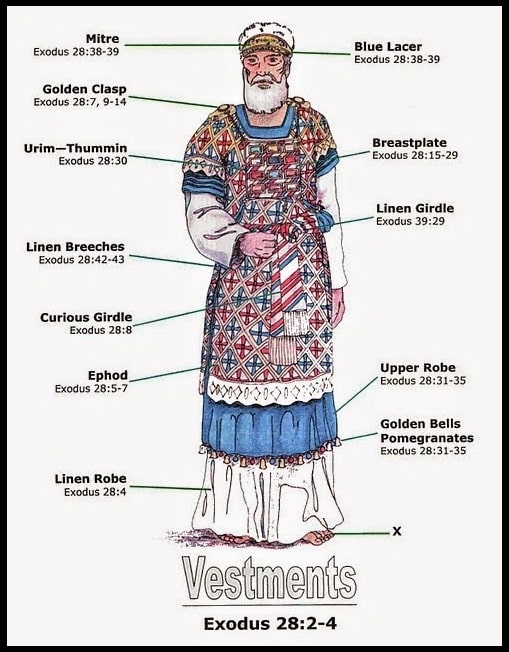
The garments of the high priest and his sons are completed. From the ephod to the breastplate, from the robe to the mitre, every detail was divinely designed and executed with precision. These were not mere clothes—they were symbols of sanctification, authority, and representation before God.
Clothed in Holiness
Exodus 39 reveals the final steps of tabernacle preparation—focusing on the garments that would set the priesthood apart. These garments were made “for glory and for beauty” (Exodus 28:2), pointing not only to external splendor but internal consecration. Holiness was not hidden—it was worn.
✔ The ephod and breastplate were finished and fastened.
✔ The robe of the ephod featured pomegranates and bells.
✔ The linen garments were crafted for Aaron’s sons.
✔ The golden crown was engraved: “HOLINESS TO THE LORD.”
📖 Key Verse: “As the Lord commanded Moses.” – Repeated throughout Exodus 39
🔎 Obedience is the true beauty that adorns God’s servants.
Exodus 39:1–7
📖 Exodus 39:1–2 – “And of the blue, and purple, and scarlet, they made cloths of service…”
🔎 A garment of divine service:
🔹 The ephod was the outermost priestly garment, signifying authority and consecration.
🔹 Made with gold thread and precious colors, it reflected heavenly royalty and purity.
🔹 Shoulder stones engraved with the names of Israel’s tribes signified representation and intercession.
➡️ Christ Connection: Jesus bears our names before the Father as our eternal High Priest (Hebrews 7:25).
Exodus 39:8–21 – The Breastplate of Judgment
📖 Exodus 39:8–9 – “And he made the breastplate of cunning work…”
🔎 Discernment and divine counsel:
🔹 The breastplate held twelve stones, each bearing a tribe’s name—resting near the priest’s heart.
🔹 It was doubled into a square, symbolizing fullness, justice, and balance.
🔹 Attached by golden chains and rings, it could not be removed—just as God’s care is unshakable.
➡️ Spiritual Insight: In Christ, we are never forgotten. He carries us close to His heart with perfect wisdom and love.
Exodus 39:22–26 – The Robe of the Ephod
📖 Exodus 39:22–23 – “And he made the robe of the ephod of woven work, all of blue.”
🔎 Sound and fruitfulness:
🔹 The robe was seamless and blue—signifying heaven and priestly continuity.
🔹 Bells and pomegranates adorned the hem, alternating in a divine pattern.
🔹 The bells ensured the priest’s presence was known; the pomegranates symbolized fruitfulness.
➡️ Faith Insight: God expects both presence and produce—true servants make sound and bear fruit.
Exodus 39:27–31 – Linen Garments and the Crown
📖 Exodus 39:30–31 – “And they made the plate of the holy crown of pure gold…”
🔎 A visible call to holiness:
🔹 The white linen garments signified purity for daily service in the tabernacle.
🔹 The golden crown engraved with “HOLINESS TO THE LORD” sat upon the high priest’s forehead—a visible testimony of his calling.
🔹 A blue lace secured the plate—royalty tied to holiness.
➡️ Spiritual Insight: Our identity in Christ is not casual—it is consecrated. Holiness should crown our thoughts and motives.
Exodus 39:32–43 – Completion and Blessing
📖 Exodus 39:32 – “Thus was all the work of the tabernacle of the tent of the congregation finished…”
🔎 Finished and faithful:
🔹 Every item commanded by God was made without deviation—obedience in the details marked the entire process.
🔹 The phrase “as the Lord commanded Moses” is repeated over and over—emphasizing the perfection of obedience.
🔹 Once the work was completed, the people brought it to Moses—showing accountability and reverence.
📖 Exodus 39:43 – “And Moses did look upon all the work, and, behold, they had done it as the Lord had commanded… And Moses blessed them.”
🔎 A divine inspection:
🔹 Moses examined everything—spiritual leadership involves discernment and careful oversight.
🔹 Because the work reflected God’s exact instructions, Moses was moved to bless the people.
➡️ Faith Insight: God’s blessing flows when His people obey fully. Completion is not just about finishing—it’s about faithfulness to every detail He commanded.
Overview: Garments for God’s Glory
🔹 Theme: Holiness on display through garments made with precision and reverence.
🔹 Focus: The spiritual role of clothing in worship and representation.
🔹 Outcome: The priesthood is now prepared to serve before the Lord.
Key Takeaways
🔑 The ephod and breastplate symbolize authority and remembrance.
🔑 The robe’s bells and pomegranates signify awareness and fruitfulness.
🔑 Linen and gold reveal purity and holiness.
🔑 Every detail was obeyed—“as the Lord commanded Moses.”
Prophetic Patterns & Dual Fulfillment
🔮 The priestly garments point to Christ’s role as our Intercessor and King (Hebrews 4:14–16).
🔮 The crown reveals the future reality of God’s people as kings and priests (Revelation 1:6).
🔮 The engraved stones represent our names written in heaven (Luke 10:20).
Historical & Cultural Context
📜 Garment Design – Each material and measurement followed a divine blueprint. Clothing was never casual before God.
📜 Symbolism – Blue, purple, scarlet, and gold signified heaven, royalty, sacrifice, and divine purity.
📜 Priestly Role – The garments marked someone set apart—sanctified to draw near for the people.
Final Reflection: Wearing Holiness
God’s people are not clothed in common garments—they are wrapped in purpose, purity, and presence. Exodus 39 teaches that holiness must be visible, obedience must be exact, and representation must be heartfelt.
📌 Are you wearing what God has prepared for you?
📌 Do your garments reflect your calling in Christ?
📌 Is your life set apart for “glory and for beauty”?
🚀 Don’t just serve in the tabernacle—dress for it.
Images