
God instructs Moses on key elements of tabernacle worship. The altar of incense, the atonement money, the anointing oil, and the holy incense all reveal deeper truths about prayer, redemption, and consecration.
Sacred Atmosphere, Sacred Acts
Every detail in Exodus 30 speaks of approaching God in holiness, with reverence, and through intercession. The elements introduced here all operate between the Holy Place and the Most Holy Place, revealing the spiritual aroma of a life devoted to God.
✔ The altar of incense—intercessory worship.
✔ Atonement money—ransom for the soul.
✔ Anointing oil—set apart for divine service.
✔ Holy incense—pure worship only for God.
📖 Key Verse: “And thou shalt make an altar to burn incense upon… before the mercy seat… where I will meet with thee.” – Exodus 30:1,6
🔎 To stand before God is no casual act—it is done through prayer, ransom, and consecration.
Exodus 30:1–10 – The Altar of Incense
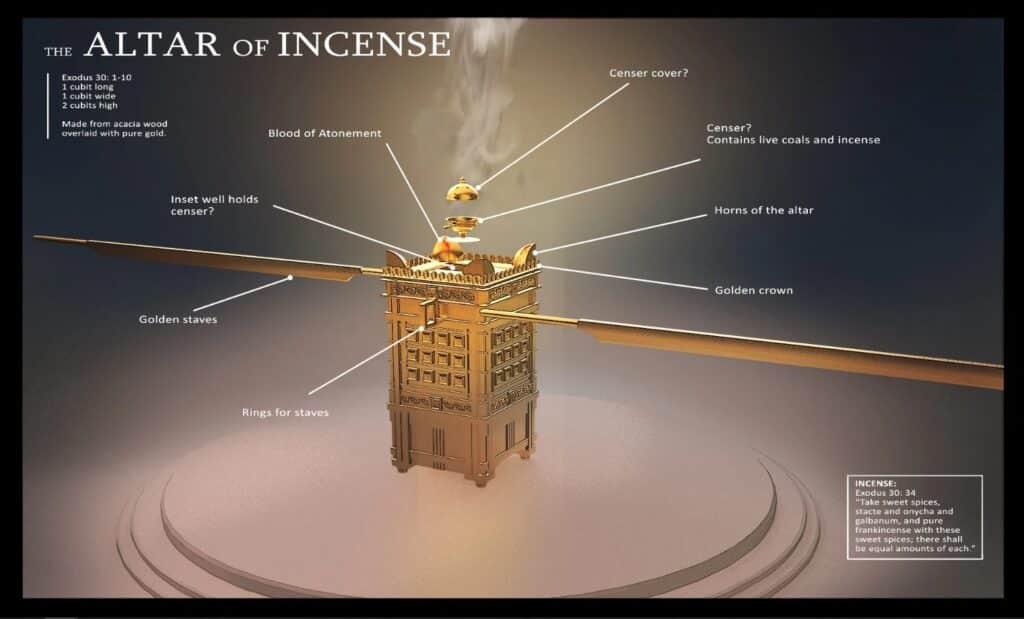
📖 Exodus 30:1–3 – *”And thou shalt make an altar to burn incense upon… overlaid with pure gold…”
🔎 Golden intercession:
🔹 The altar of incense was small in size but mighty in purpose—representing the continual prayers and worship of God’s people.
🔹 Overlaid in gold, it sat closest to the veil before the Most Holy Place—prayer reaches where man cannot go.
➡️ Spiritual Insight: Intercession is a golden work, fragrant to God and eternally significant (Revelation 5:8).
📖 Exodus 30:4–5 – *”And two golden rings shalt thou make for it… and thou shalt make the staves of shittim wood…”
🔎 Holy mobility:
🔹 Like the ark, this altar was meant to move with the people. Prayer is never restricted—it follows us through the wilderness and into glory.
➡️ Ministry Insight: A prayerful life is a portable altar—always burning, always ready.
📖 Exodus 30:6 – *”And thou shalt put it before the veil… before the mercy seat… where I will meet with thee.”
🔎 A meeting place:
🔹 God links this altar to His voice and mercy—He meets His people in the place of prayer.
🔹 Though the altar stood before the veil, its incense passed through into the presence of God.
➡️ Christ Connection: Jesus, our intercessor, offers perfect prayers—and ours rise with His (Hebrews 7:25).
📖 Exodus 30:7–8 – *”Aaron shall burn incense… every morning… and at even… a perpetual incense…”
🔎 Daily worship:
🔹 Incense was burned twice daily, morning and evening—symbolizing unceasing communion and watchfulness.
➡️ Spiritual Insight: Make prayer a rhythm—morning and evening let your worship rise (Psalm 141:2).
📖 Exodus 30:9–10 – *”Ye shall offer no strange incense… Aaron shall make atonement… once a year with the blood of the sin offering…”
🔎 Holy worship, holy access:
🔹 Only pure incense was permitted—no strange fire (Leviticus 10:1-2). Worship must be authentic and reverent.
🔹 Once a year, blood was applied to the altar—reminding that even intercession is only possible through atonement.
➡️ Warning & Glory: Never treat prayer lightly—it is a blood-bought access into the holy presence of God.
Exodus 30:11–16 – The Atonement Money
📖 Exodus 30:11–12 – *”When thou takest the sum of the children of Israel… then shall they give every man a ransom for his soul unto the Lord…”
🔎 No life without ransom:
🔹 The census required each man to pay a ransom, acknowledging that life belongs to God.
🔹 This offering was a symbol of atonement and dependence, not a tax—it was a spiritual declaration.
➡️ Christ Connection: Jesus paid the ultimate ransom for our souls (1 Timothy 2:5–6).
📖 Exodus 30:13–14 – *”Half a shekel… shall be the offering… from twenty years old and above…”
🔎 Equal value before God:
🔹 Whether rich or poor, all paid the same amount. No one could buy more favor.
🔹 This pointed to the truth that every soul has equal worth, and salvation cannot be bought or earned.
➡️ Spiritual Insight: The ground is level at the altar—we are all equally in need of grace.
📖 Exodus 30:15–16 – *”The rich shall not give more… to make an atonement for your souls… that it may be a memorial unto the Lord…”
🔎 A memorial of redemption:
🔹 The silver was used in the tabernacle—a constant reminder of their redemption.
🔹 This offering connected each person to God’s dwelling—a tangible act of devotion and remembrance.
➡️ Ministry Insight: We give not to earn favor, but as a response to the priceless value of our redemption.
Exodus 30:17–21 – The Bronze Laver
📖 Exodus 30:17–18 – *”Thou shalt also make a laver of brass… for Aaron and his sons shall wash their hands and their feet thereat.”
🔎 Washed before service:
🔹 The bronze laver was placed between the altar and the tabernacle—cleansing came after sacrifice, before service.
🔹 Hands and feet were washed—symbolizing purity in action and direction.
➡️ Spiritual Insight: Cleansing is a daily need, even after atonement—walk and serve with a clean heart (John 13:10).
📖 Exodus 30:19–21 – *”They shall wash… that they die not… it shall be a statute forever.”
🔎 Holiness and survival:
🔹 Approaching God without cleansing was deadly—not because God is cruel, but because His presence is holy.
🔹 The laver taught the seriousness of purity—even forgiven people need sanctified service.
➡️ Christ Connection: Jesus, our High Priest, washes us daily through His Word (Ephesians 5:26). We are not only forgiven—we are continually sanctified.
Exodus 30:22–33 – The Holy Anointing Oil
📖 Exodus 30:22–25 – *”Take thou also unto thee principal spices… and thou shalt make it an oil of holy ointment…”
🔎 A recipe for holiness:
🔹 God gave specific ingredients—myrrh, cinnamon, calamus, cassia, and olive oil—to craft the holy anointing oil.
🔹 This was not man-made worship—it was divinely prescribed, reminding us that true consecration must follow God’s pattern.
➡️ Spiritual Insight: The fragrance of Christ (2 Corinthians 2:15) is formed not by imitation, but by divine instruction and surrender.
📖 Exodus 30:26–29 – *”Thou shalt anoint the tabernacle… and all the vessels… they shall be most holy.”
🔎 Consecration through contact:
🔹 Everything anointed with this oil became set apart for God—anointed, sanctified, and untouchable for common use.
🔹 The oil wasn’t just symbolic—it marked the object or person as sacred.
➡️ Christ Connection: Jesus was anointed by the Spirit without measure (John 3:34), and believers are now anointed for holy living (1 John 2:20).
📖 Exodus 30:30–33 – *”Thou shalt anoint Aaron and his sons… upon man’s flesh shall it not be poured… it is holy.”
🔎 Not for common use:
🔹 This oil couldn’t be copied or applied to anyone not consecrated. Worship isn’t entertainment—it’s set apart, reverent, and Spirit-led.
🔹 Counterfeiting it was punishable—God will not accept false anointing or irreverent imitation.
➡️ Ministry Insight: The true anointing comes by calling, holiness, and obedience—not charisma or showmanship.
Exodus 30:34–38 – The Incense of Worship
📖 Exodus 30:34–35 – *”Take unto thee sweet spices… pure frankincense… tempered together, pure and holy.”
🔎 Heavenly fragrance:
🔹 This incense was not random—it was a sacred blend, perfectly measured and divinely crafted.
🔹 The ingredients were chosen for their fragrance—symbolizing prayer, praise, and reverent worship rising to God.
➡️ Spiritual Insight: Pure worship is intentionally prepared, not emotionally improvised.
📖 Exodus 30:36 – *”Thou shalt beat some of it very small… before the testimony in the tabernacle… where I will meet with thee.”
🔎 Crushed before the throne:
🔹 The incense was crushed finely before being used—reminding us that brokenness refines our worship.
🔹 It was placed before the ark—true worship brings us to the very presence of God.
➡️ Ministry Insight: The closer you want to be to God, the more refined your worship must become—holy, humble, and heartfelt.
📖 Exodus 30:37–38 – *”Ye shall not make it for yourselves… whosoever shall make like unto that… shall be cut off.”
🔎 Not for common use:
🔹 This incense was exclusive to God—never to be used for personal pleasure. Worship is not a performance or commodity.
🔹 To replicate it was to profane it—God guards His presence from counterfeit worship.
➡️ Warning & Glory: Worship is sacred. When we approach God, we must do so with purity, preparation, and awe.
Overview: Atmosphere of Holiness and Prayer
🔹 Timeframe: God’s continued instruction to Moses on Mount Sinai.
🔹 Setting: Interior worship of the tabernacle.
🔹 Theme: God is approached through intercession, cleansing, and consecrated worship.
The Altar of Incense – Fragrance of Intercession
The altar of incense stood just before the veil—the closest piece of furniture to the presence of God without entering the Most Holy Place. Every detail about it carried profound spiritual meaning:
🔹 Symbol of Prayer – The sweet-smelling incense represented the prayers of the saints rising to God (Psalm 141:2; Revelation 8:3–4). It was a constant reminder that God listens and that intercession opens the heavens.
🔹 Positioned for Access – Placed just outside the veil, it showed that prayer bridges the gap between humanity and God’s throne. Though the high priest alone could enter the Most Holy Place once a year, daily incense brought the people near.
🔹 Offered Daily – Aaron burned incense every morning and evening, just like the burnt offering. Prayer was not optional or occasional—it was part of Israel’s spiritual rhythm.
🔹 Fueled by Atonement – Once a year, blood was applied to the altar of incense, reminding us that prayer has power only through atonement. It is the blood of Christ that gives our prayers access (Hebrews 10:19).
🔹 Exclusive Worship – No strange incense was permitted. Worship had to be pure, undiluted, and designed by God. This teaches us that prayer is sacred, not casual or for performance.
➡️ Christ Connection: Jesus, our High Priest, continually intercedes for us at the heavenly altar. Because of Him, our prayers rise like incense, and we are welcomed into intimate communion with the Father (Hebrews 7:25).
Key Takeaways
🔑 Prayer is a sacred offering that rises like incense.
🔑 Atonement is required for all—rich or poor.
🔑 Cleansing, consecration, and spiritual fragrance are daily needs.
Prophetic Patterns & Dual Fulfillment
🔮 Incense altar – Symbol of Christ’s continual intercession (Revelation 8:3–4).
🔮 Atonement money – Points to Christ’s ransom for all (1 Timothy 2:6).
🔮 Anointing oil and incense – Represent the Holy Spirit and true worship (2 Corinthians 2:15).