
Exodus 27 brings us to the outer parts of God’s tabernacle—the altar of sacrifice, the courtyard boundaries, and the oil for the eternal flame. All reveal deeper spiritual truths about redemption and presence.
From the Outer Court to the Inner Fire
As we move from the Most Holy Place outward, Exodus 27 reminds us that before one draws near to God, there must be atonement through sacrifice and cleansing through separation. The journey begins at the altar and continues through the courtyard into the light.
✔ The bronze altar for sacrifices.
✔ The linen court and its pillars.
✔ Pure olive oil to keep the lamp burning continually.
📖 Key Verse: “And thou shalt command the children of Israel, that they bring thee pure oil olive beaten for the light, to cause the lamp to burn always.” – Exodus 27:20
🔎 Worship that pleases God begins at the altar and continues in the light.
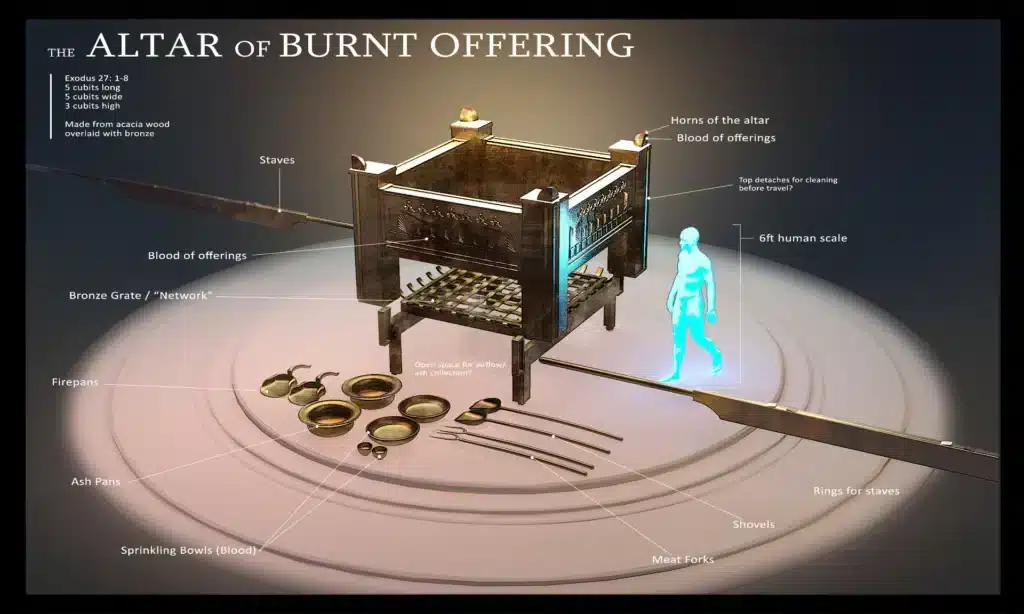
Exodus 27:1–8 – The Bronze Altar
📖 Exodus 27:1–2 – “And thou shalt make an altar of shittim wood… and overlay it with brass.”
🔎 The altar of judgment and mercy:
🔹 Made of acacia wood (durable humanity) and overlaid with bronze (symbol of judgment), the altar represents Christ’s humanity bearing divine judgment.
🔹 This was the first object one encountered—no approach to God happened without sacrifice.
➡️ Gospel Pattern: Every step toward God begins with the cross—sacrifice comes before communion.
📖 Exodus 27:3–5 – “Pans… shovels… basons… flesh hooks… all the vessels… shalt thou make of brass.”
🔎 Instruments of atonement:
🔹 Every item connected to the altar was made of bronze—tools of cleansing, fire, and offering.
🔹 Fire on the altar consumed the sacrifice—judgment poured out, but not on the sinner.
➡️ Spiritual Insight: The bronze altar speaks of the severity of sin and the depth of grace.
📖 Exodus 27:6–8 – *”And thou shalt make staves… to bear it… hollow with boards shalt thou make it…”
🔎 Mobility and mission:
🔹 The altar was made portable, emphasizing that sacrifice follows the people—atonement is always at the center of the journey.
🔹 It had to be lifted and carried—God’s grace travels with the pilgrim heart.
➡️ Christ Connection: The cross of Christ is not fixed to one place—it is for every generation, every wilderness, every heart.
Exodus 27:9–19 – The Courtyard of Separation
📖 Exodus 27:9–11 – “And thou shalt make the court of the tabernacle… with hangings of fine twined linen… and twenty pillars… with their twenty sockets of brass…”
🔎 A boundary of holiness:
🔹 The courtyard marked a clear line between the sacred and the common. Linen hangings symbolized purity and righteousness, while bronze bases reminded of judgment at the boundary.
🔹 Though visible and open, it still required a conscious entry—approach to God was invitation with reverence.
➡️ Spiritual Insight: God’s presence is open, but not casual—approach with purity and intention.
📖 Exodus 27:12–15 – “And for the breadth of the court on the west side… and the north side…”
🔎 Precision in God’s space:
🔹 Each side was measured and aligned—God’s presence demands structure, reverence, and clarity.
🔹 The symmetry reflected God’s orderly nature and consistency in holiness.
➡️ Worship Insight: How we approach God matters. Our lives must reflect intentional separation from worldly chaos.
📖 Exodus 27:16–19 – “And for the gate of the court shall be an hanging of twenty cubits… with their pillars… and sockets of brass…”
🔎 One gate, one way in:
🔹 The entrance was a single, designated gate—pointing prophetically to Christ as the only way (John 10:9).
🔹 Though the court was inclusive for all Israelites, access still required reverence and direction.
➡️ Christ Connection: There is only one door into God’s dwelling—Jesus is the gate of salvation and holiness.
Exodus 27:20–21 – The Oil That Keeps the Flame Burning
📖 Exodus 27:20 – “And thou shalt command the children of Israel, that they bring thee pure oil olive beaten for the light…”
🔎 Pure oil, faithful flame:
🔹 The oil had to be pure and beaten—not pressed with impurities. It represents the Holy Spirit, who brings clarity, purity, and presence (Zechariah 4:1–6).
🔹 Oil beaten by pressure reminds us of Christ in Gethsemane, crushed for our light.
➡️ Spiritual Insight: The Spirit that lights our lamp comes through the cost of surrender and purity.
📖 Exodus 27:21 – *”In the tabernacle of the congregation… shall order it evening to morning before the Lord continually…”
🔎 Continual intercession and presence:
🔹 The lamp was tended day and night—there was never to be darkness in God’s house.
🔹 Aaron and his sons (priests) kept it burning, symbolizing unceasing spiritual vigilance and prayer (1 Thessalonians 5:17).
🔹 The lamp’s light reflected the presence of God never departing from His people.
➡️ Christ Connection: Jesus is the Light (John 8:12), and believers are to be lamps trimmed and burning (Matthew 25:1–13).
Overview: The Path of Approach to a Holy God
🔹 Timeframe: Instructions given on Mount Sinai.
🔹 Setting: The exterior and outer court of the sanctuary.
🔹 Theme: God is holy and must be approached through sacrifice, separation, and light.
The Bronze Altar – Center of Sacrifice and Mercy
The bronze altar stood at the entrance to the courtyard—the very first object seen when approaching God’s sanctuary. It symbolized the centrality of atonement in the life of worship.
🔹 Material and Meaning – Made of acacia wood overlaid with bronze, it reflected Christ’s incorruptible humanity bearing judgment in our place. Bronze throughout Scripture represents strength and justice—used where sin is confronted.
🔹 Location – Positioned just inside the entrance of the tabernacle courtyard, the altar made it clear: before one can proceed toward the presence of God, sin must be addressed through sacrifice.
🔹 Sacrifice and Substitution – Daily offerings were made here. Animals died in place of sinners—a picture of Christ, the Lamb of God, taking our place. This wasn’t a decorative feature—it was a bloody, solemn, necessary place.
🔹 Fire That Never Went Out – Leviticus 6:13 says the fire on the altar must burn continually. It represented unceasing grace, unending access, and constant readiness to receive repentance.
🔹 Prophetic Fulfillment – The altar pointed forward to the cross. Hebrews 13:10–12 speaks of an altar we now approach spiritually—where Jesus offered Himself once for all.
➡️ Spiritual Truth: We cannot skip the altar. Forgiveness, cleansing, and access to the Father all begin where the blood is shed. The altar is not just a piece of furniture—it is a gateway to mercy.
The Tabernacle as a Journey of Spiritual Transformation
The layout of the tabernacle is not just architectural—it’s both prophetic and personal. It mirrors the believer’s walk from death to new life, and into the presence of God through Jesus Christ.
🔹 The Bronze Altar – Death to Self
This is where the journey begins. Sacrifice was made here, symbolizing repentance and the death of the old nature (Romans 6:6). It points to the cross—our first step in following Christ is surrendering self.
🔹 The Bronze Laver – Cleansing and Baptism
Next came the laver, where priests washed before service (Exodus 30:18–21). It represents baptism, cleansing, and sanctification (Titus 3:5). It reminds us that we must be washed in the Word and Spirit before entering deeper.
🔹 The Holy Place – Fellowship and Growth
Here stood the table of shewbread (communion), lampstand (Spirit), and incense altar (prayer)—daily spiritual disciplines that sustain us. This is where the believer walks in intimacy, service, and maturity.
🔹 The Most Holy Place – Presence and Glory
Beyond the veil was the ark—the throne of God. Only one could enter, once per year. But now, through Christ, the veil is torn (Hebrews 10:19–22). We are invited into full communion with God, His glory dwelling in us.
➡️ Christian Life Blueprint: From the altar to the ark, the tabernacle maps our transformation—justified by sacrifice, cleansed by water, sustained in fellowship, and welcomed into glory.
Key Takeaways
🔑 The altar is the first step to communion with God.
🔑 The courtyard establishes boundaries between the sacred and the common.
🔑 The oil represents continual light and spiritual vigilance.
Prophetic Patterns & Dual Fulfillment
🔮 The altar of burnt offering – Points to Christ’s sacrificial death (Hebrews 13:10–12).
🔮 The courtyard – Represents the believer’s separation from the world (2 Corinthians 6:17).
🔮 The oil and lamp – Symbolize the Spirit’s light (Matthew 25:1–13, Revelation 1:20).
Historical & Cultural Context
📜 Bronze (brass) – A symbol of judgment and strength, used for sacrificial instruments.
📜 The outer court – A visible, daily space where worshippers could observe sacrifices.
📜 Olive oil – Valuable, pure, and symbolically linked to anointing and spiritual presence.
Final Reflection: Have You Come Through the Altar?
No one comes into God’s presence without first passing by the altar. It is the place where sin is dealt with and light begins to shine.
📌 Have you brought your offering before the Lord?
📌 Is your heart set apart from the world’s noise and defilement?
📌 Is your lamp burning with the Spirit’s oil?
🚀 Begin at the altar. Walk through the gate. Let your flame burn always.