
In Exodus 26, God outlines the construction of the tabernacle’s inner structure. From curtains of fine linen to golden clasps and sacred veils, every element reflects the holiness and order of heaven.
A Dwelling Not Made by Human Imagination
This chapter is not just about fabric and framework—it’s about a divinely revealed pattern that speaks of access, separation, and worship. God’s house on earth is a shadow of His eternal glory above.
✔ Ten linen curtains with cherubim.
✔ Boards of acacia overlaid with gold.
✔ Veils separating the Holy Place from the Most Holy.
✔ God’s presence hidden behind the veil.
📖 Key Verse: “And thou shalt rear up the tabernacle according to the fashion thereof which was shewed thee in the mount.” – Exodus 26:30
🔎 Worship begins when God reveals the pattern, and we respond in obedience.
Exodus 26:1–14 – Curtains of Glory
📖 Exodus 26:1 – “Moreover thou shalt make the tabernacle with ten curtains of fine twined linen, and blue, and purple, and scarlet: with cherubims of cunning work shalt thou make them.”
🔎 Heavenly fabric and spiritual symbolism:
🔹 The colors—blue (heaven), purple (royalty), and scarlet (sacrifice)—reflect Christ’s divinity, kingship, and atonement.
🔹 Fine linen symbolizes purity and righteousness (Revelation 19:8).
🔹 Cherubim woven into the curtains signal that this is sacred space guarded by heaven’s host.
➡️ Worship Insight: Every detail of God’s house teaches us something about His nature, His throne, and our reverence.
📖 Exodus 26:2–6 – Curtains measured in precision, coupled together with loops and taches of gold.
🔎 Unity and order in the house of God:
🔹 The curtains were joined together as one—separate parts, yet unified.
🔹 The gold clasps (taches) held them together—symbolizing how divine glory unites the fabric of worship.
🔹 Even hidden seams mattered—God sees what we consider small.
➡️ Spiritual Pattern: In the body of Christ, we are stitched together with divine intent—different pieces, one sanctuary.
📖 Exodus 26:7–11 – “And thou shalt make curtains of goats’ hair… eleven curtains shalt thou make.”
🔎 The covering of humility:
🔹 The goats’ hair layer served as an outer covering—more rugged and less beautiful, yet essential.
🔹 It speaks of Christ’s humility and atoning sacrifice (Leviticus 16:5, the scapegoat).
🔹 What is seen outwardly may be plain, but the glory is within.
➡️ Christ Connection: Jesus bore no beauty outwardly (Isaiah 53:2), yet inside was the fullness of God.
📖 Exodus 26:12–14 – The sixth curtain doubled in the forefront… with coverings of ram skins dyed red and badgers’ skins.
🔎 Layers of protection and meaning:
🔹 The doubled curtain likely covered the entrance—a veil of mercy before the holy place.
🔹 Ram skins dyed red speak of substitutionary sacrifice, while badgers’ skins (or durable sea cow hides) offered weatherproofing—God’s dwelling is covered in redemption and strength.
➡️ Spiritual Shelter: We are covered in Christ’s blood and protected by God’s enduring strength.
Exodus 26:15–30 – Boards and Foundations
📖 Exodus 26:15–17 – “Thou shalt make boards for the tabernacle of shittim wood… every board shall have two tenons…”
🔎 Strength and structure:
🔹 Acacia wood is known for its durability and resistance to decay—symbolizing the incorruptibility of Christ and the saints (1 Corinthians 15:42).
🔹 Each board was individually shaped but designed to interlock—unity in design, firm in faith, joined in purpose.
🔹 The tabernacle could move, but it stood because of rooted boards and connectedness.
➡️ Spiritual Insight: We are the boards—hewn, refined, and placed together to form God’s dwelling.
📖 Exodus 26:18–25 – “And thou shalt make the boards for the tabernacle, twenty boards on the south side… and for the sides westward thou shalt make six boards…”
🔎 Foundation of symmetry:
🔹 God’s house had precise dimensions—not chaotic, but intentional.
🔹 Symmetry reflects divine order—God is a God of balance and proportion.
🔹 The boards were not scattered but aligned—truth and structure matter in worship.
➡️ Worship Pattern: The tabernacle reminds us that God’s design involves order, placement, and unity.
📖 Exodus 26:26–30 – “And thou shalt make bars of shittim wood… and rear up the tabernacle according to the fashion thereof…”
🔎 Held together by invisible strength:
🔹 Five bars ran across the boards, binding them together in hidden strength.
🔹 The middle bar passed through the boards—like a spine of unity, unseen but vital.
🔹 The entire tabernacle stood only because the boards held firm to the foundation and to each other.
➡️ Church Connection: Just as the Spirit unites and holds together the Body of Christ (Ephesians 4:3–6), so the bars secured the structure—a hidden strength running through God’s house.
Exodus 26:31–37 – Veils and Separation
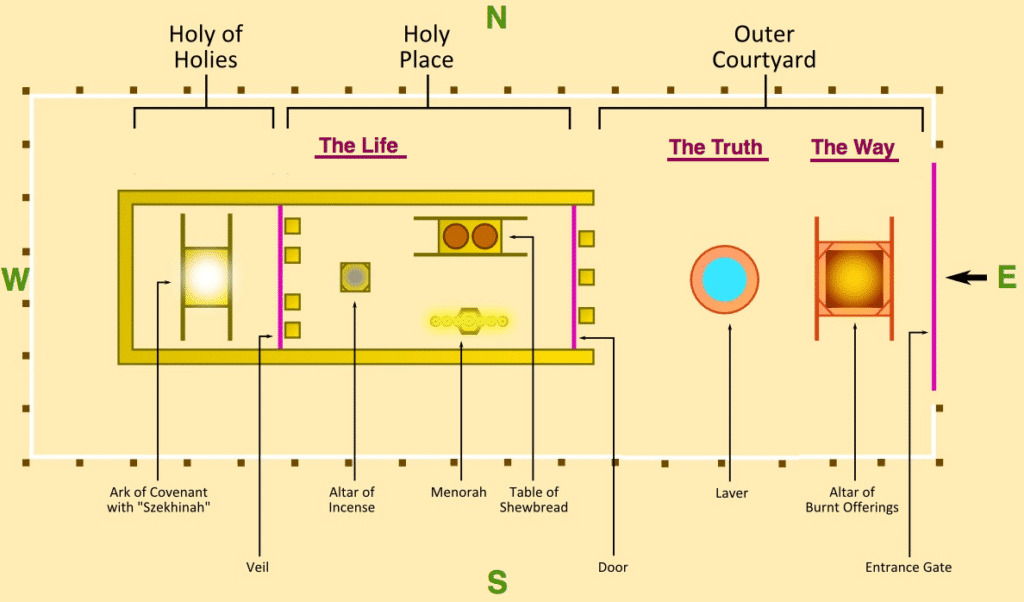
📖 Exodus 26:31–33 – “Thou shalt make a veil of blue, and purple, and scarlet, and fine twined linen of cunning work: with cherubims shall it be made… and the veil shall divide unto you between the holy place and the most holy.”
🔎 The veil of sacred separation:
🔹 The veil signified the boundary between man and the glory of God—access was strictly limited.
🔹 Like the inner curtains, it bore heavenly colors and cherubim, reflecting God’s majesty and holiness.
🔹 The veil was eventually torn at Christ’s death (Matthew 27:51), symbolizing open access to God’s presence.
➡️ Prophetic Insight: The veil once separated—but in Christ, the veil is removed (Hebrews 10:19–20).
📖 Exodus 26:34–35 – *”And thou shalt put the mercy seat upon the ark… and the table and the candlestick shall be set…”
🔎 Arrangement reveals priority:
🔹 The Ark and Mercy Seat in the Most Holy Place = God’s throne and atonement.
🔹 The Table of Shewbread and Lampstand in the Holy Place = communion and light.
🔹 God’s design flows from presence (Most Holy) to preparation (Holy Place).
➡️ Spiritual Order: True worship begins with encountering God’s mercy, then walking in light and fellowship.
📖 Exodus 26:36–37 – *”Thou shalt make an hanging for the door of the tent… and five pillars of shittim wood overlaid with gold…”
🔎 Entry with reverence:
🔹 Even the entrance had a special veil—distinct from the inner veil, but still sacred.
🔹 The five pillars symbolize stability and structure, supporting the way in.
🔹 Access to God’s house always requires respect, design, and holiness.
➡️ Christ Connection: Jesus is the door (John 10:9)—the only way into the true tabernacle of God.
Overview: God’s House on Earth as a Shadow of Heaven
🔹 Timeframe: During Moses’ 40 days on Mount Sinai.
🔹 Setting: Instructions for the internal structure of the tabernacle.
🔹 Theme: God’s holiness, separation, and desire to dwell with man.
The Tabernacle – A Blueprint of Heaven on Earth
The tabernacle was far more than a tent—it was a visible revelation of God’s invisible reality. Every element of its construction, material, and layout teaches something about heaven’s order, Christ’s ministry, and our relationship with God.
🔹 A Heavenly Pattern – God showed Moses the tabernacle as it exists in heaven (Hebrews 8:5). It was not man’s imagination—it was a divine replica pointing to greater realities.
🔹 Three Compartments – The Outer Court (salvation), Holy Place (fellowship), and Most Holy (God’s presence) reflect stages of spiritual growth and nearness.
🔹 Every Material Preaches – Gold for divinity, silver for redemption, wood for humanity, and blue, purple, and scarlet for Christ’s ministry as God, King, and Sacrifice.
🔹 God at the Center – The ark and mercy seat rested in the innermost room—teaching that God’s throne belongs at the center of worship, life, and identity.
🔹 The Tabernacle Moves – God traveled with His people. His glory was not fixed to a place, but dwelling among those who followed His voice.
➡️ Living Tabernacle: Today, believers are the sanctuary (1 Corinthians 3:16). God still desires to dwell among us—not in tents, but in hearts made holy by His Spirit.
Key Takeaways
🔑 Every part of worship must follow the divine pattern.
🔑 God reveals the way to His presence through layers of glory and reverence.
🔑 The tabernacle points to Christ and the heavenly sanctuary.
Prophetic Patterns & Dual Fulfillment
🔮 The veil – Symbol of separation between God and man, later torn by Christ (Matthew 27:51).
🔮 The cherubim-covered curtains – Reflect the heavenly throne room (Ezekiel 10, Revelation 4).
🔮 Gold-covered boards and silver sockets – Speak of both divine value and redemptive foundation.
Historical & Cultural Context
📜 Curtains and veils – Used not for decoration but to define sacred space.
📜 Acacia wood – Durable and resistant, symbolizing the incorruptible nature of what holds God’s house.
📜 Priestly access – Only the high priest entered the Most Holy once per year—until Christ tore the veil.
Final Reflection: Is Your Worship Patterned After His Revelation?
Worship is not invented—it’s received. The closer we follow God’s pattern, the more we reflect His glory.
📌 Are you treating God’s house and presence with the awe it deserves?
📌 Is your spiritual foundation built on holiness and redemption?
📌 Will you enter in through the veil made open by Christ?
🚀 God designed a meeting place—follow the pattern and enter in.