
God gives Moses heavenly instructions for a sanctuary so He can dwell among Israel. Each item—the Ark, the Table of Shewbread, and the Lampstand—points to spiritual truths and a greater reality to come in Christ.
Heaven’s Pattern, Earth’s Tabernacle
Exodus 25 shifts from covenant to construction—not of mere architecture, but of a sacred space where heaven meets earth. God gives Moses a pattern, a shadow of things above, and calls His people to give freely toward it.
✔ Offerings from willing hearts.
✔ Blueprints for the Ark of the Covenant.
✔ The golden table and lampstand.
✔ A dwelling place for God among men.
📖 Key Verse: “Let them make me a sanctuary; that I may dwell among them.” – Exodus 25:8
🔎 God doesn’t just deliver His people—He desires to dwell with them.
Exodus 25:1–9 – Willing Offerings and the Divine Pattern
📖 Exodus 25:1–2 – “Speak unto the children of Israel, that they bring me an offering: of every man that giveth it willingly with his heart…”
🔎 Worship begins with a willing heart:
🔹 God does not command forced giving—He desires gifts offered freely, out of devotion and gratitude.
🔹 This sets a precedent for cheerful giving in both Testaments (see 2 Corinthians 9:7).
🔹 The sanctuary was built by love—not compulsion.
➡️ Spiritual Insight: True worship begins when the heart is moved to give without pressure.
📖 Exodus 25:3–7 – “And this is the offering which ye shall take of them; gold, and silver, and brass…”
🔎 Specific materials with spiritual significance:
🔹 Each material had symbolic meaning—gold for divinity, silver for redemption, brass for judgment.
🔹 Blue, purple, and scarlet reflect royalty, priesthood, and sacrifice.
🔹 These materials were not random—they were chosen by God to reflect His heavenly glory.
➡️ Sanctified Resources: What we offer to God should reflect both excellence and meaning.
📖 Exodus 25:8 – “Let them make me a sanctuary; that I may dwell among them.”
🔎 God’s desire is nearness:
🔹 The sanctuary was not for spectacle, but for presence—God longs to dwell with His people.
🔹 This echoes Eden and foreshadows the incarnation of Christ and the indwelling of the Spirit (John 1:14, Revelation 21:3).
➡️ Covenant Fulfillment: The sanctuary is God’s dwelling made visible—a place where heaven touches earth.
📖 Exodus 25:9 – “According to all that I shew thee… even so shall ye make it.”
🔎 A heavenly blueprint:
🔹 God gives Moses a precise pattern—this wasn’t left to human creativity.
🔹 Hebrews 8:5 confirms this pattern reflects heavenly realities—a copy of the true tabernacle above.
🔹 Obedience to the pattern is part of faithful worship.
➡️ Divine Design: We don’t invent how to approach God—we follow His revealed pattern.
Exodus 25:10–22 – The Ark of the Covenant
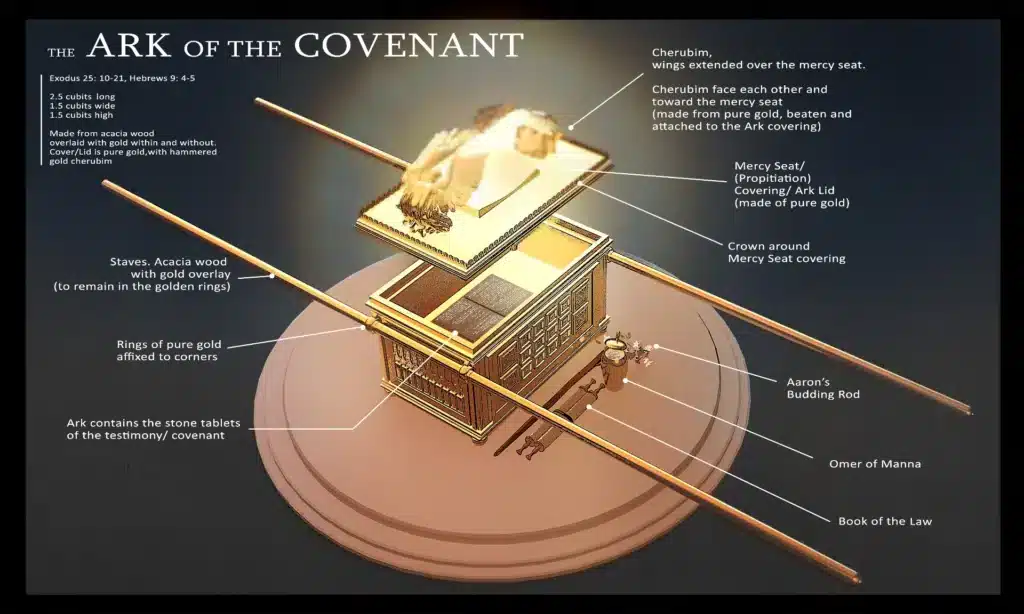
📖 Exodus 25:10–11 – “And they shall make an ark of shittim wood… and thou shalt overlay it with pure gold…”
🔎 Earth meets heaven:
🔹 The Ark is made from acacia wood (durability) and overlaid with gold (divinity)—symbolizing Christ’s dual nature: fully man and fully God.
🔹 It is the most sacred object in the tabernacle, representing God’s throne on earth.
➡️ Christ Connection: Jesus is the true Ark—God dwelling among us in flesh and glory.
📖 Exodus 25:12–16 – “And thou shalt cast four rings of gold for it… And thou shalt put into the ark the testimony…”
🔎 Mobility and covenant:
🔹 The Ark had rings and poles so it would never be touched directly—God’s holiness must be approached with reverence.
🔹 The tablets of the covenant were placed inside—this was the core of the relationship between God and His people.
➡️ Spiritual Insight: God’s throne is built upon truth, holiness, and covenant loyalty.
📖 Exodus 25:17–22 – “And thou shalt make a mercy seat of pure gold… and there I will meet with thee…”
🔎 The Mercy Seat and divine presence:
🔹 The mercy seat (Hebrew: kapporeth) was the golden lid covering the Ark—where blood was sprinkled on the Day of Atonement (Leviticus 16).
🔹 Two cherubim faced each other over it—representing heavenly witnesses to God’s holiness.
🔹 God said, “There I will meet with thee”—the mercy seat became the intersection of justice and mercy.
➡️ Prophetic Fulfillment: Romans 3:25 calls Christ our hilasterion (mercy seat)—God meets us through His blood, not our merit.
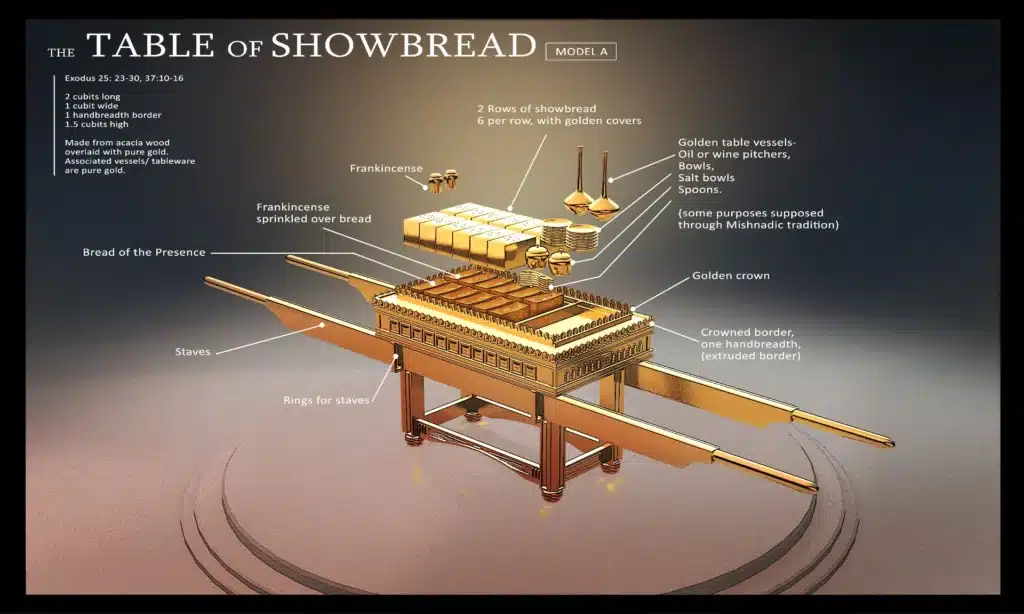
Exodus 25:23–30 – The Table of Shewbread
📖 Exodus 25:23–24 – “Thou shalt also make a table of shittim wood… and overlay it with pure gold…”
🔎 Provision in the presence:
🔹 The table represents God’s continual provision and communion.
🔹 Acacia wood and gold again reflect humanity wrapped in divinity, pointing to Christ as the source of sustenance.
🔹 The table was set in the Holy Place—fellowship is central in worship.
➡️ Christ Connection: Jesus is the Bread of Life who sits before the Father as our everlasting provision (John 6:35).
📖 Exodus 25:25–28 – “And thou shalt make unto it a border… and four rings of gold… to bear the table withal.”
🔎 Framed in beauty, built for service:
🔹 The border preserved the bread—God’s provision is guarded and secure.
🔹 The rings and staves once again show that God travels with His people—fellowship is never confined.
🔹 Holiness is meant to move, not remain hidden.
➡️ Worship Insight: Our relationship with God must be both protected and portable—sacred but active.
📖 Exodus 25:29–30 – “And thou shalt set upon the table shewbread before me alway.”
🔎 Eternal fellowship:
🔹 The bread (Hebrew: lechem panim, “bread of the presence”) symbolized constant communion between God and His people.
🔹 It pointed forward to Christ’s abiding presence, and the unending access to God through Him.
🔹 The bread was always to be before God—a visual sign of provision and relationship.
➡️ Prophetic Fulfillment: Christ is always before the Father—our nourishment, intercession, and covenant feast.
Exodus 25:31–40 – The Golden Lampstand
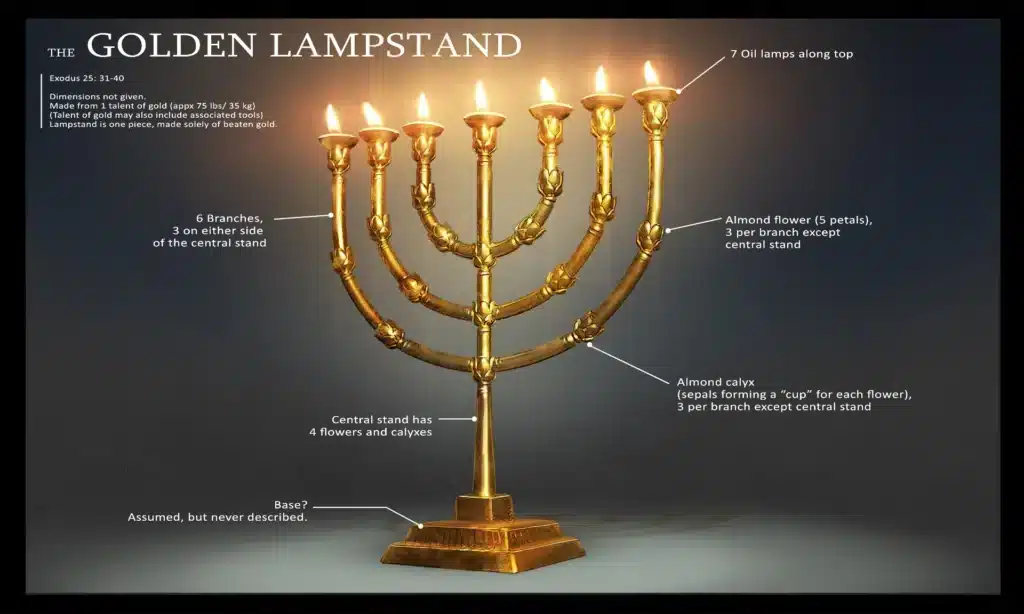
📖 Exodus 25:31–32 – *”And thou shalt make a candlestick of pure gold… and six branches shall come out of the sides of it…”
🔎 Light crafted in purity:
🔹 The lampstand (Hebrew: menorah) was beaten from one piece of pure gold, symbolizing divine unity and perfection.
🔹 With seven branches, it represents completion, light, and the Spirit of God (see Revelation 4:5).
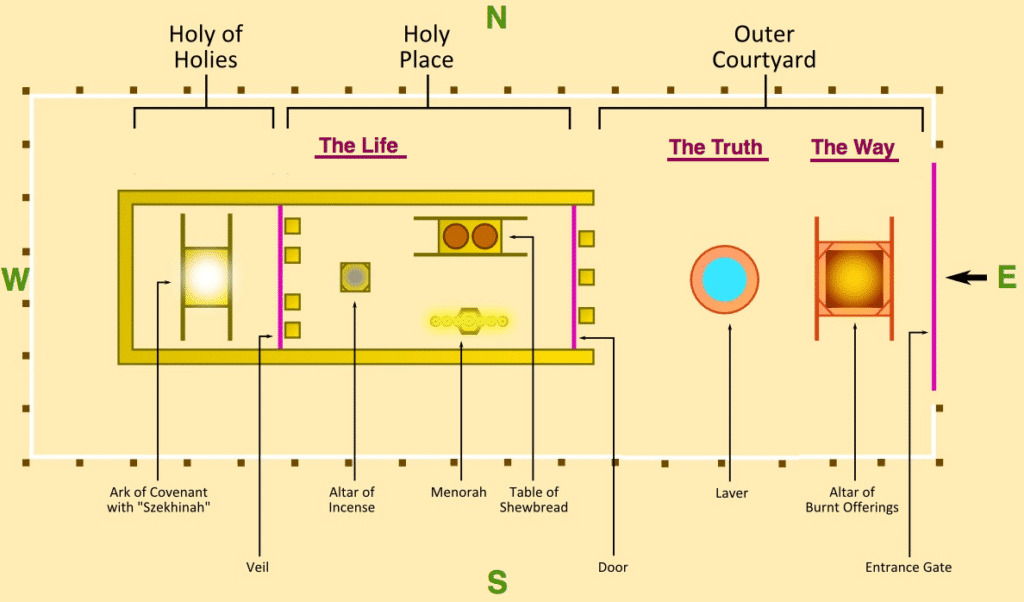
🔹 It stood in the Holy Place, providing the only light—God’s Spirit is the light in the darkness.
➡️ Spiritual Insight: The lampstand points to the Holy Spirit, illuminating truth and guiding worship.
📖 Exodus 25:33–36 – *”Three bowls made like unto almonds… with a knop and a flower… one beaten work of pure gold.”
🔎 Life from the light:
🔹 Almond blossoms were the first to bloom in spring—symbolizing resurrection, new life, and watchfulness.
🔹 Every detail of the lampstand speaks of beauty, growth, and divine design.
🔹 It was not just functional—it was living symbolism, reflecting spiritual awakening.
➡️ Christ Connection: Jesus is the true Light (John 8:12) and the Branch that blossoms (Isaiah 11:1).
📖 Exodus 25:37–40 – *”And thou shalt make the seven lamps… and look that thou make them after their pattern…”
🔎 Heavenly light, heavenly pattern:
🔹 The seven lamps were to give light over against the table—pointing light toward fellowship and provision.
🔹 God reminds Moses again to follow the pattern exactly—this was no human invention, but a shadow of heavenly reality.
➡️ Prophetic Fulfillment: The menorah reflects the fullness of God’s Spirit (Isaiah 11:2), illuminating the way of holiness.
Overview: Where God Dwells Among Men
🔹 Timeframe: During Moses’ 40 days on Mount Sinai.
🔹 Setting: God gives precise instructions for sacred objects.
🔹 Theme: God desires worship, reverence, and relationship through a holy sanctuary.
Symbolic Significance of the Ark, Table, and Lampstand
Each item in Exodus 25 carries layers of symbolic and prophetic meaning that point to Christ and the divine order of worship.
🔹 The Ark of the Covenant – This was the throne of God on earth, containing the covenant tablets, and crowned with the mercy seat. It symbolized:
- God’s presence and holiness
- Christ as the dwelling of God in flesh (John 1:14)
- The cross where mercy meets justice (Romans 3:25)
🔹 The Table of Shewbread – Always present before God, this table held the bread of the Presence:
- Fellowship and provision in God’s presence
- Christ as the Bread of Life (John 6:35)
- Continual communion with God through covenant
🔹 The Golden Lampstand – Beaten from pure gold, it stood as the only source of light in the Holy Place:
- The fullness of the Holy Spirit (Isaiah 11:2, Revelation 4:5)
- Christ as the Light of the World (John 8:12)
- Spiritual illumination and guidance for worship
➡️ Sanctuary Insight: These three elements—presence (ark), provision (table), and light (lampstand)—form the foundation of true worship and reveal the heavenly pattern of relationship with God.
Key Takeaways
🔑 God wants a dwelling place among His people.
🔑 He asks for offerings only from willing hearts.
🔑 The tabernacle is a shadow of heavenly realities.
🔑 Every item holds deep spiritual symbolism.
Prophetic Patterns & Dual Fulfillment
🔮 The Ark as God’s throne – Fulfilled in Christ, our mercy seat (Romans 3:25).
🔮 The Lampstand as the Spirit – Seven lamps = the fullness of the Spirit (Revelation 4:5).
🔮 The Table of Shewbread – Christ, the Bread of Life, ever-present before God (John 6:35).
Historical & Cultural Context
📜 Sanctuary structure – A mobile tent of worship central to Israel’s identity.
📜 Freewill offerings – Participation in worship through giving.
📜 Heavenly pattern – Everything God designed for holiness on earth was a reflection of something greater in heaven (Hebrews 8:5).
Final Reflection: Is Your Heart a Sanctuary?
The true sanctuary God desires is not built with hands—but within us.
📌 Do you offer your worship and obedience willingly?
📌 Are you patterning your life after heaven’s design?
📌 Is your heart a place where God delights to dwell?
🚀 Let Him build a holy place within you. Follow the pattern.