
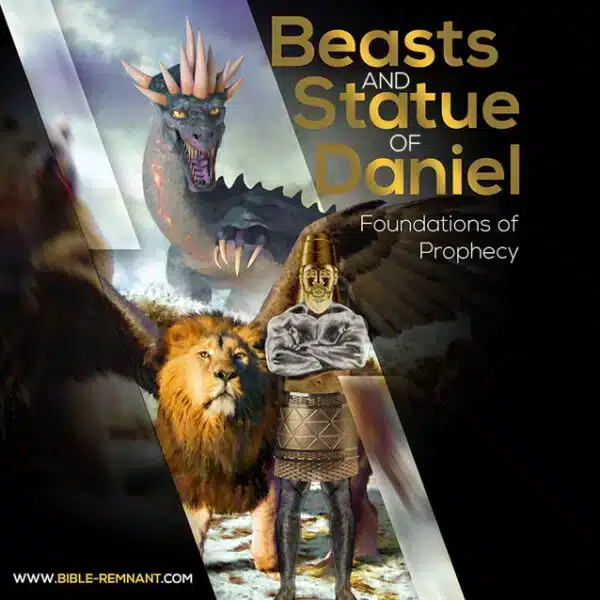
Daniel’s Statue and Beasts – The Prophetic Blueprint of Empires
📖 Isaiah 46:9–10 – “I am God, and there is none else; I am God, and there is none like me, declaring the end from the beginning, and from ancient times the things that are not yet done.”
God alone has the power to reveal the course of history before it happens. In the book of Daniel, He gave a panoramic view of world empires, showing how each kingdom would rise and fall until the final triumph of Christ’s everlasting kingdom.
The visions of the statue in Daniel 2 and the four beasts in Daniel 7 are two sides of the same coin. The statue shows the outward splendor of human empires; the beasts reveal their inner character—predatory, violent, and opposed to God’s people. Together, these visions form the foundation of prophecy, preparing us to understand the beasts of Revelation.
To study Daniel’s prophecies is to see that history is not random—it is guided by God. And the same God who revealed the rise of Babylon and Rome has also revealed the powers at work today.
Study Guides for Understanding Prophecy
To follow this study with clarity, we encourage you to first review these two foundational guides:
🔹 Prophecy Symbols Explained – A quick-reference guide to beasts, horns, crowns, women, waters, and other prophetic symbols.
🔹 Prophetic Time Unveiled – A complete study on how God measures time in prophecy, including the 70 weeks, the 1,260 years, and more.
⚠️ These two guides act as keys, unlocking the language of prophecy and helping us rightly interpret the messages of Daniel and Revelation.
The Dream of the Statue – God’s Panorama of History
📖 Daniel 2:31–33 – “Thou, O king, sawest, and behold a great image. This great image, whose brightness was excellent, stood before thee; and the form thereof was terrible. This image’s head was of fine gold, his breast and his arms of silver, his belly and his thighs of brass, his legs of iron, his feet part of iron and part of clay.”
🔎 In Nebuchadnezzar’s dream, God revealed the rise and fall of the world’s empires in one sweeping panorama. The image was dazzling to human eyes—gold, silver, bronze, iron. To man, these kingdoms appeared glorious and enduring. Yet their glitter masked their corruption. The statue showed history from the outside.
Later, in Daniel 7, God peeled back the curtain and gave Daniel a second vision—this time not to a king but to His prophet. Instead of a glittering statue, the empires were shown as beasts. This is how they look from heaven’s perspective: violent, devouring, destructive. The contrast is deliberate—man sees splendor, God sees sin.
Why God Gave These Visions
🔹 To Reveal His Sovereignty – No empire rises or falls by accident. God foretold history before it happened to prove He rules over the kingdoms of men (Daniel 2:21).
🔹 To Expose Human Pride – The statue’s shining metals reveal how men glorify themselves. The beasts expose their true nature before God.
🔹 To Prepare His People – God’s people would live under these empires. Knowing what was to come gave them courage to stand faithful.
🔹 To Point to the End – Both visions climax with God’s everlasting kingdom, showing that human empires are temporary, but Christ’s reign is eternal (Daniel 2:44).
Lessons from the Statue and Beasts
🔹 The Statue (Daniel 2) – Outward splendor, man’s perspective, kingdoms seen as mighty and glorious.
🔹 The Beasts (Daniel 7) – Inward corruption, God’s perspective, kingdoms seen as predatory and cruel.
📖 1 Samuel 16:7 – “For the Lord seeth not as man seeth; for man looketh on the outward appearance, but the Lord looketh on the heart.”
🔎 The two visions together teach us: what men exalt, God exposes. What looks like gold to us may look like a beast to Him.
⚠️ God gave Nebuchadnezzar the statue to show the sweep of history in human terms. He gave Daniel the beasts to show the spiritual reality behind the same powers. Together, they form the foundation of prophecy, setting the stage for all that follows in Daniel and Revelation.
The Dream of the Statue – God’s Panorama of History
📖 Daniel 2:31–33 – “Thou, O king, sawest, and behold a great image. This great image, whose brightness was excellent, stood before thee; and the form thereof was terrible. This image’s head was of fine gold, his breast and his arms of silver, his belly and his thighs of brass, his legs of iron, his feet part of iron and part of clay.”
🔎 The statue represents the succession of world empires, each metal symbolizing a kingdom that would dominate history until Christ’s return.
The Breakdown of the Statue
🔹 Head of Gold – Babylon (605–539 B.C.)
The kingdom of Nebuchadnezzar, wealthy and glorious, represented by gold (Daniel 2:37–38).
🔹 Chest and Arms of Silver – Medo-Persia (539–331 B.C.)
Inferior in wealth but stronger militarily. Two arms = dual kingdom of the Medes and Persians (Daniel 5:28, 31).
🔹 Belly and Thighs of Bronze – Greece (331–168 B.C.)
Swift and expansive, led by Alexander the Great. Bronze symbolized Greek dominance (Daniel 8:21).
🔹 Legs of Iron – Rome (168 B.C.–A.D. 476)
Strong and crushing, Rome ruled with unmatched military power, symbolized by iron (Daniel 7:23).
🔹 Feet of Iron and Clay – Divided Europe (476 A.D.–Present)
After Rome’s fall, Europe never reunited into one empire. Iron mixed with clay = strong and weak elements, partly united, partly divided (Daniel 2:41–43).
🔹 The Stone Cut Without Hands – Christ’s Eternal Kingdom
God’s kingdom will destroy all earthly powers and stand forever (Daniel 2:44–45).
⚠️ The statue shows us that God rules history. Every empire rose and fell exactly as He foretold. The final empire will not be man-made—it will be the eternal kingdom of Christ.
A Pointer for Deeper Study
This overview provides the framework of history, but each empire’s role is explored in greater depth in our dedicated series:
👉 The Statue of Daniel Series
The Four Beasts of Daniel 7 – The Hidden Character of Empires
📖 Daniel 7:3–4 – “And four great beasts came up from the sea, diverse one from another. The first was like a lion, and had eagle’s wings…”
🔎 In Daniel 2, the empires of man appear as a dazzling statue of gold, silver, bronze, and iron. But in Daniel 7, God reveals how He sees them—not as shining metals, but as wild beasts, devouring and trampling the earth. To man, they looked glorious; to God, they were violent, oppressive, and opposed to His truth.
The Lion with Eagle’s Wings – Babylon (605–539 B.C.)
📖 Daniel 7:4 – “The first was like a lion, and had eagle’s wings: I beheld till the wings thereof were plucked, and it was lifted up from the earth, and made stand upon the feet as a man, and a man’s heart was given to it.”
🔹 Symbolism: The lion is the king of beasts, and eagle’s wings symbolize speed and majesty. Babylon’s palaces and gates were adorned with winged lions, making the image unmistakable.
🔹 Fulfillment: The plucked wings point to Babylon’s sudden fall to Medo-Persia (Daniel 5:30–31). The lion standing as a man reflects Nebuchadnezzar’s humbling and eventual acknowledgment of the true God (Daniel 4:34–37).
🔹 Cross-References: Jeremiah 4:7 calls Babylon “a lion” that destroys nations.
🔹 Spiritual Insight: Babylon fell because of pride. When nations or individuals exalt themselves against God, He humbles them.
🔹 Christ in Babylon: God preserved His people—Daniel, Shadrach, Meshach, and Abednego—witnesses to His power in the midst of pagan rule.
🔹 Link to Statue: Head of gold (Daniel 2:38).
The Bear Raised on One Side – Medo-Persia (539–331 B.C.)
📖 Daniel 7:5 – “And behold another beast, a second, like to a bear, and it raised up itself on one side, and it had three ribs in the mouth of it between the teeth of it: and they said thus unto it, Arise, devour much flesh.”
🔹 Symbolism: The bear raised higher on one side reflects the Persians’ dominance over the Medes.
🔹 Three Ribs: Are its conquests of Babylon, Lydia, and Egypt—three major conquests.
🔹 Fulfillment: Medo-Persia conquered Babylon in 539 B.C., becoming vast but less splendid than Babylon. Heavy and devouring, the bear shows brute force more than brilliance.
🔹 Cross-References: Isaiah 13:17 foretold God stirring up the Medes against Babylon.
🔹 Spiritual Insight: Violence and raw power can dominate for a time, but they cannot stand forever.
🔹 Christ in Persia: God raised up Esther, Ezra, and Nehemiah under Persian rule, preserving His people and restoring Jerusalem.
🔹 Link to Statue: Chest and arms of silver (Daniel 2:39).
The Leopard with Four Wings and Four Heads – Greece (331–168 B.C.)
📖 Daniel 7:6 – “After this I beheld, and lo another, like a leopard, which had upon the back of it four wings of a fowl; the beast had also four heads; and dominion was given to it.”
🔹 Symbolism: A leopard is swift, but four wings make it even faster. This perfectly mirrors Alexander the Great’s lightning conquests across the world.
🔹 Four Heads: After Alexander’s sudden death in 323 B.C., his empire split among four generals—Cassander, Lysimachus, Seleucus, and Ptolemy (Daniel 8:8, 22).
🔹 Fulfillment: Greece spread Hellenistic culture—philosophy, politics, and false religion—throughout the world, leaving a lasting influence.
🔹 Cross-References: Habakkuk 1:8 compares invaders to leopards swift to devour.
🔹 Spiritual Insight: Human wisdom, apart from God, may dazzle for a time but ultimately corrupts. Greek philosophy still shapes modern secular thought, often in opposition to Scripture.
🔹 Christ in Greece: The Old Testament was translated into Greek (the Septuagint), preparing the way for the gospel to spread across the world in the New Testament era.
🔹 Link to Statue: Belly and thighs of bronze (Daniel 2:39).
The Dreadful Beast with Iron Teeth – Rome (168 B.C.–476 A.D.)
📖 Daniel 7:7 – “After this I saw in the night visions, and behold a fourth beast, dreadful and terrible, and strong exceedingly; and it had great iron teeth: it devoured and brake in pieces, and stamped the residue with the feet of it: and it was diverse from all the beasts that were before it; and it had ten horns.”
🔹 Symbolism: Unlike the others, this beast is not compared to any animal—it is too brutal. Its iron teeth match the iron legs of the statue.
🔹 Fulfillment: Rome ruled with unmatched might, crushing nations under its armies. It was during Rome’s reign that Christ was born, crucified, and the early church was persecuted.
🔹 Ten Horns: Symbolize the division of Rome into ten kingdoms after its fall in A.D. 476 (Daniel 7:24). These became the foundation of modern Europe.
🔹 Cross-References: Revelation 13:2 describes the final beast as a composite of lion, bear, and leopard with the dragon’s power—showing Rome’s legacy carried forward.
🔹 Spiritual Insight: Rome’s cruelty reminds us that worldly power always turns against Christ. The cross itself is the ultimate proof.
🔹 Christ in Rome: The empire that crucified Christ also carried the gospel to the world through Roman roads, language, and order—God used Rome’s strength to advance His truth.
🔹 Link to Statue: Legs of iron, feet of iron and clay (Daniel 2:40–43).
⚠️ Daniel’s beasts are not myths but prophetic history with spiritual lessons. Babylon fell through pride. Medo-Persia through brute force. Greece through corrupted wisdom. Rome through oppressive cruelty. Each empire rose and fell exactly as God foretold, proving His sovereignty. And just as surely, the final system of false worship will rise—blending the traits of all before it. These visions set the stage for the little horn power (papal Rome) and the beasts of Revelation, showing prophecy’s unbroken continuity from Daniel to John, and from history to our day.
The Little Horn – The Power That Rises From Rome
📖 Daniel 7:8 – “I considered the horns, and, behold, there came up among them another little horn, before whom there were three of the first horns plucked up by the roots: and, behold, in this horn were eyes like the eyes of man, and a mouth speaking great things.”
🔎 Out of the ruins of the Roman Empire, ten horns (kingdoms) arose. But then came another horn—small at first, yet more powerful than the rest. Unlike the other kingdoms, this horn was unique. It was not just political; it was religious. It claimed authority over kings, nations, and even the conscience of God’s people.
Identifying Features of the Little Horn
🔹 Rises Among the Ten Horns
The little horn emerges from the divided Roman Empire, meaning it must be located in Western Europe (Daniel 7:8). History confirms this: the papacy rose in Rome, at the heart of the empire’s ruins.
🔹 Uproots Three Horns
Three Arian kingdoms—the Heruli (493), Vandals (534), and Ostrogoths (538)—were removed to secure papal supremacy (Daniel 7:24). These were powers that opposed papal authority. Their removal paved the way for Rome’s bishop to rise uncontested.
🔹 Eyes Like a Man
Symbolizes intelligence, cunning, and human leadership substituting for divine authority (Daniel 7:8). Instead of Christ as Head, one man claimed to be the Vicar of Christ on earth.
🔹 A Mouth Speaking Great Things and Blasphemy
Boasts of divine titles, claiming power to forgive sins and stand in God’s place (Daniel 7:25; Revelation 13:5–6).
📖 2 Thessalonians 2:4 – “Who opposeth and exalteth himself above all that is called God… shewing himself that he is God.”
🔹 Persecutes the Saints
For 1,260 prophetic days (years), the little horn “wore out the saints” (Daniel 7:25). Millions of faithful believers were tortured, burned, and martyred during the Inquisition, Crusades, and persecutions of the Middle Ages.
🔹 Thinks to Change Times and Laws
The papacy altered God’s law, shifting the Sabbath from the seventh day to Sunday and splitting the Ten Commandments to preserve the number (Daniel 7:25).
📖 Matthew 15:9 – “But in vain they do worship me, teaching for doctrines the commandments of men.”
🔹 Dominates for 1,260 Years
From A.D. 538 to 1798, papal Rome ruled with both civil and religious power, exactly as prophecy foretold (Revelation 13:5–7).
Historical Fulfillment
🔹 493–534 – The Heruli and Vandals were destroyed.
🔹 533 A.D. – Emperor Justinian issued a decree recognizing the bishop of Rome as the “head of all the holy churches,” granting him authority in both religious and civil matters.
🔹 538 A.D. – The decree became effective only after the Ostrogoths, the final Arian power opposing papal supremacy, were driven from Rome. From this point, the papacy held uncontested religious and political authority.
🔹 538–1798 – For 1,260 years, the papacy wielded civil and spiritual power, persecuting those who clung to Scripture.
🔹 1798 – Napoleon’s general Berthier entered Rome, captured Pope Pius VI, and ended papal civil authority, striking the prophesied “deadly wound” (Revelation 13:3).
⚠️ The little horn is not a matter of speculation—it matches every prophetic marker. It is the papal system, rising from Rome, uprooting rivals, claiming God’s authority, persecuting His saints, and ruling for 1,260 years exactly as foretold.
This is the same power John later described as the beast from the sea in Revelation 13. Daniel and Revelation unite to give us one picture: a counterfeit religious system empowered by Satan, standing in opposition to Christ.
📖 John 8:36 – “If the Son therefore shall make you free, ye shall be free indeed.”
🔎 Where the little horn enslaves through fear, false worship, and man-made decrees, Christ brings freedom through truth. Prophecy unmasks the counterfeit so that God’s people can stand firm in Christ alone.
From Daniel to Revelation – Prophecy’s Continuity
📖 Daniel 7:25 – “And he shall speak great words against the most High, and shall wear out the saints of the most High, and think to change times and laws: and they shall be given into his hand until a time and times and the dividing of time.”
📖 Revelation 13:5–7 – “And there was given unto him a mouth speaking great things and blasphemies… and it was given unto him to make war with the saints, and to overcome them: and power was given him over all kindreds, and tongues, and nations.”
🔎 The little horn of Daniel 7 and the sea beast of Revelation 13 are the same power, described from different angles and across different times. Daniel focuses on its rise out of Rome; John shows its global reach at the end of time. Together, they form one continuous prophetic picture.
Parallels Between Daniel 7 and Revelation 13
🔹 Speaks Great Words / Blasphemy – Claims divine prerogatives (Daniel 7:25; Revelation 13:5–6).
🔹 Persecutes the Saints – Wages war against God’s people (Daniel 7:25; Revelation 13:7).
🔹 Time of Rule – “Time, times, and half a time” = 42 months = 1,260 years (Daniel 7:25; Revelation 13:5).
🔹 Changes God’s Law – Daniel emphasizes altering “times and laws” (Daniel 7:25), while Revelation highlights enforced false worship (Revelation 13:15).
🔹 Global Influence – Daniel shows regional dominance; John reveals worldwide authority, power over “all kindreds, tongues, and nations” (Revelation 13:7).
Why This Connection Matters
🔹 It proves the Bible is consistent: Daniel and John, separated by 600 years, describe the same power.
🔹 It shows prophecy unfolding in stages: first in history (538–1798), and then in end-time fulfillment (the healing of the deadly wound).
🔹 It prepares us for the final test: enforced false worship, when the image of the beast is established.
⚠️ Daniel and Revelation are not separate books—they are one prophetic voice. Daniel lays the foundation; Revelation brings it to completion. To understand the beasts of Revelation, we must first understand the beasts of Daniel.
Final Reflection – Foundations That Point to the End
📖 Daniel 2:44 – “And in the days of these kings shall the God of heaven set up a kingdom, which shall never be destroyed… and it shall stand for ever.”
🔎 The visions of the statue in Daniel 2 and the beasts in Daniel 7 form the foundation of prophecy. They reveal that God foresaw every empire, from Babylon to Rome, and exposed their true nature—not glorious metals, but beasts devouring and trampling His people. Out of this sequence rose the little horn, the power that would later appear in Revelation as the sea beast.
History has confirmed every step with precision. Babylon fell, Medo-Persia rose, Greece conquered, Rome crushed, and papal Rome ruled for 1,260 years—exactly as prophecy declared. The same God who guided history in the past now points us forward to the final test: the rise of the beast, the image, and Babylon’s last deception.
📌 Do I see history as random, or as unfolding exactly as God revealed through Daniel?
📌 Am I prepared to recognize the same powers at work today in different forms?
📌 Will I follow Christ’s eternal kingdom, or be swept up by the temporary powers of this world?
⚠️ Daniel’s prophecy is not just history—it is the blueprint of the end. To understand Revelation, we must first understand Daniel. Those who see the continuity will not be deceived when the final beast rises.
View the complete series: View Now