

Daniel 1 sets the stage for prophetic history. Taken into captivity, Daniel and his friends face cultural assimilation, but choose faithfulness over compromise. Their obedience leads to divine favor and long-lasting influence in a pagan world.
A Remnant Tested in a Foreign Land
When Babylon conquers Jerusalem, it doesn’t just destroy walls—it tries to reprogram minds. Daniel and his companions are chosen for re-education in the king’s court. Yet instead of compromise, they demonstrate courageous faith, laying the foundation for the prophetic revelations that follow.
✔ Jerusalem is besieged by Babylon.
✔ Young Hebrews are taken captive.
✔ Daniel refuses the king’s food.
✔ God gives them wisdom and favor.
📖 Key Verse: “But Daniel purposed in his heart that he would not defile himself…” – Daniel 1:8
🔎 True faith begins with quiet decisions that resist pressure, even when no one is watching.
Daniel 1:1–2 – Judgment Begins
📖 Daniel 1:1 – “In the third year of the reign of Jehoiakim king of Judah came Nebuchadnezzar king of Babylon unto Jerusalem, and besieged it.”
🔎 What looks like a geopolitical event is actually the start of a divine clock:
🔹 The year is around 605 BC, marking the first of three Babylonian invasions of Jerusalem. This moment begins the prophesied 70 years of captivity (Jeremiah 25:11; 29:10).
🔹 This siege is a judgment from God, not just a loss in war. Jehoiakim’s rebellion against God (see 2 Kings 23:37) brings national consequences.
🔹 This event transitions Israel from the Theocracy era into the Times of the Gentiles (Luke 21:24)—when Gentile powers rule until Christ returns.
➡️ Prophetic Insight: Every prophetic timeline begins with real history. Daniel 1:1 is the launchpad for end-time prophecy.
📖 Daniel 1:2 – “And the Lord gave Jehoiakim king of Judah into his hand, with part of the vessels of the house of God…”
🔎 The real power behind Babylon’s conquest is not military—it’s divine sovereignty:
🔹 “The Lord gave…” – This isn’t Babylon’s strength; it’s God’s judgment. Even pagan victory is under God’s control.
🔹 The sacred vessels of the temple—items used for worship—are taken and placed in a pagan temple. This is symbolic desecration.
🔹 These same vessels will reappear in Daniel 5, during Belshazzar’s feast—where their misuse triggers the writing on the wall.
➡️ Spiritual Insight: When we misuse holy things—or allow them to be removed from our lives—judgment accelerates. God allows desecration to expose deeper spiritual decay.
Hidden Layers & Parallel Themes
🔹 This is the beginning of Daniel’s journey—a young man living in the fallout of national apostasy.
🔹 The judgment here is covenantal. It fulfills Deuteronomy 28:36–37, where God warned that disobedience would lead to being taken into a foreign land.
🔹 It’s also a microcosm of the final crisis—a faithful remnant tested by Babylon’s system of assimilation, power, and false worship (paralleling Revelation 13 & 17).
➡️ Prophetic Pattern:
Temple defiled → faithful remnant tested → Babylon rises → God still rules.
This will repeat at the end of time—with a global Babylon, a sealed remnant, and a desecrated spiritual temple (2 Thessalonians 2:3–4).
Daniel 1:3–7 – Identity Under Pressure
📖 Daniel 1:3–4 – “…that they should bring certain of the children of Israel… well-favoured and skilful… whom they might teach the learning and the tongue of the Chaldeans.”
🔎 Babylon wasn’t interested in just slaves—it wanted the best minds, the young, the influencers:
🔹 This was a strategic assimilation plan: take the brightest from Judah and train them to become loyal servants of the empire.
🔹 The goal wasn’t just education—it was transformation. Babylon wanted to create Chaldean citizens out of Hebrew captives.
🔹 “Learning and tongue of the Chaldeans” refers to Babylonian literature, science, astrology, and pagan philosophy.
➡️ Prophetic Insight: This is exactly how end-time Babylon operates—through education, language, and culture, it tries to reshape values, beliefs, and identity (Revelation 13:14–17).
📖 Daniel 1:5 – “And the king appointed them a daily provision of the king’s meat…”
🔎 The system offers provision in exchange for assimilation:
🔹 Food from the king’s table was prestigious, but also saturated with compromise—likely unclean and offered to idols.
🔹 This was an effort to get these young men to taste Babylon’s favor—to slowly draw them into dependency and compliance.
🔹 The diet was more than physical—it represented participation in a pagan system.
➡️ Spiritual Warning: Compromise often begins with what we consume—physically, mentally, or spiritually. The enemy often leads with subtle indulgence.
📖 Daniel 1:6–7 – “Unto whom the prince of the eunuchs gave names…”
🔎 The name change was a direct assault on identity:
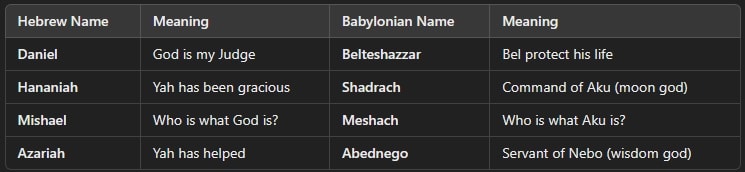
🔹 This wasn’t just renaming—it was redefining. Babylon tried to erase their connection to Yahweh and redefine them by pagan gods.
🔹 Identity confusion is one of Satan’s oldest and most effective tactics—if he can make you forget who you are, he can make you serve another system.
➡️ End-Time Parallel: Revelation 13 speaks of marks, names, and allegiance. In both Daniel and Revelation, the war is over identity and worship.
Key Spiritual Lessons from Daniel 1:3–7
🔹 Satan targets youth, intellect, and influence—because they shape the future.
🔹 Babylon doesn’t destroy faith immediately—it re-educates and re-labels.
🔹 The battle over identity is the gateway to deeper compromise.
🔹 Even in a pagan system, God can raise up a remnant who remember their true name.
Daniel 1:8–16 – The Test of Appetite
📖 Daniel 1:8 – “But Daniel purposed in his heart that he would not defile himself with the portion of the king’s meat…”
🔎 This verse is the turning point of Daniel’s destiny:
🔹 “Purposed in his heart” – Daniel made a pre-decision. He didn’t wait until the plate was in front of him.
🔹 “Defile” – This wasn’t just a dietary preference; it was a spiritual boundary. The king’s food likely included unclean meats (Leviticus 11) and was probably offered to idols (1 Corinthians 10:20).
🔹 Babylon offered luxury, but Daniel chose loyalty.
➡️ Spiritual Insight: Every believer must decide—will I let Babylon shape my appetite, or will I hunger for righteousness?
📖 Daniel 1:9 – “Now God had brought Daniel into favour and tender love with the prince of the eunuchs.”
🔎 When Daniel made a stand, God opened hearts:
🔹 “Favour and tender love” – This is supernatural. It’s not charm, it’s covenant protection.
🔹 God prepared the environment around Daniel because of what He had already placed inside him.
➡️ Key Principle: Faith unlocks favor. When you walk in integrity, God opens doors even in hostile systems.
📖 Daniel 1:10–11 – “I fear my lord the king… then shall ye make me endanger my head…”
🔎 This wasn’t just a minor disagreement—it could cost lives:
🔹 Refusing the king’s provision could be seen as defiance of authority.
🔹 Daniel responds not with rebellion, but with wisdom and humility.
🔹 He appeals through reason and testing, not arrogance.
➡️ Spiritual Application: Boldness in faith doesn’t mean pride. It means being firm in conviction and gracious in action.
📖 Daniel 1:12–13 – “Prove thy servants, I beseech thee, ten days…”
🔎 Daniel suggests a ten-day test:
🔹 “Pulse” – A simple diet of vegetables, grains, seeds, and water—clean, untainted, and humble.
🔹 He’s not trusting in health food—he’s trusting in God’s reward for obedience.
🔹 The number 10 in scripture often represents testing and trial (see Exodus 20 – Ten Commandments, Revelation 2:10).
➡️ Prophetic Echo: The remnant will also face tests of appetite and allegiance. Like Eve in Eden or Christ in the wilderness, what we choose to consume reflects who we serve.
📖 Daniel 1:15–16 – “At the end of ten days… they appeared fairer and fatter in flesh…”
🔎 God vindicates Daniel and his friends:
🔹 “Fairer and fatter” – They looked healthier, stronger, and more vibrant than those indulging in Babylon’s best.
🔹 This was not just physical—it was spiritual blessing made visible.
🔹 The steward then removes the king’s meat from all of them. One act of faith influenced the entire group.
➡️ Devotional Truth: Private integrity often leads to public influence. One person’s obedience can shift the atmosphere.
Parallel Themes & Prophetic Patterns
🔹 The test of appetite – Mirrors Eve in Eden, Jesus in the wilderness, and the end-time refusal of the wine of Babylon (Revelation 14:8).
🔹 Refusing king’s meat – Foreshadows the faithful who will refuse the mark of allegiance to the beast (Revelation 13:17).
🔹 Faith during captivity – Shows how to be in Babylon but not of Babylon.
Daniel 1:17–21 – Wisdom from Above
📖 Daniel 1:17 – “As for these four children, God gave them knowledge and skill in all learning and wisdom: and Daniel had understanding in all visions and dreams.”
🔎 The source of their wisdom is clear: God gave it.
🔹 Babylon educated them, but God enlightened them.
🔹 Their gifts were not the result of compromise or participation in the culture—they came through faithful separation.
🔹 Daniel, in particular, receives a special prophetic gift—understanding in visions and dreams. This sets the stage for the rest of the book (see chapters 2, 7, 8, 9).
➡️ Spiritual Insight: God entrusts deeper revelation to those who have proven faithful in small and hidden tests.
📖 Daniel 1:18–19 – “The king communed with them; and among them all was found none like Daniel, Hananiah, Mishael, and Azariah…”
🔎 God’s excellence shines through His people—even in a pagan system:
🔹 The king himself evaluates them. Their brilliance is not self-proclaimed—it’s recognized by the world.
🔹 They didn’t just pass—they stood head and shoulders above the rest.
🔹 Their Hebrew names are used here—a subtle reminder that God still sees them as His own, regardless of Babylon’s attempts to rename them.
➡️ Devotional Note: The world may try to redefine you, but God still calls you by your true name.
📖 Daniel 1:20 – “In all matters of wisdom and understanding… he found them ten times better…”
🔎 Ten times better. That’s divine math.
🔹 This wasn’t ordinary excellence—it was a supernatural distinction.
🔹 “All matters” – their superiority was holistic: intellectual, emotional, spiritual.
🔹 The number ten again reflects completion, testing, and divine fullness.
➡️ End-Time Parallel: As Babylon rises again in the last days, God will raise up a remnant with tenfold wisdom and Spirit (see Joel 2:28, Revelation 14:1–5).
📖 Daniel 1:21 – “And Daniel continued even unto the first year of king Cyrus.”
🔎 This final verse reveals the longevity of Daniel’s influence:
🔹 From Nebuchadnezzar to Cyrus spans about 70 years—Daniel outlives the empire that tried to assimilate him.
🔹 The mention of Cyrus is prophetically significant—he is the king who will decree the return of the Jews (Ezra 1:1), fulfilling Isaiah 44:28.
🔹 Daniel’s presence during this transition shows that God plants His people to influence empires.
➡️ Prophetic Reflection: Babylon may rise, but it will fall. And when it does, the faithful will still be standing.
Key Spiritual Lessons from Daniel 1:17–21
🔹 True wisdom comes from above—not man.
🔹 Faithfulness unlocks spiritual gifts.
🔹 You can thrive without compromising.
🔹 God exalts the humble—and sustains them across generations.
🔹 God’s people outlast Babylon.
Overview: The Remnant Rises in Captivity
🔹 Timeframe: Around 605 BC, during Babylon’s first invasion of Judah.
🔹 Setting: The royal courts of Nebuchadnezzar in Babylon.
🔹 Theme: Faithfulness in private leads to power in public.
Key Takeaways
🔑 God is sovereign even in judgment.
🔑 Babylon always tries to reshape identity.
🔑 Obedience begins with inner purpose.
🔑 God honors faithfulness with wisdom and favor.
🔑 True faith resists even when no one is watching.
Prophetic Patterns & Dual Fulfillment
🔮 Daniel’s stand – A type of the end-time remnant who will not defile themselves with the “wine of Babylon” (Revelation 14:8).
🔮 Naming and assimilation – Reflects the identity war in Revelation 13, where names and allegiances are tested.
🔮 Wisdom ten times greater – A shadow of God’s outpouring of latter-day knowledge and spiritual discernment (Daniel 12:10).
Historical & Cultural Context
📜 Babylonian education – Aimed to produce loyal servants of the empire through language, science, astrology, and philosophy.
📜 Food from the king’s table – Often included unclean animals and wine offered to idols.
📜 Daniel’s position – Though young, Daniel’s decision would shape the prophetic future of nations.
Final Reflection: Will You Purpose in Your Heart Today?
Daniel didn’t wait for crisis to find conviction. His quiet resolve became a catalyst for revelation.
📌 Are you letting Babylon rename your identity?
📌 Will you resist defilement even when no one else sees?
📌 Have you purposed in your heart to obey—no matter where you are?
🚀 The journey to prophetic influence starts with a single yes to faithfulness.

