
They held power in the Temple. They controlled the priesthood. They made alliances with Rome. Yet the Sadducees denied spiritual realities, denied the resurrection, and rejected vital truths of God’s Word.
Their story is a warning: religious influence without spiritual grounding leads to destruction.
This study explores who the Sadducees were, what they believed, why Jesus often rebuked them, and what their downfall teaches us about modern faith systems.
A Powerful Group, A Powerless Faith
They were the religious elite of their day—guardians of the Temple, allies of the Romans, and keepers of the Law of Moses. Yet the Sadducees, despite their high status, were spiritually bankrupt. They denied the resurrection, dismissed the supernatural, and prioritized power over truth.
The Sadducees remind us that it is possible to be deeply religious and still far from God. They held influence among men but rejected the deeper things of God. And in doing so, they stood in opposition to the very Messiah they claimed to serve.
In this study, we’ll take a closer look at who the Sadducees were, what they believed, how Jesus responded to them, and why their downfall offers a sobering warning for today’s believers. Their story is not just ancient history—it’s a mirror that reflects the dangers of religion without revelation.
Origins and Rise to Power
The Sadducees emerged during the Second Temple period, likely around the 2nd century BC, and rose to prominence during the Hasmonean dynasty. Rooted in the priestly line of Zadok, their name is believed to derive from “Zadokites”—those descended from Zadok, a high priest under King David and Solomon.
📖 Acts 5:17 – “Then the high priest rose up, and all they that were with him (which is the sect of the Sadducees)…”
🔎 The Sadducees held priestly authority, but their allegiance leaned toward political advantage over spiritual purity.
As temple administrators and aristocrats, they became intertwined with political power and wealth. They maintained a strong presence in the Sanhedrin—the Jewish supreme court—and often sided with Rome to protect their privileges. Their influence came not from prophetic truth, but from politics and position.
Their rise to power was marked by compromise. They traded the hope of Israel’s coming Messiah for stability under Caesar. In doing so, they forfeited the spiritual heritage of their priesthood for political relevance.
🚨 This is the tragedy of the Sadducees: They were born from a line meant to represent holiness but ended up representing human control over divine matters. They aligned themselves with Roman governance to preserve their influence. Their main concern was preserving the Temple system and their status—not seeking God’s will.
What the Sadducees Believed
The Sadducees were defined more by their denials than their declarations. Unlike the Pharisees, who embraced a broader range of Scripture and spiritual teachings, the Sadducees limited their beliefs to only what was found in the written Torah—the first five books of Moses. Everything beyond that, including the writings of the prophets, oral tradition, angelic beings, and life after death, was dismissed.
🔸 They rejected belief in angels and spirits.
🔸 They denied the resurrection of the dead.
🔸 They accepted only the written Torah as authoritative.
🔸 They rejected oral tradition and later prophetic writings.
🔸 They were materialistic and politically motivated.
📖 Matthew 22:23 – “The same day came to him the Sadducees, which say that there is no resurrection…”
🔎 Their theology was limited, dismissing anything that went beyond the written Law of Moses.
To them, religion was a means of cultural control and political preservation—not a gateway to eternity. By rejecting the resurrection, they essentially nullified hope beyond this life. This belief system left them spiritually dry, focused only on what they could see, control, and benefit from in the present age.
Their version of faith stripped God of mystery, eternity, and power. The supernatural was inconvenient to their philosophy and threatening to their authority. As a result, they became gatekeepers of ritual but enemies of revelation.
🚨 Though they wore the garments of holiness, their doctrine removed the supernatural—leaving them spiritually dead.
Conflict with Christ – Power Challenged by Truth
Jesus confronted both Pharisees and Sadducees, but His rebuke of the Sadducees was especially direct—because their error cut at the very heart of God’s redemptive plan. They denied the resurrection, which meant they denied the hope of eternal life and the coming kingdom. This placed them in direct opposition to the gospel itself.
📖 Matthew 22:29 – “Ye do err, not knowing the scriptures, nor the power of God.”
🔎 Jesus exposed the root of their error: biblical ignorance and disbelief in God’s power.
In their attempt to trap Jesus, the Sadducees asked a hypothetical question about a woman who had been married to seven brothers—seeking to make the resurrection look foolish. But Jesus didn’t just answer them—He dismantled their theology.
📖 Luke 20:37-38 – “Now that the dead are raised, even Moses shewed at the bush… For he is not a God of the dead, but of the living.”
🔎 Jesus used the very Scriptures they claimed to uphold to reveal their error.
He met their denial with truth, showing that even Moses—whom they revered—affirmed resurrection when God called Himself “the God of Abraham, Isaac, and Jacob.” If God is their God, and God is not the God of the dead, then those patriarchs must live again.
The Sadducees’ pride and allegiance to power blinded them to the One who stood before them. They rejected the very truth they claimed to defend.
🚨 Their conflict with Christ was not just a clash of ideas—it was the rejection of the living Truth incarnate.
The Doctrinal Danger – Religion Without Resurrection
The Sadducees represent a form of religion that looks legitimate—but denies spiritual power. Their theology removed the unseen and the eternal, reducing faith to rituals, hierarchy, and human reasoning. In doing so, they crafted a belief system that served the flesh but starved the soul.
📖 2 Timothy 3:5 – “Having a form of godliness, but denying the power thereof…”
🔎 Like many today, they had structure and rituals—but no Spirit, no depth, no faith in the eternal.
To deny the resurrection is to deny the very nature of God—who brings life out of death, hope out of despair, and eternity out of dust. Without the resurrection, there is no justice, no final reckoning, and no victory over sin. This made the Sadducees’ religion not just incomplete—but dangerous.
📖 Matthew 12:6 – “But I say unto you, That in this place is one greater than the temple.”
🔎 They clung to the Temple but missed the Living Word who stood among them—Jesus Christ.
Their doctrine was built to maintain control, not to invite transformation. It protected their political standing but silenced their spiritual hunger. They preferred a manageable religion over a miraculous one—a tragic choice that cost them truth.
A religion without resurrection is a system without salvation. It may preserve traditions, but it cannot produce life.
🚨 Their theology was convenient. Their religion was compromised.
Lessons for Today – Truth Must Be Fully Embraced
The spirit of the Sadducees lives on wherever truth is selectively accepted and spiritual realities are denied. Their legacy is not just historical—it’s prophetic. In every generation, there are those who profess religion but resist revelation. They seek God on their terms, filtering His Word through personal preference, political convenience, or cultural pressure.
🔸 Truth must not be trimmed to fit culture or politics.
🔸 Rejecting spiritual realities leads to spiritual ruin.
🔸 Knowing Scripture is not enough—we must believe and obey it.
🔸 God is not honored by empty ritual, but by living faith.
🔸 Denying the resurrection is denying the heart of the gospel.
📖 John 5:39-40 – “Search the scriptures; for in them ye think ye have eternal life: and they are they which testify of me. And ye will not come to me, that ye might have life.”
🔎 Scripture is not meant to be admired—it’s meant to lead us to Christ.
We must guard ourselves against a sanitized gospel that removes repentance, resurrection, and the power of the Holy Spirit. God is not looking for ritual observers—He is calling for covenant walkers.
🚨 Let us not follow in the footsteps of those who held power—but lost eternity. Let us embrace the full truth of God’s Word, walk in the Spirit, and cling to the hope of resurrection that defines the true faith.
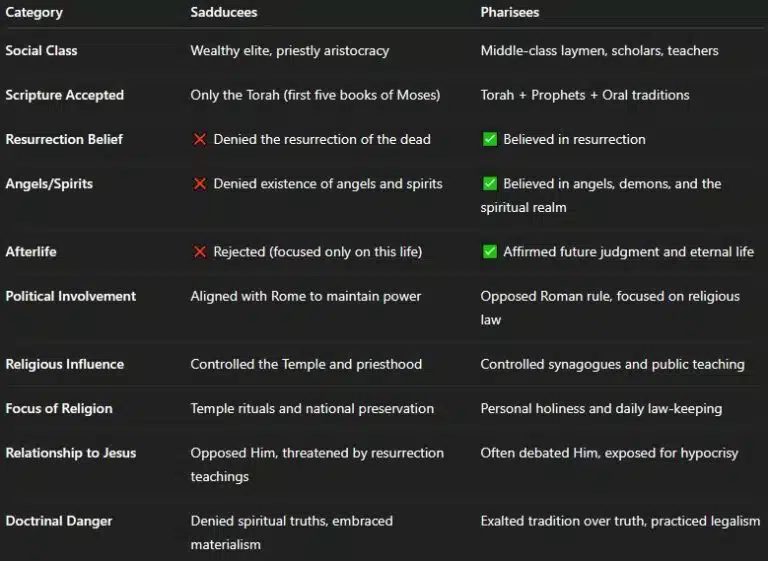
Sadducees vs. Pharisees – Belief & Practice Comparison

Final Reflection – Are We Any Different?
📖 Mark 12:24 – “Do ye not therefore err, because ye know not the scriptures, neither the power of God?”
🔎 Jesus’ words cut through time. They challenge every soul today: do we truly know the Scriptures—and believe in the power of the God behind them?
The Sadducees show us what happens when comfort overrides conviction. When religious status replaces surrendered faith. When the present world becomes more important than the eternal one. They had access to truth, but no hunger for it. They had power, but no spiritual insight. They carried titles, but lacked transformation.
We must ask ourselves: are we holding to Scripture while denying its power? Are we rooted in tradition but resistant to truth? Are we followers of Christ—or followers of comfort?
Let this not be said of us. Let us be a people who embrace the full counsel of God, who walk in truth even when it’s costly, and who anchor our hope in the resurrection to come.
🔥 Now is the time to believe every word of God—and live like eternity is real.